AP Bio Lab
Home
Learn
Flashcards
Practice
Mock Exam
Dashboard
About
Sign out
Home
Learn
Flashcards
Practice
Mock Exam
Dashboard
About
AP Bio Lab
Learn
Ecology
Unit 08
10-15% of exam
7 lessons
Ecology
Populations, communities, ecosystems, and biodiversity.
Progress
0/7 · 0%
Lessons
8.1
Responses to the Environment
Organisms respond to environmental stimuli through innate and learned behaviors that increase fitness.
8.2
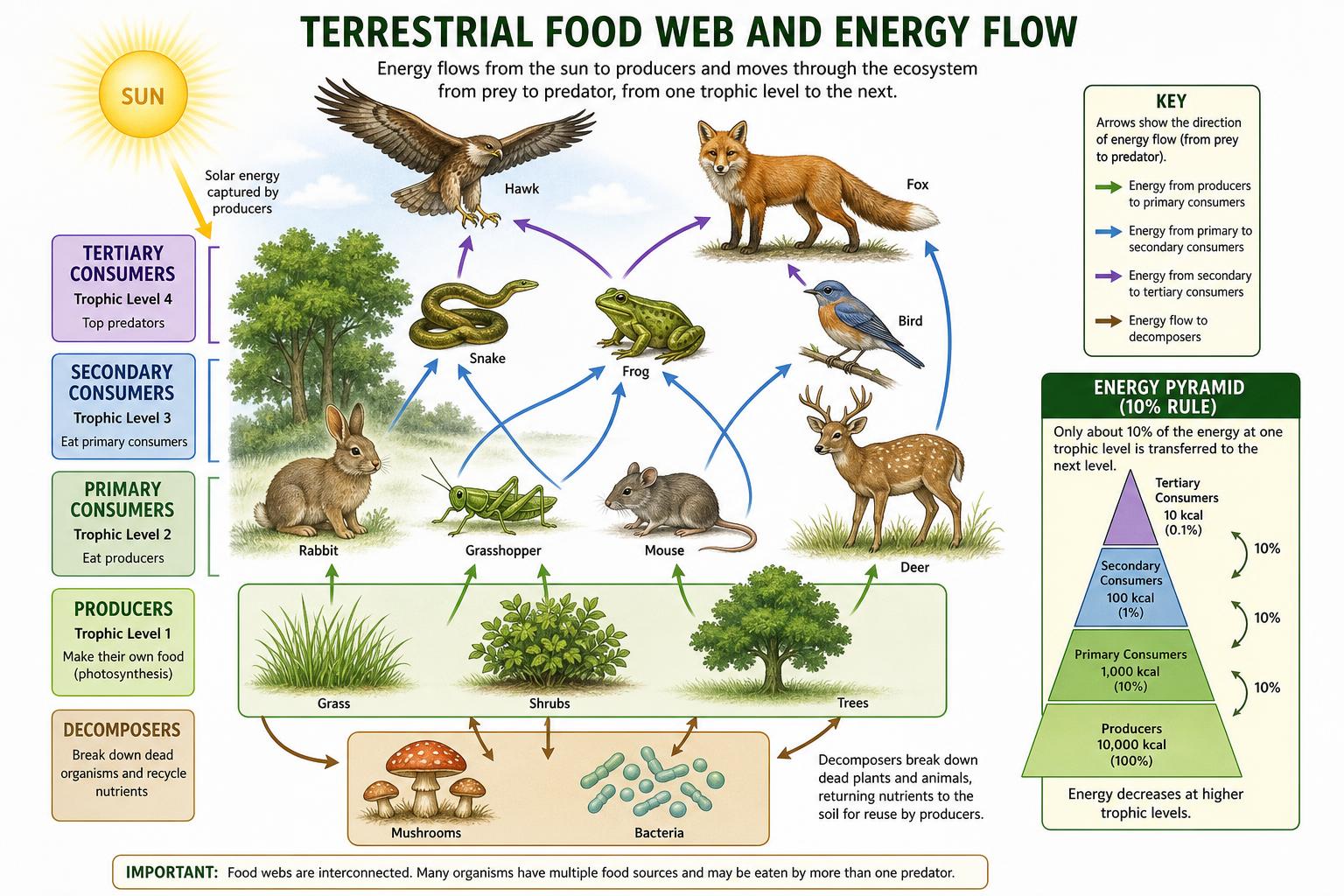
Energy Flow Through Ecosystems
Energy enters ecosystems via producers and flows unidirectionally through trophic levels, with substantial loss at each transfer.
8.3
Population Ecology
Populations grow exponentially under ideal conditions but logistically as resources become limiting, and life-history strategies reflect trade-offs shaped by selection.
8.4
Effect of Density on Populations
Density-dependent factors intensify as population density increases, while density-independent factors affect populations regardless of size.
8.5
Community Ecology
Interspecific interactions - competition, predation, mutualism, commensalism, and parasitism - structure biological communities and drive coevolution and succession.
8.6
Biodiversity
Biodiversity at genetic, species, and ecosystem levels underlies ecosystem stability, productivity, and resilience.
8.7
Disruptions to Ecosystems
Natural disturbances and human activities disrupt ecosystems and reduce biodiversity, though conservation strategies can mitigate these impacts.
Figure · reference
Practice MCQs
Practice FRQs
Flashcards