
Effect of Density on Populations
Density-dependent factors intensify as population density increases, while density-independent factors affect populations regardless of size.
Density-dependent factors
- Intraspecific competition for food, water, mates, nesting sites, and space intensifies as density rises, since more individuals must divide the same finite resources - this reduces per-capita birth rates and increases death rates as density increases.
- Disease and parasites spread more readily in dense populations because transmission depends on proximity and contact rate between infected and susceptible individuals; epidemics are far more likely to devastate crowded populations.
- Predation pressure can rise with prey density if predators preferentially hunt where prey are abundant (a functional or numerical response), while waste and toxic byproduct accumulation also increase with crowding, further reducing survival and reproduction.
Density-independent factors
Density-independent factors reduce population size by a similar proportion regardless of how many individuals are present. Severe weather events (hurricanes, droughts, early frosts), natural disasters (wildfires, floods, volcanic eruptions), and sudden anthropogenic habitat destruction are classic examples - a hard freeze kills the same fraction of an insect population whether it is sparse or dense.
In practice, many real-world limiting factors have both density-dependent and density-independent components; for instance, a drought (density-independent trigger) can intensify competition for scarce remaining water (a density-dependent effect on the survivors).
Regulation of population size
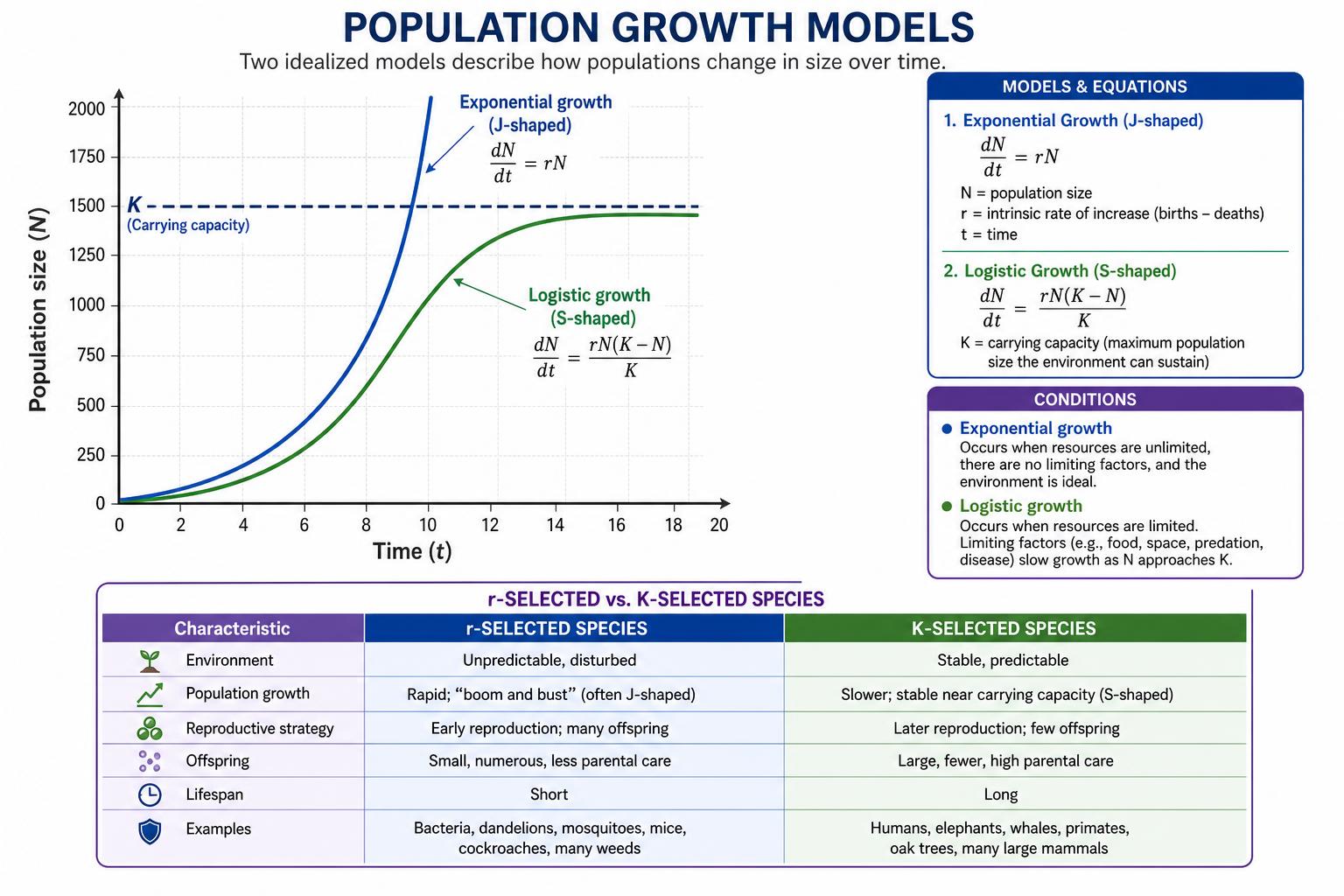
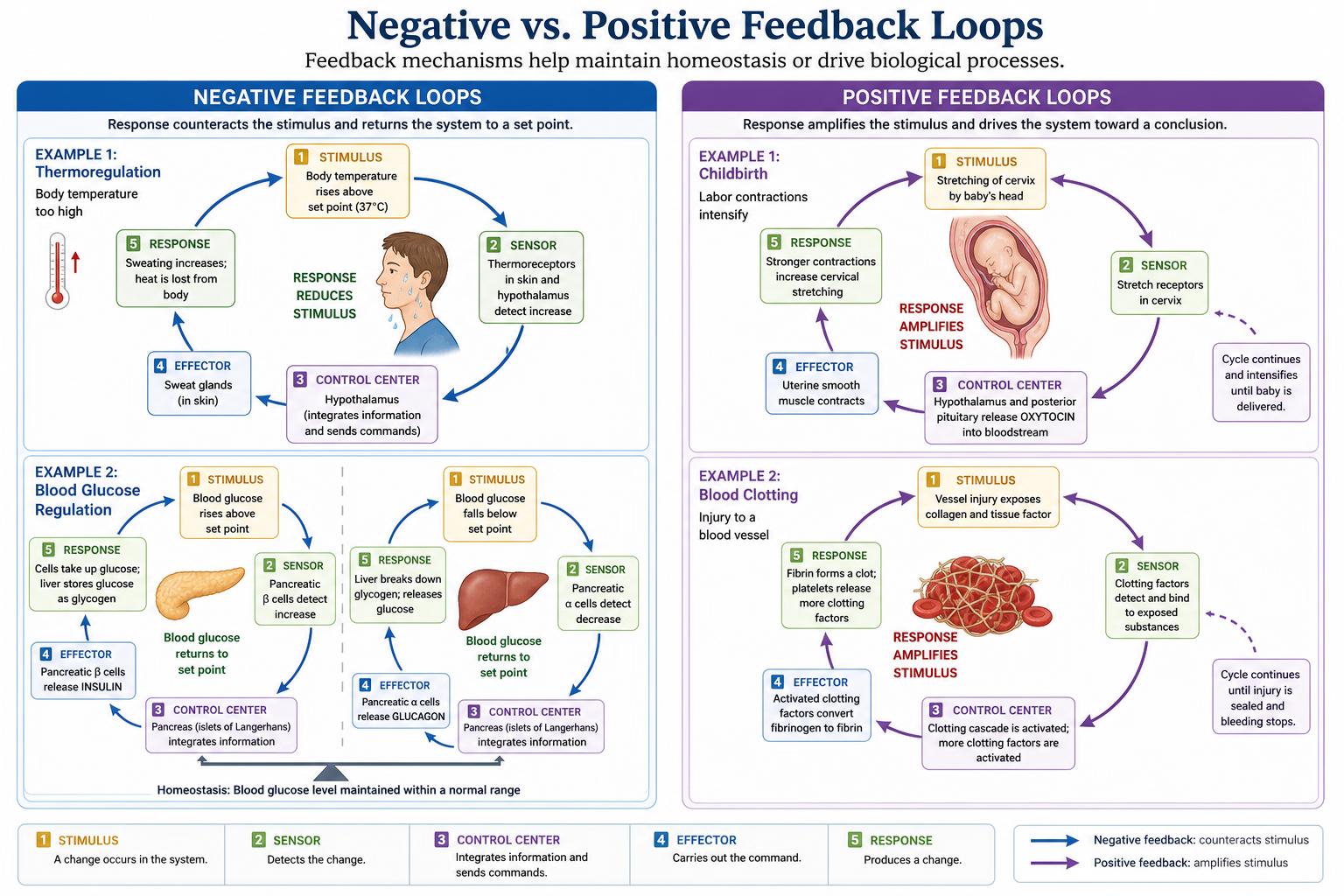
Density-dependent factors act as negative feedback mechanisms that tend to stabilize populations near carrying capacity: as N increases toward K, density-dependent mortality rises and/or birth rate falls, slowing growth; if N drops well below K, density-dependent pressures relax, allowing growth to resume. This feedback loop is what produces the logistic growth curve's characteristic leveling off.
Because density-independent factors do not respond to population size, they can cause sudden, large fluctuations or crashes unrelated to how close a population is to K, which is one reason real populations rarely follow a perfectly smooth logistic curve.
Key terms
4
- Density-dependent factor
- A limiting factor whose effect on a population intensifies as population density increases.
- Density-independent factor
- A limiting factor that affects population size regardless of population density.
- Intraspecific competition
- Competition between members of the same species for limited resources.
- Negative feedback (population)
- A regulatory process in which increasing density triggers factors that reduce further growth, stabilizing the population near K.
Sign-off
Finish this lesson
A lesson only counts once you've read all the way through and completed every activity on the page.
- Read the full lesson (scroll to the end)
- Complete all activities (0/2 done)