
Community Ecology
Interspecific interactions - competition, predation, mutualism, commensalism, and parasitism - structure biological communities and drive coevolution and succession.
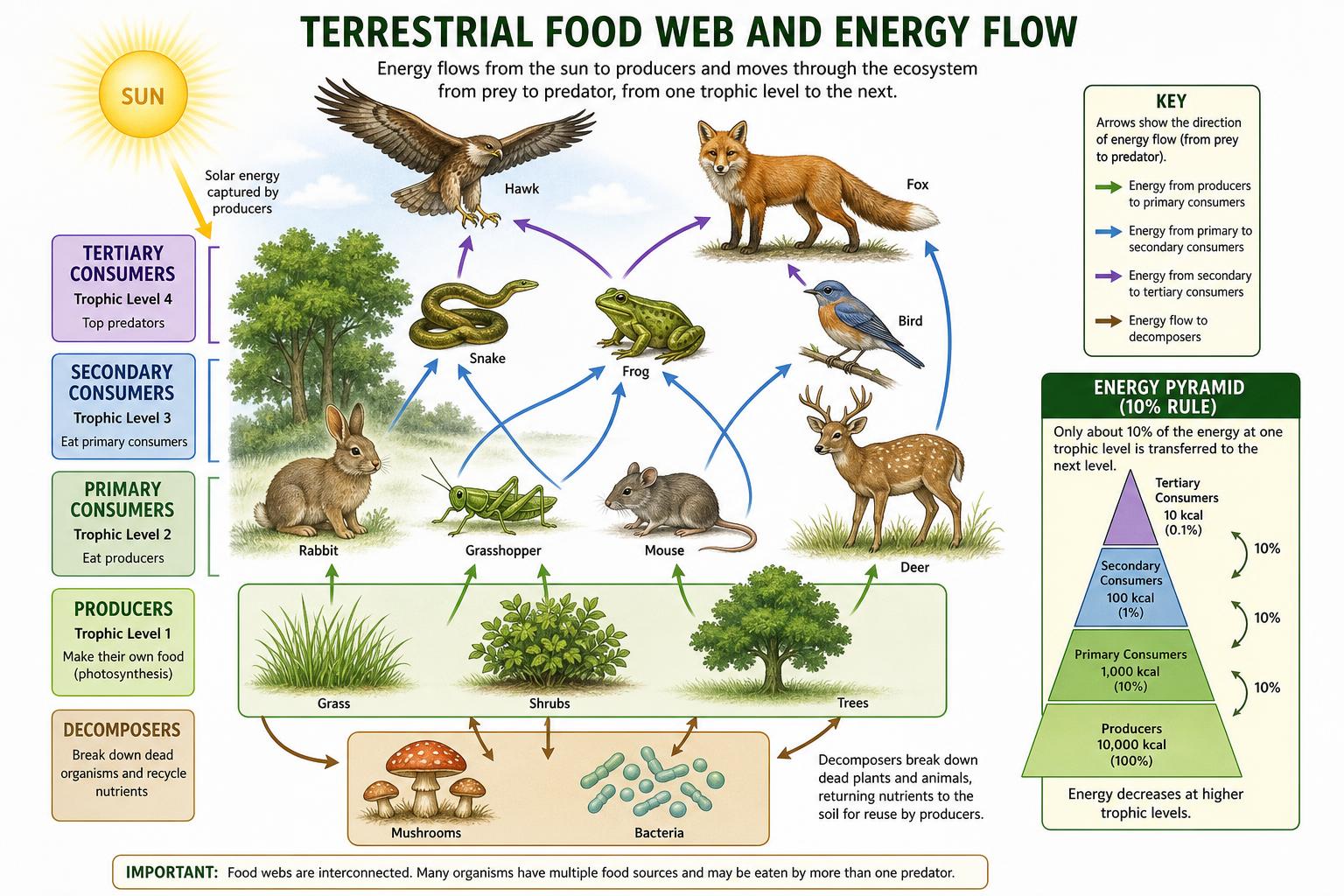
Types of species interactions
- Competition (-/-): both species are harmed as they vie for the same limiting resource; intraspecific competition (within a species) is typically more intense than interspecific competition because niche overlap is greatest among conspecifics.
- Predation and herbivory (+/-): the predator or herbivore benefits while the prey or plant is harmed; this interaction drives coevolutionary arms races (e.g., cheetah speed versus gazelle speed; plant toxins versus herbivore detoxification enzymes).
- Mutualism (+/+): both species benefit, as in pollinators and flowering plants, mycorrhizal fungi and plant roots, or gut microbiota and their animal hosts.
- Commensalism (+/0): one species benefits while the other is largely unaffected, such as barnacles attaching to a whale for transport and access to food-rich waters.
- Parasitism (+/-): the parasite benefits, often without killing its host outright, while the host is harmed; examples include ticks, tapeworms, and parasitic wasps that lay eggs in living hosts.
Niches, competitive exclusion, and coexistence
A species' niche encompasses everything about how it makes its living: what it eats, where and when it is active, its habitat requirements, and its interactions with other species. The competitive exclusion principle holds that when two species occupy identical niches and compete for the same limiting resource, one will eventually outcompete and locally eliminate the other - they cannot coexist indefinitely at the same trophic level using an identical resource.
In practice, closely related or ecologically similar species often coexist by resource partitioning - dividing a shared resource by using different portions of it (Darwin's finches with different beak sizes exploiting different seed sizes, warblers foraging in different parts of the same tree). Over evolutionary time, this can produce character displacement, in which competing species diverge in traits where their ranges overlap, reducing niche overlap and competition.
Keystone species and trophic cascades
Some species exert influence on community structure far out of proportion to their numerical abundance. Sea otters keep sea urchin populations in check; without otters, urchins overgraze kelp forests, collapsing the many species that depend on kelp for habitat and food. Wolves reintroduced to Yellowstone reduced elk overgrazing, allowing willow and aspen recovery, which in turn supported returning beaver and songbird populations - a textbook trophic cascade in which effects propagate down multiple trophic levels.
Ecological succession
Primary succession begins on bare, lifeless substrate - newly exposed rock after a volcanic eruption or glacial retreat - with no pre-existing soil. Pioneer species such as lichens and mosses colonize first, chemically and physically breaking down rock to begin soil formation; over decades to centuries, grasses, shrubs, and eventually trees establish as soil deepens and diversifies.
Secondary succession occurs after a disturbance (fire, flood, farmland abandonment) that removes most organisms but leaves soil and often a seed bank intact. Because the substrate is already fertile, secondary succession proceeds much faster than primary succession - abandoned fields can transition to forest within 50-150 years, passing through a somewhat predictable series of stages toward a relatively stable climax community.
Key terms
5
- Niche
- The full set of biotic and abiotic conditions and resources a species needs, and its functional role in the community.
- Competitive exclusion principle
- The principle that two species competing for the exact same limiting resource cannot coexist indefinitely.
- Resource partitioning
- The differentiation of niches among coexisting species, reducing competition for a shared resource.
- Keystone species
- A species whose impact on its community is disproportionately large relative to its abundance.
- Ecological succession
- The predictable, sequential change in species composition of a community over time.
Sign-off
Finish this lesson
A lesson only counts once you've read all the way through and completed every activity on the page.
- Read the full lesson (scroll to the end)
- Complete all activities (0/1 done)