
Energy Flow Through Ecosystems
Energy enters ecosystems via producers and flows unidirectionally through trophic levels, with substantial loss at each transfer.
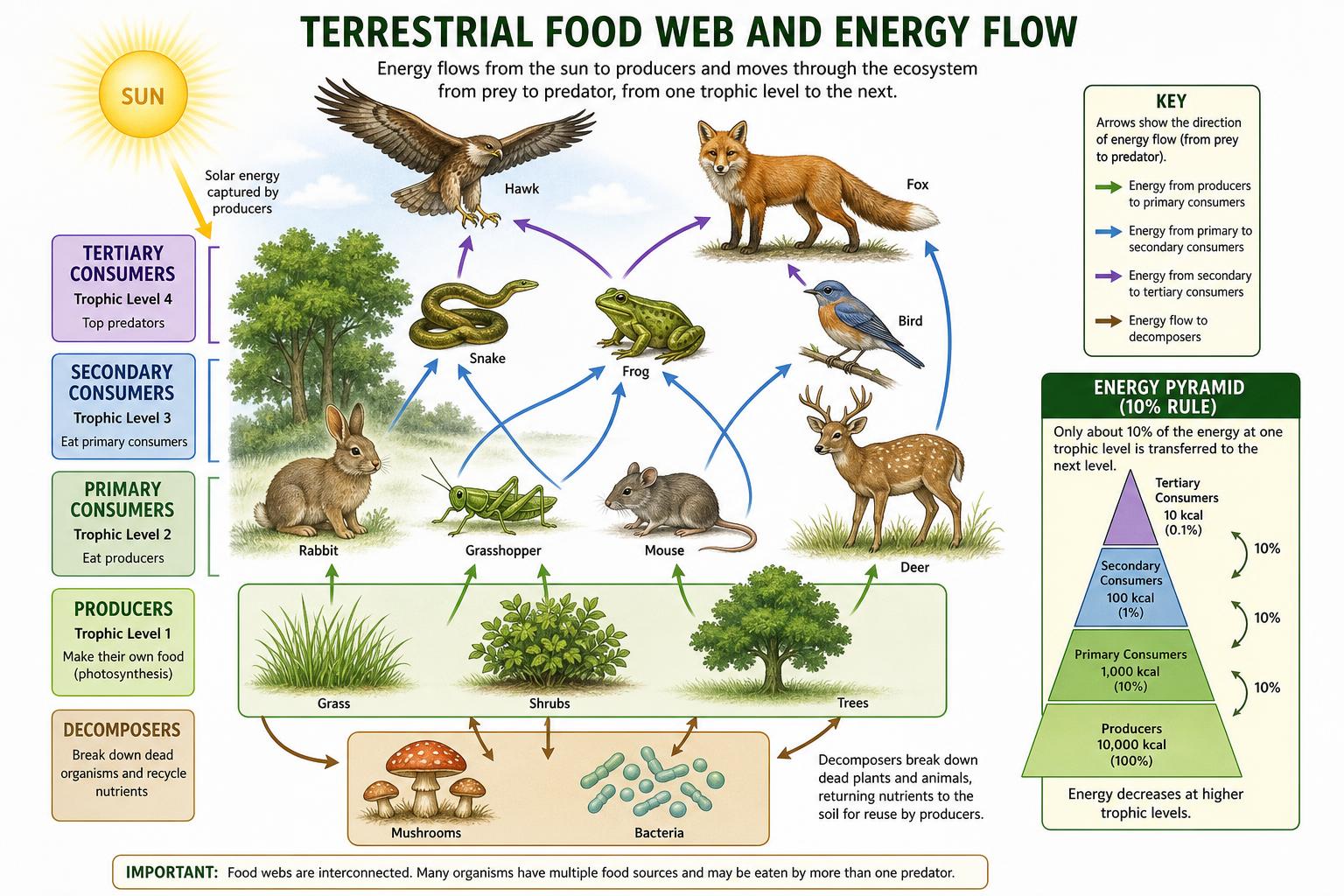
Trophic structure and the flow of energy
Energy flows in one direction through an ecosystem: from the sun to producers (autotrophs, mainly photosynthetic organisms) to primary consumers (herbivores) to secondary consumers (carnivores that eat herbivores) and sometimes tertiary or quaternary consumers. Unlike matter, energy is not recycled - it is ultimately lost as heat to the environment in accordance with the second law of thermodynamics, which is why ecosystems require a continuous energy input from the sun (or chemical energy for chemoautotroph-based systems).
Decomposers (bacteria, fungi) and detritivores act at every trophic level, breaking down dead organisms and waste products. This releases the chemical energy remaining in that matter as heat while returning nutrients (not energy) to the abiotic environment for producers to reuse - nutrient cycles are closed, but energy flow is not.
The 10% rule and ecological pyramids
At each transfer between trophic levels, only about 10% of the energy is incorporated into the biomass of the next level; the remaining ~90% is lost as metabolic heat (respiration), used for movement and other life processes, or contained in feces and undigested/unassimilated material. This progressive loss is why food chains rarely extend beyond four or five trophic levels - insufficient energy remains to support another level.
This pattern generates an energy pyramid that is always upright (widest at the producer base). Biomass pyramids are usually but not always upright - in some aquatic systems, fast-reproducing, short-lived phytoplankton support a larger standing biomass of zooplankton, briefly inverting the pyramid at any given moment even though total energy captured over time still follows the 10% rule.
Primary productivity
Gross primary productivity (GPP) is the total amount of energy producers capture and convert into chemical energy through photosynthesis. Net primary productivity (NPP) equals GPP minus the energy producers themselves use in cellular respiration; NPP represents the energy actually available to be consumed by heterotrophs or stored as biomass.
NPP varies dramatically by ecosystem: tropical rainforests and coral reefs/estuaries have very high productivity due to abundant light, warmth, and water/nutrients, while deserts and open ocean have low productivity due to limiting factors (water scarcity or nutrient limitation, respectively). Productivity sets the energy ceiling for how much life a given ecosystem can support at all higher trophic levels.
Key terms
5
- Trophic level
- An organism's position in a food chain, defined by how many energy transfers separate it from producers.
- Gross primary productivity (GPP)
- Total rate at which producers convert light energy into chemical energy via photosynthesis.
- Net primary productivity (NPP)
- GPP minus the energy producers use for their own cellular respiration; the energy available to consumers.
- 10% rule
- The generalization that only about 10% of energy at one trophic level is available to the next trophic level.
- Decomposer
- An organism that breaks down dead organic matter, recycling nutrients back into the ecosystem.
Sign-off
Finish this lesson
A lesson only counts once you've read all the way through and completed every activity on the page.
- Read the full lesson (scroll to the end)
- Complete all activities (0/2 done)