AP Bio Lab
Home
Learn
Flashcards
Practice
Mock Exam
Dashboard
About
Sign out
Home
Learn
Flashcards
Practice
Mock Exam
Dashboard
About
AP Bio Lab
Learn
Cellular Energetics
Unit 03
12-16% of exam
9 lessons
Cellular Energetics
Enzymes, photosynthesis, and cellular respiration.
Progress
0/9 · 0%
Lessons
3.1
Enzyme Structure
Enzymes are shaped proteins (or ribozymes) whose specific structure creates an active site for a substrate.
3.2
Enzyme Catalysis
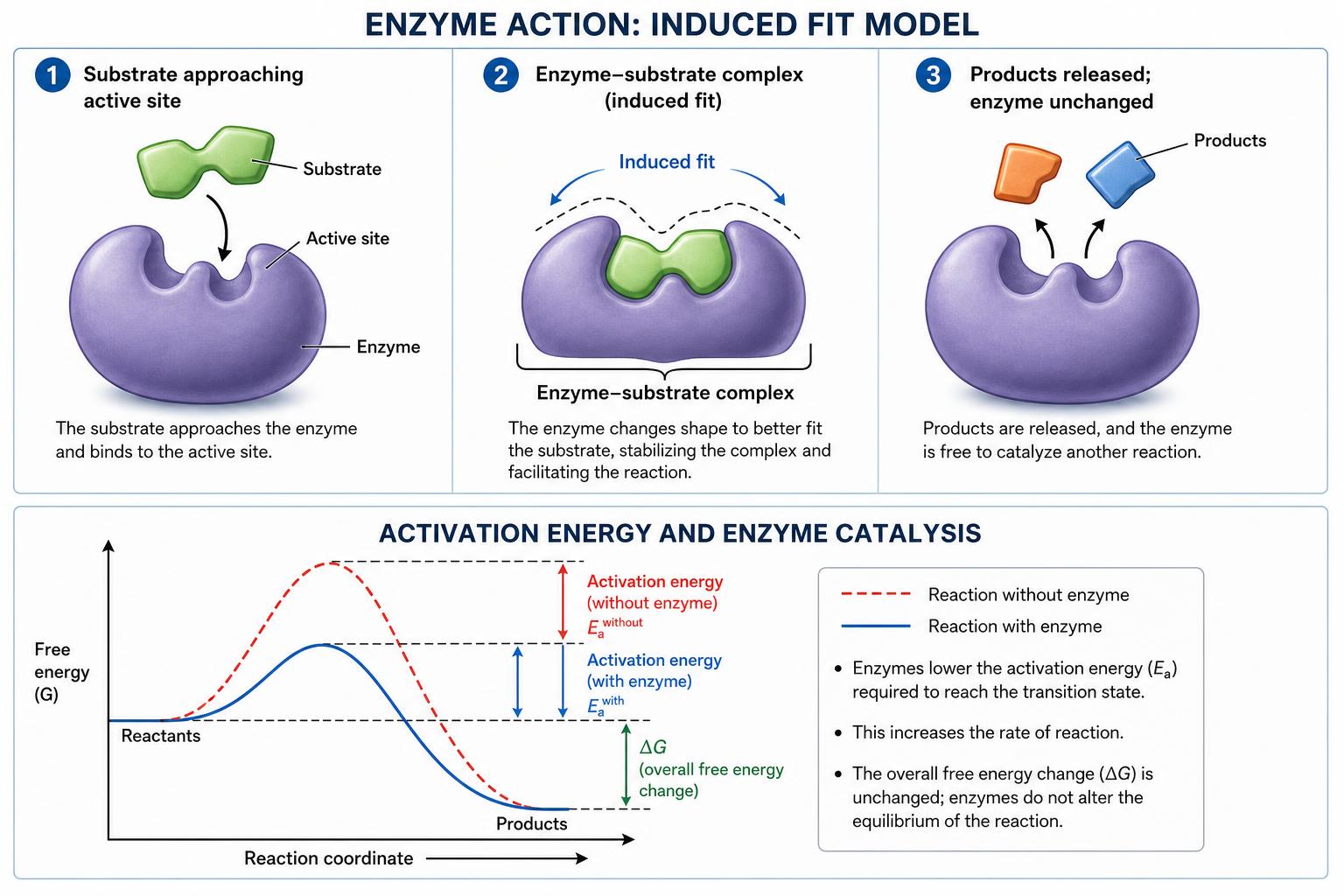
Enzymes speed up reactions by lowering activation energy through induced fit and other mechanisms.
3.3
Environmental Impacts on Enzyme Function
Temperature, pH, and regulatory molecules alter enzyme shape and thus reaction rate.
3.4
Cellular Energy
Cells capture, store, and spend energy mainly via coupled reactions involving ATP.
3.5
Photosynthesis
Light energy is converted into chemical energy stored in glucose via the light reactions and the Calvin cycle.
3.6
Cellular Respiration
Glucose is broken down through glycolysis, pyruvate oxidation, the Krebs cycle, and oxidative phosphorylation to produce ATP.
3.7
Fitness
Variation in metabolic and enzymatic pathways affects an organism's fitness across different environments.
3.6 (b)
Anaerobic Respiration & Fermentation
What cells do when oxygen runs out - and why the yield collapses.
3.5 (b)
C3, C4, and CAM Photosynthesis
Three evolutionary answers to the same problem: photorespiration in hot, dry climates.
Figure · reference
Practice MCQs
Practice FRQs
Flashcards