
Enzyme Structure
Enzymes are shaped proteins (or ribozymes) whose specific structure creates an active site for a substrate.
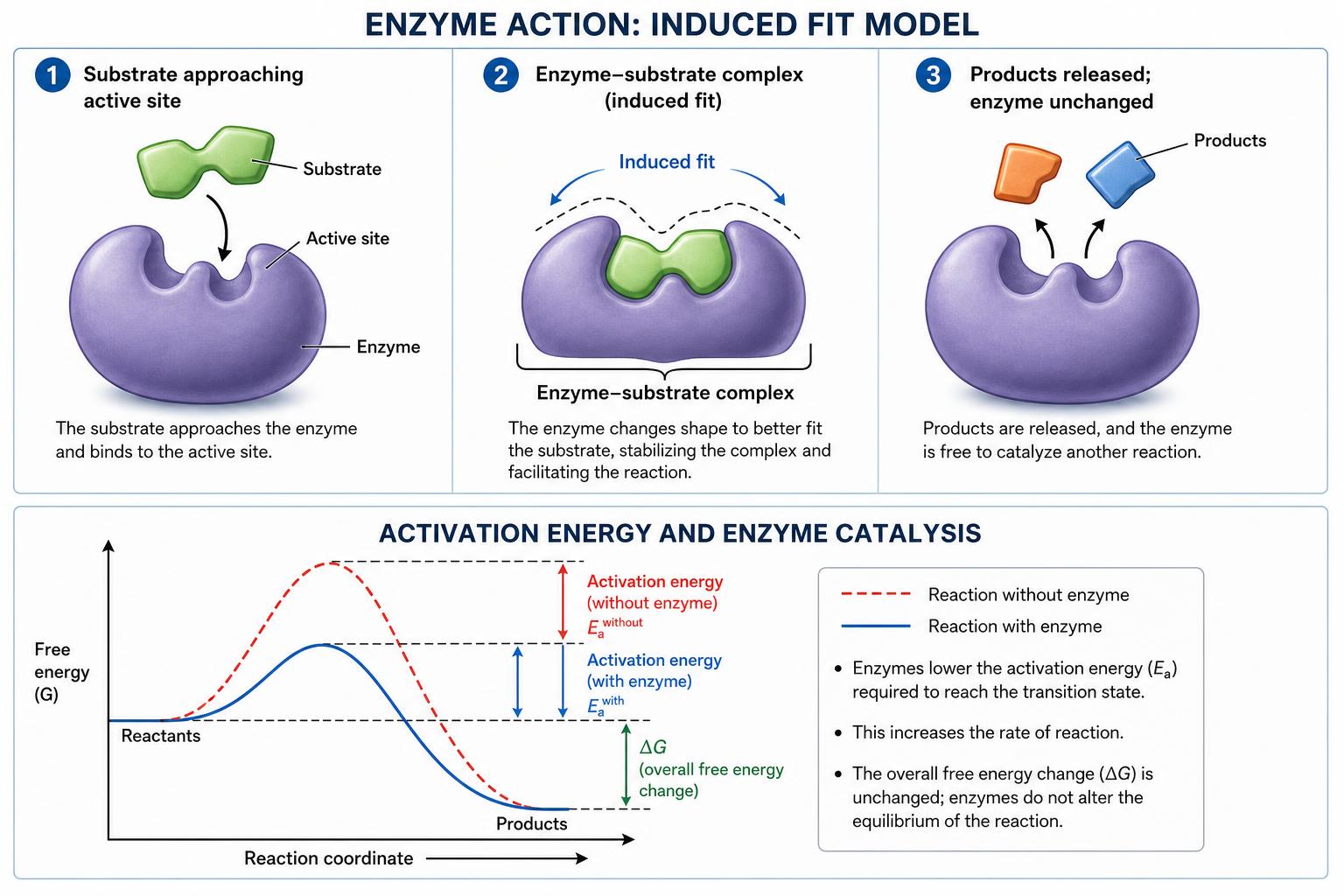
Enzymes as catalysts
Enzymes are catalysts - molecules that speed up the rate of a chemical reaction without themselves being permanently changed or consumed. The overwhelming majority of enzymes are proteins, though a small class of catalytic RNA molecules called ribozymes also exist (e.g., in the ribosome and in RNA splicing). Because enzymes are not used up, a single enzyme molecule can catalyze the same reaction over and over again.
What makes an enzyme catalytic rather than just a structural protein is its capacity to bind a specific reactant, known as its substrate, and facilitate a chemical transformation. This capacity is entirely a consequence of the enzyme's molecular structure.
From primary sequence to functional shape
An enzyme's function begins with its primary structure: the linear sequence of amino acids encoded by a gene. This sequence determines how the polypeptide folds - hydrogen bonding between backbone atoms creates local secondary structures (α-helices and β-pleated sheets), and interactions among the R-groups (hydrophobic clustering, ionic bonds, hydrogen bonds, and disulfide bridges) fold the protein into its overall tertiary structure. Some enzymes also require a quaternary structure, i.e., multiple polypeptide subunits assembled together, to be functional.
This intricate 3D folding is what produces the active site: a pocket or cleft on the enzyme's surface with a precise shape and chemical environment (charged, polar, or hydrophobic R-groups arranged in just the right geometry) that matches a particular substrate.
Specificity of the active site
Because the active site's shape and chemical properties are so precisely determined by the protein's folding, most enzymes are highly specific - they catalyze only one reaction or a narrow set of closely related reactions. This specificity is why cells can have thousands of different enzymes each controlling a distinct step in metabolism without cross-reacting chaotically.
Enzyme names often reflect this specificity: sucrase acts only on sucrose, lactase only on lactose, and DNA polymerase only synthesizes DNA. The suffix '-ase' is a strong clue on the AP exam that a molecule is an enzyme.
Key terms
4
- Active site
- Region of the enzyme where the substrate binds and the reaction is catalyzed.
- Substrate
- The reactant molecule an enzyme acts upon.
- Specificity
- The property of an enzyme binding only one substrate or a narrow group of related substrates.
- Tertiary structure
- The overall 3D folding of a protein, determined by R-group interactions, that creates the active site.
Sign-off
Finish this lesson
A lesson only counts once you've read all the way through and completed every activity on the page.
- Read the full lesson (scroll to the end)
- Complete all activities (0/1 done)