
Enzyme Catalysis
Enzymes speed up reactions by lowering activation energy through induced fit and other mechanisms.
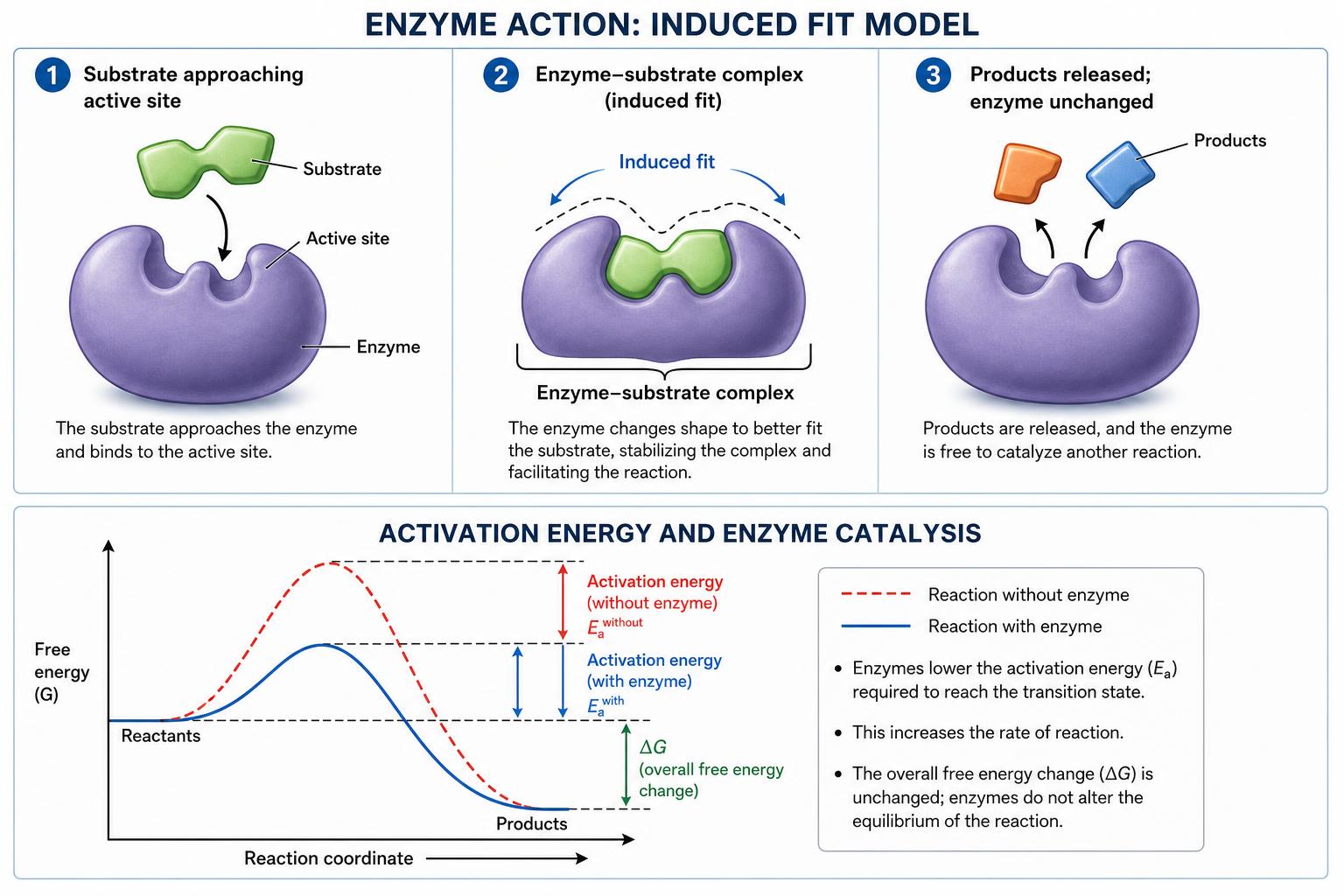
Lowering activation energy
Every chemical reaction must pass through a high-energy transition state before reactants can become products; the energy needed to reach this transition state is the activation energy (Eₐ). Without help, many biologically important reactions would occur far too slowly to sustain life because the Eₐ barrier is too high to be regularly overcome at body temperature.
Enzymes solve this problem by providing an alternative reaction pathway with a lower activation energy. Crucially, enzymes do not change the free-energy difference between reactants and products (ΔG) - they only change how quickly the reaction reaches equilibrium. A reaction that is thermodynamically unfavorable will not be made favorable by an enzyme; only reactions that are already spontaneous (exergonic) or coupled to an energy source can proceed, just faster.
Induced fit and catalytic mechanisms
The classical 'lock and key' model has been replaced by the more accurate induced fit model: when a substrate enters the active site, the enzyme's shape adjusts slightly, tightening its grip on the substrate and often straining specific bonds within the substrate in ways that make the reaction proceed more readily.
Enzymes catalyze reactions through several concrete mechanisms: they can orient substrates precisely so reactive groups align; they can create a microenvironment (e.g., a hydrophobic pocket that excludes water) favorable to the reaction; they can strain substrate bonds toward the transition-state shape; or they can transiently donate/accept protons or electrons through R-groups in the active site.
Cofactors and coenzymes
Many enzymes cannot function alone and require helper molecules. Cofactors are inorganic ions such as Mg²⁺, Zn²⁺, or Fe²⁺ that stabilize enzyme structure or participate directly in catalysis. Coenzymes are organic helper molecules, frequently derived from vitamins, such as NAD⁺ (from niacin/vitamin B3), FAD (from riboflavin/B2), and coenzyme A (from pantothenic acid/B5).
Coenzymes commonly act as shuttles, carrying electrons, hydrogen atoms, or functional groups between enzymes in a metabolic pathway - as seen dramatically in cellular respiration, where NAD⁺ and FAD ferry high-energy electrons to the electron transport chain.
Key terms
4
- Activation energy (Eₐ)
- The energy input required to destabilize existing bonds and start a chemical reaction.
- Induced fit
- The active site's slight conformational change upon substrate binding that improves the catalytic interaction.
- Cofactor
- A non-protein inorganic ion (e.g. Mg²⁺, Zn²⁺) required for an enzyme to function.
- Coenzyme
- An organic cofactor, often derived from a vitamin (e.g. NAD⁺ from niacin), that assists enzyme catalysis.
Sign-off
Finish this lesson
A lesson only counts once you've read all the way through and completed every activity on the page.
- Read the full lesson (scroll to the end)
- Complete all activities (0/1 done)