
Environmental Impacts on Enzyme Function
Temperature, pH, and regulatory molecules alter enzyme shape and thus reaction rate.
Temperature effects
Enzyme activity generally increases with rising temperature because warmer molecules move faster and collide more often, increasing the chance that substrate and enzyme meet with enough energy to react. However, this trend only holds up to an optimum temperature - for most human enzymes, roughly 37°C, matching normal body temperature.
Beyond the optimum, additional heat begins to break the hydrogen bonds and other weak interactions holding the enzyme's tertiary structure together. This causes denaturation: the protein unfolds, the active site's precise shape is lost, and catalytic activity plummets, often irreversibly.
pH effects
Every enzyme also has an optimal pH range reflecting the chemical environment it normally operates in. Pepsin, which digests protein in the acidic stomach, has an optimum around pH 2; trypsin, which works in the small intestine, has an optimum around pH 8.
Deviating from the optimal pH changes the protonation state of acidic and basic R-groups in and around the active site. This can disrupt ionic bonds and hydrogen bonds that maintain the enzyme's shape, distorting or destroying the active site much like extreme temperature does.
Inhibition: competitive vs. noncompetitive
A competitive inhibitor structurally resembles the natural substrate and competes for the same active site. Because it directly occupies the binding pocket, its effect can be overcome by increasing substrate concentration, which outcompetes the inhibitor for access to the active site - Vmax can still be reached, though more slowly.
A noncompetitive (allosteric) inhibitor binds to a different site on the enzyme, called an allosteric site, and induces a conformational change that alters or destroys the active site's shape. Because the inhibitor isn't competing directly for the active site, adding more substrate cannot restore full activity, and Vmax is reduced.
Allosteric regulation and feedback inhibition
Beyond inhibitors, allosteric sites also allow activators to bind and stabilize an enzyme's active conformation, increasing catalytic efficiency. This two-way allosteric control lets enzymes act as regulatory switches responsive to the cell's metabolic state.
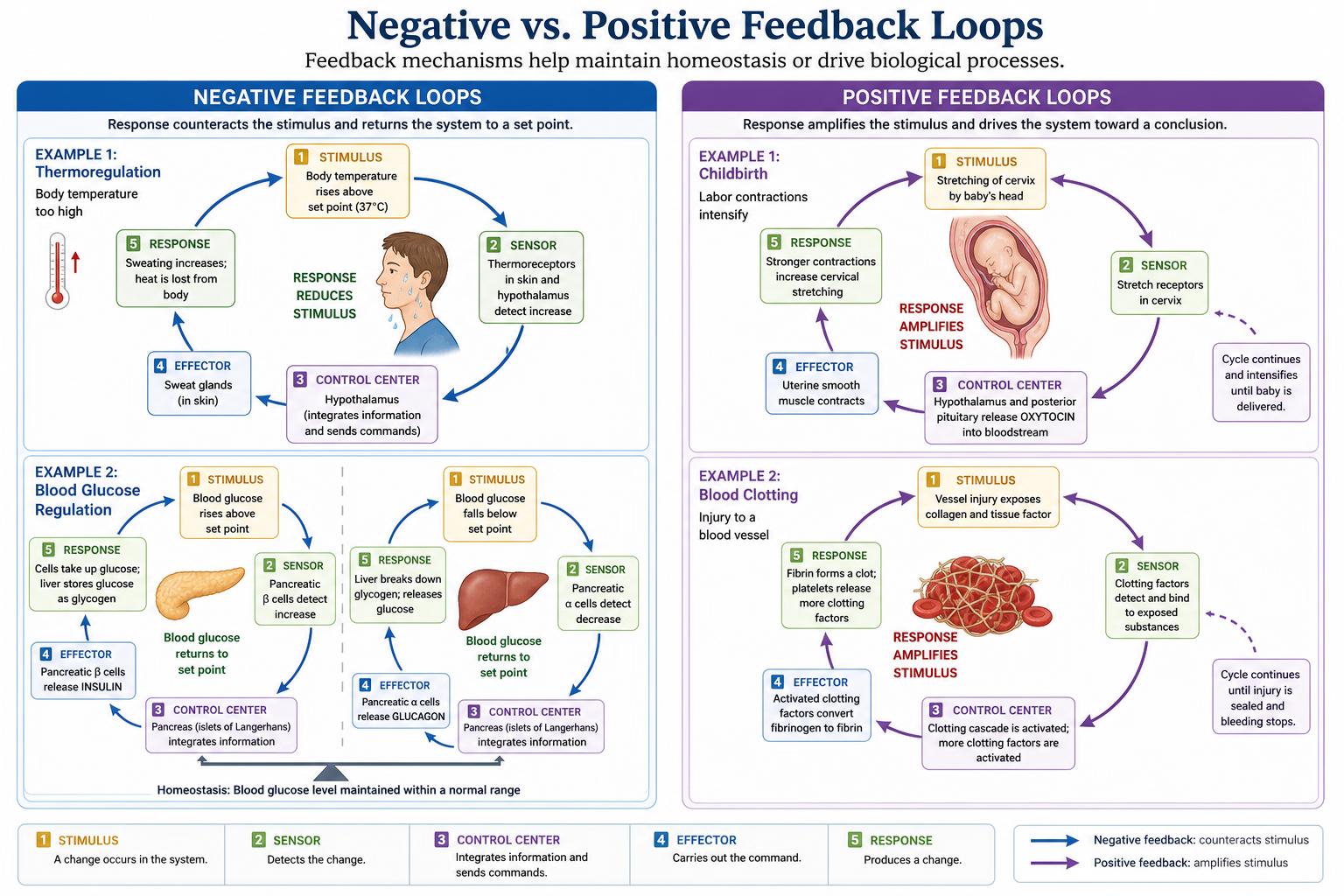
A key regulatory strategy built on this is feedback inhibition: the final product of a multistep metabolic pathway binds allosterically to an enzyme catalyzing an early step in that same pathway, shutting it down once enough product has accumulated. This prevents the cell from wasting energy and resources overproducing a molecule it doesn't currently need.
Key terms
4
- Denaturation
- Loss of a protein's native shape due to disruption of non-covalent (and sometimes covalent) interactions.
- Competitive inhibitor
- A molecule that resembles the substrate and competes with it for the active site.
- Noncompetitive inhibitor
- A molecule that binds an allosteric site, altering the enzyme's shape and reducing activity regardless of substrate concentration.
- Feedback inhibition
- Regulation in which the end product of a pathway allosterically inhibits an enzyme earlier in that pathway.
Sign-off
Finish this lesson
A lesson only counts once you've read all the way through and completed every activity on the page.
- Read the full lesson (scroll to the end)
- Complete all activities (0/1 done)