
Photosynthesis
Light energy is converted into chemical energy stored in glucose via the light reactions and the Calvin cycle.
The big picture
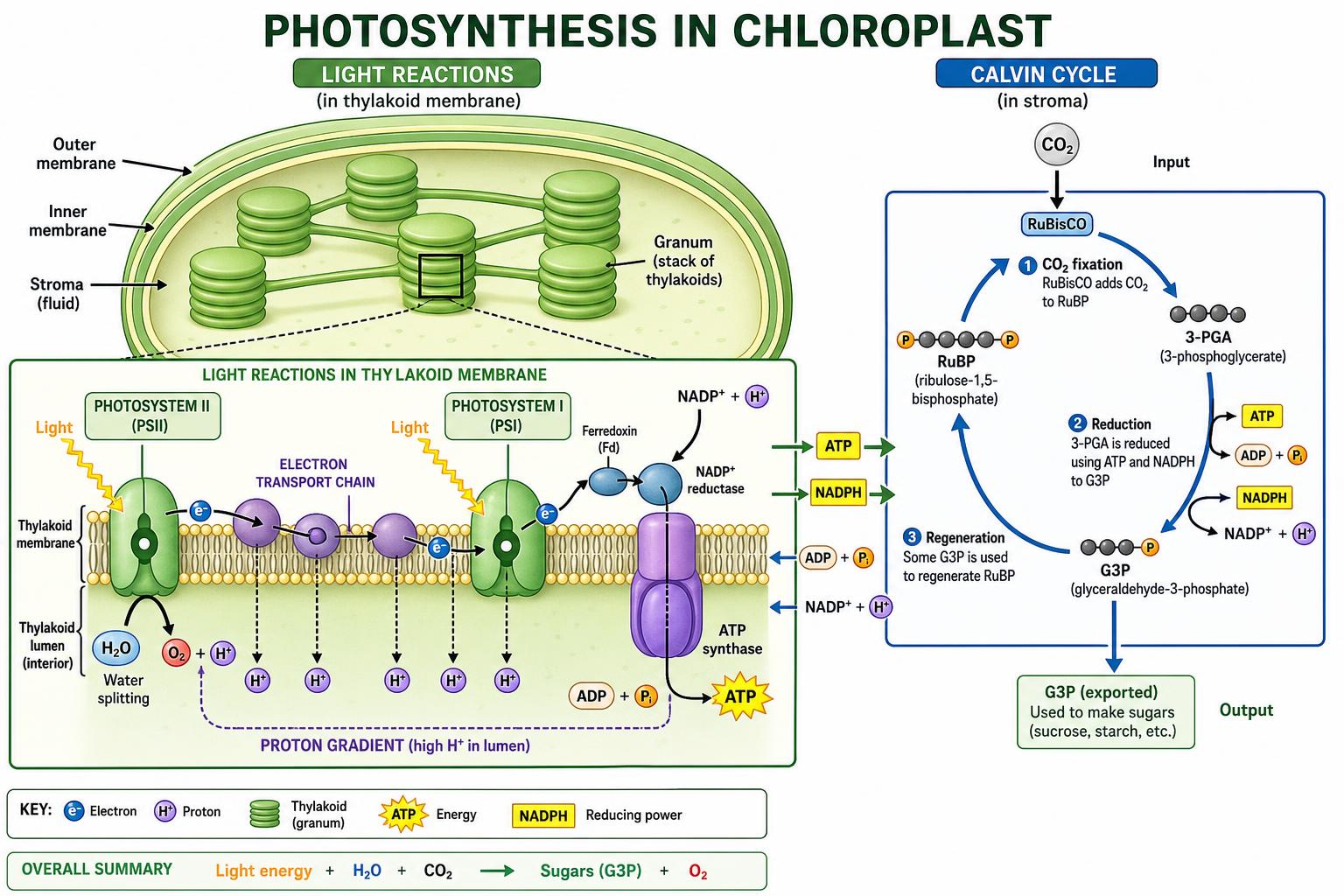
Photosynthesis converts light energy into the chemical energy stored in glucose. The overall equation is 6 CO₂ + 6 H₂O + light → C₆H₁₂O₆ + 6 O₂. Isotope-labeling experiments (using heavy oxygen, ¹⁸O) confirmed that the oxygen gas released comes from the splitting of water, not from carbon dioxide - a key piece of evidence you should be able to cite on the exam.
Photosynthesis proceeds in two linked stages that occur in different parts of the chloroplast: the light reactions in the thylakoid membrane convert light energy into ATP and NADPH, and the Calvin cycle in the stroma uses that ATP and NADPH to fix carbon from CO₂ into sugar.
Light reactions
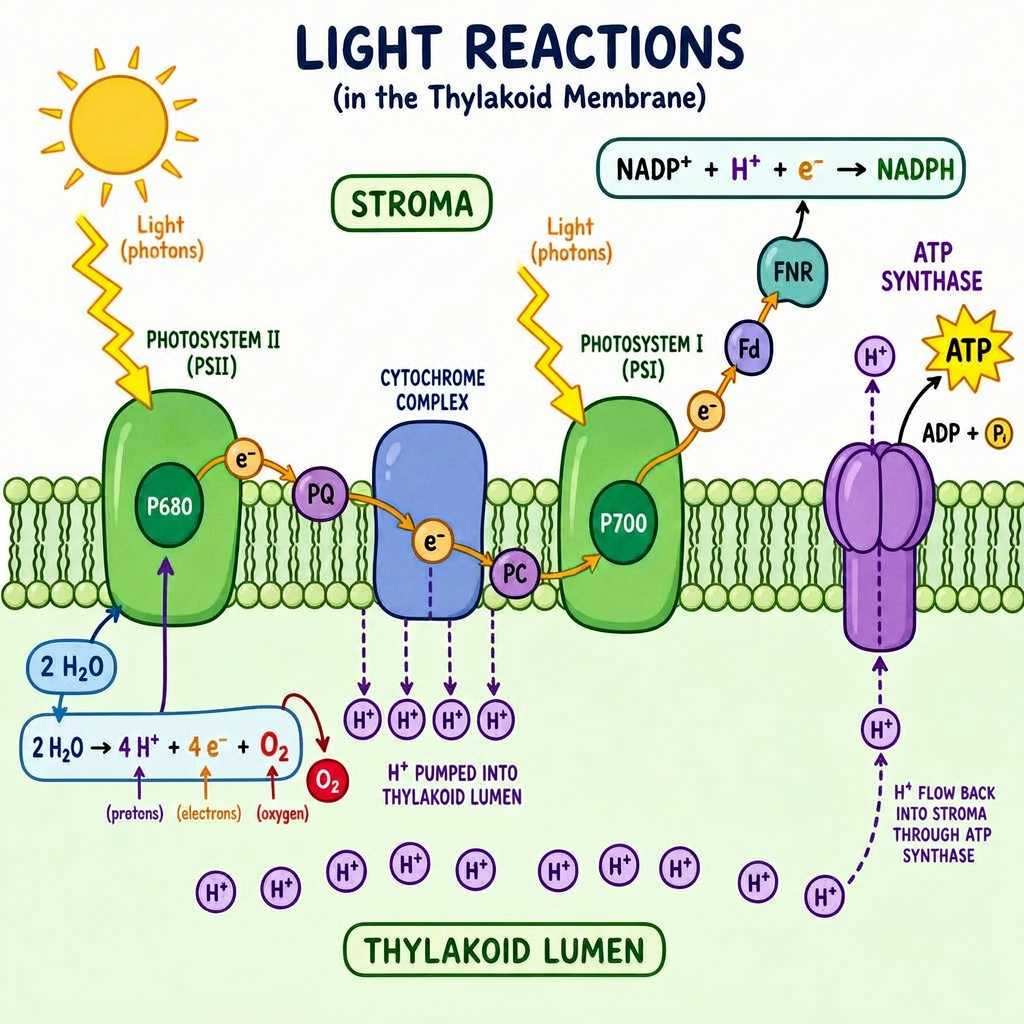
Pigments - chlorophyll a, chlorophyll b, and carotenoids - embedded in Photosystem II (PSII) absorb photons of light. This energy excites an electron in chlorophyll, which is passed to an electron transport chain leading to Photosystem I (PSI). PSI absorbs additional light and re-energizes the electron a second time, ultimately reducing NADP⁺ to NADPH.
Each time PSII loses an excited electron, it replaces it by splitting a water molecule: 2 H₂O → 4 H⁺ + 4 e⁻ + O₂. This reaction is the direct source of atmospheric oxygen and also contributes H⁺ ions to the thylakoid lumen.
As electrons move down the electron transport chain between PSII and PSI, released energy pumps additional H⁺ from the stroma into the thylakoid lumen, building a steep proton gradient. These protons flow back out through ATP synthase, driving photophosphorylation (chemiosmosis) and generating ATP.
The Calvin cycle
The Calvin cycle takes place in the stroma and proceeds in three phases. First, carbon fixation: the enzyme RuBisCO attaches atmospheric CO₂ to the five-carbon sugar RuBP, forming an unstable six-carbon intermediate that immediately splits into two molecules of 3-phosphoglycerate (3-PGA). Second, reduction: ATP and NADPH generated by the light reactions convert 3-PGA into glyceraldehyde-3-phosphate (G3P). Third, regeneration: most G3P molecules are recycled, using additional ATP, to regenerate RuBP so the cycle can continue.
For every three turns of the cycle, three CO₂ molecules are fixed and one net G3P molecule is produced (the rest are used to regenerate RuBP). It takes six turns of the cycle - and two G3P molecules combined - to build one molecule of glucose.

C3, C4, and CAM adaptations
RuBisCO's usefulness has a flaw: in hot, dry conditions, plants close their stomata to conserve water, which causes O₂ to build up inside the leaf while CO₂ is depleted. Under these conditions, RuBisCO sometimes binds O₂ instead of CO₂, initiating photorespiration - a wasteful pathway that consumes energy and releases CO₂ without producing any sugar.
C3 plants (the majority, including wheat and rice) simply tolerate this inefficiency. C4 plants (corn, sugarcane) reduce photorespiration through spatial separation: PEP carboxylase in mesophyll cells fixes CO₂ into a four-carbon compound, which is shuttled into bundle-sheath cells where CO₂ is released at high local concentration right next to RuBisCO. CAM plants (cacti, pineapples, and other succulents) reduce photorespiration through temporal separation: stomata open only at night to fix CO₂ into stored organic acids, and the Calvin cycle runs during the day with stomata closed, conserving water.

Key terms
4
- Photophosphorylation
- ATP synthesis driven by a light-generated proton gradient across the thylakoid membrane.
- RuBisCO
- The enzyme that fixes atmospheric CO₂ onto RuBP in the Calvin cycle; can also bind O₂, causing photorespiration.
- Photorespiration
- A wasteful process in which RuBisCO binds O₂ instead of CO₂, consuming energy without producing sugar.
- Chemiosmosis
- ATP synthesis driven by the flow of H⁺ ions down their electrochemical gradient through ATP synthase.
Sign-off
Finish this lesson
A lesson only counts once you've read all the way through and completed every activity on the page.
- Read the full lesson (scroll to the end)
- Complete all activities (0/4 done)