
Cellular Respiration
Glucose is broken down through glycolysis, pyruvate oxidation, the Krebs cycle, and oxidative phosphorylation to produce ATP.
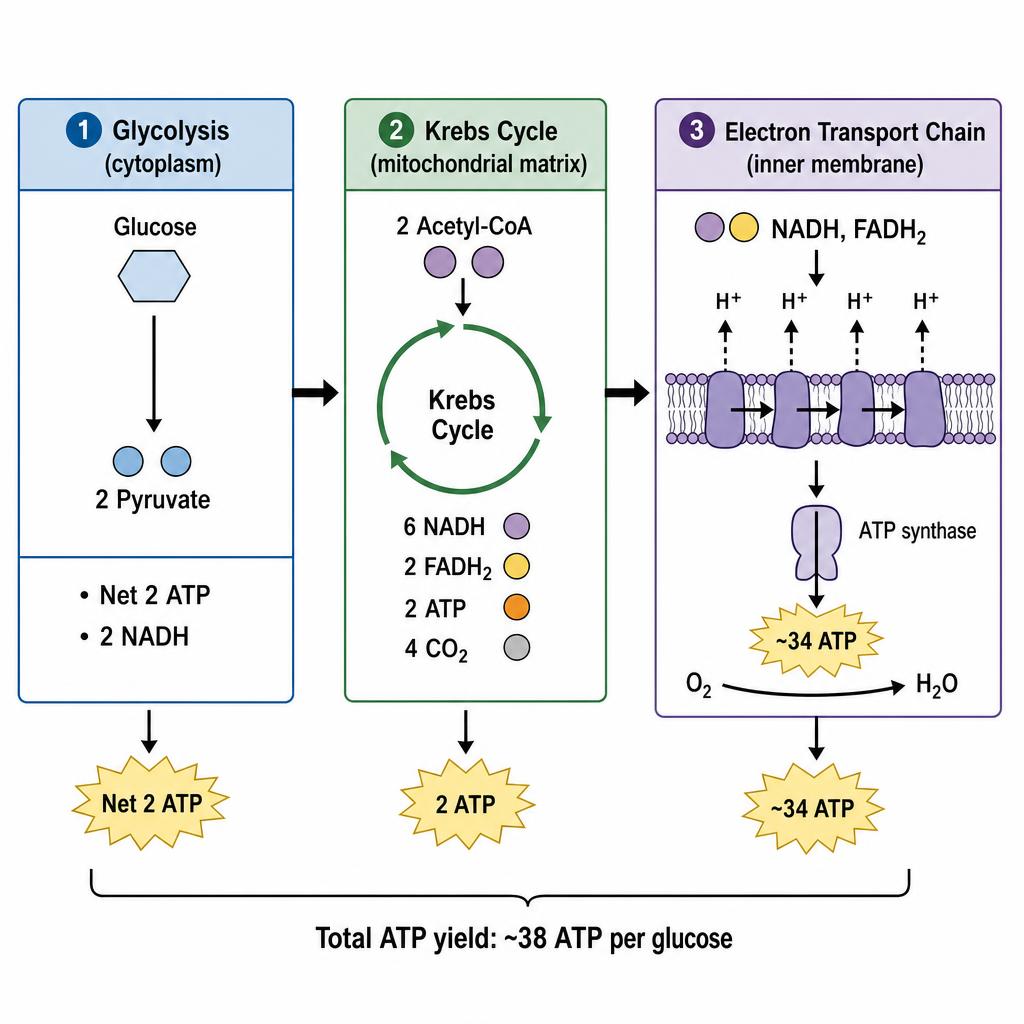
Overview of the four stages
Cellular respiration breaks down glucose to capture its stored energy in the form of ATP. The overall reaction is C₆H₁₂O₆ + 6 O₂ → 6 CO₂ + 6 H₂O + ~30-32 ATP. This process unfolds across four stages: glycolysis, pyruvate oxidation, the Krebs (citric acid) cycle, and oxidative phosphorylation (the electron transport chain coupled with chemiosmosis).
Glycolysis
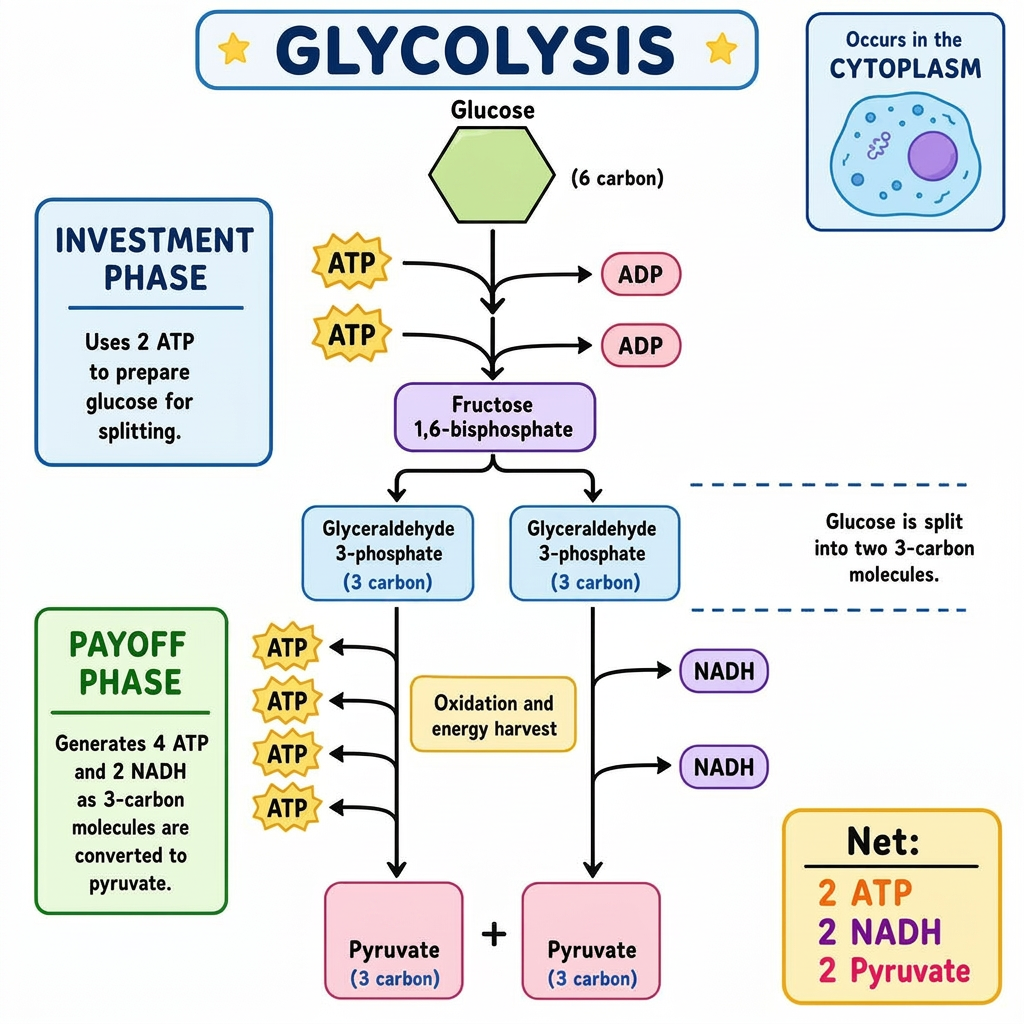
Glycolysis takes place in the cytoplasm and splits one six-carbon glucose molecule into two three-carbon pyruvate molecules. An initial energy investment phase consumes 2 ATP to destabilize glucose, while a subsequent payoff phase generates 4 ATP and 2 NADH. The net yield per glucose is therefore 2 ATP, 2 NADH, and 2 pyruvate.
Because glycolysis does not require oxygen, it is thought to be one of the most ancient metabolic pathways, present in essentially every living cell, from bacteria to humans.
Pyruvate oxidation and the Krebs cycle
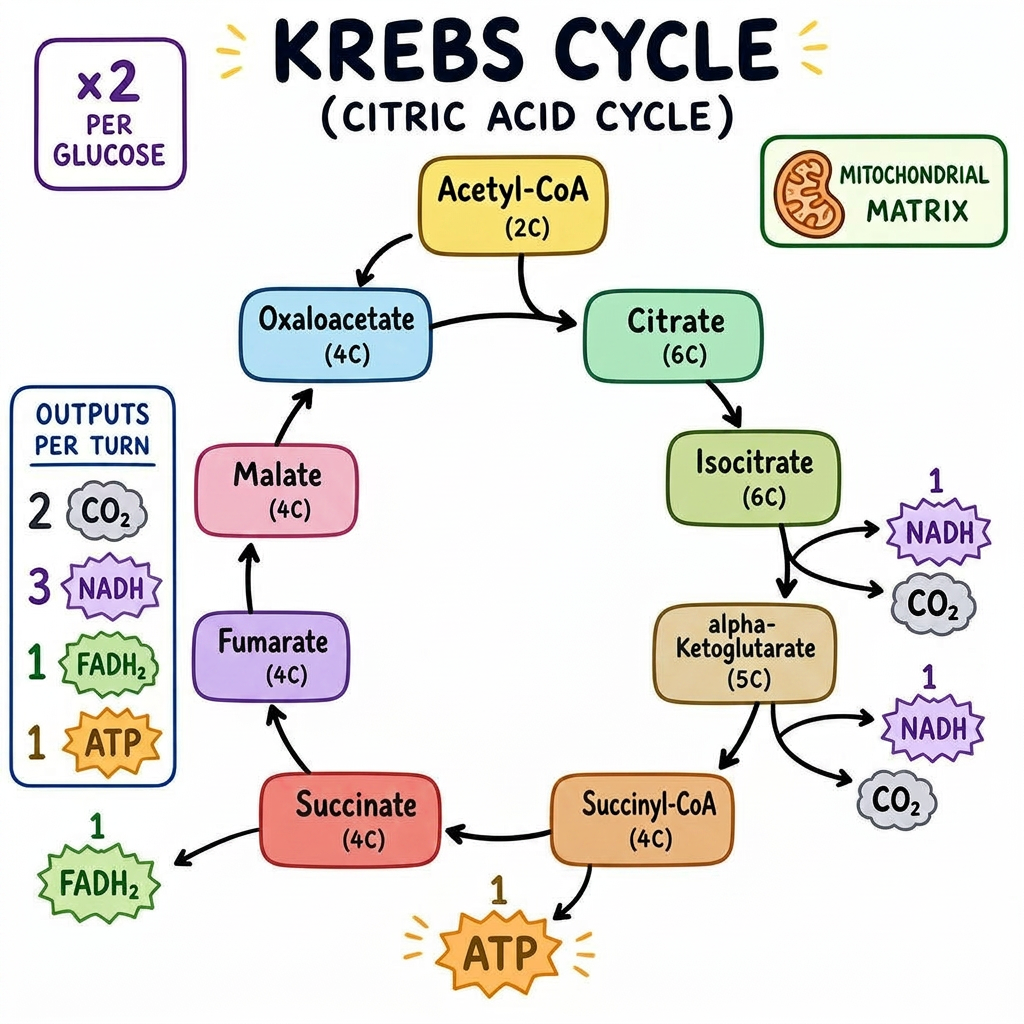
If oxygen is present, each pyruvate molecule is transported into the mitochondrial matrix, where it is converted into acetyl-CoA, releasing one CO₂ and generating one NADH per pyruvate. Per glucose molecule, this yields 2 acetyl-CoA, 2 CO₂, and 2 NADH.
Acetyl-CoA then enters the Krebs cycle by combining with oxaloacetate to form citrate. Across the cycle's series of reactions, the remaining carbons are progressively released as CO₂, and high-energy electrons are captured by the carriers NADH and FADH₂. Per glucose (accounting for two turns of the cycle), the Krebs cycle yields 2 ATP, 6 NADH, 2 FADH₂, and 4 CO₂. By this point, all six carbons of the original glucose molecule have been released as carbon dioxide.
Electron transport chain and chemiosmosis
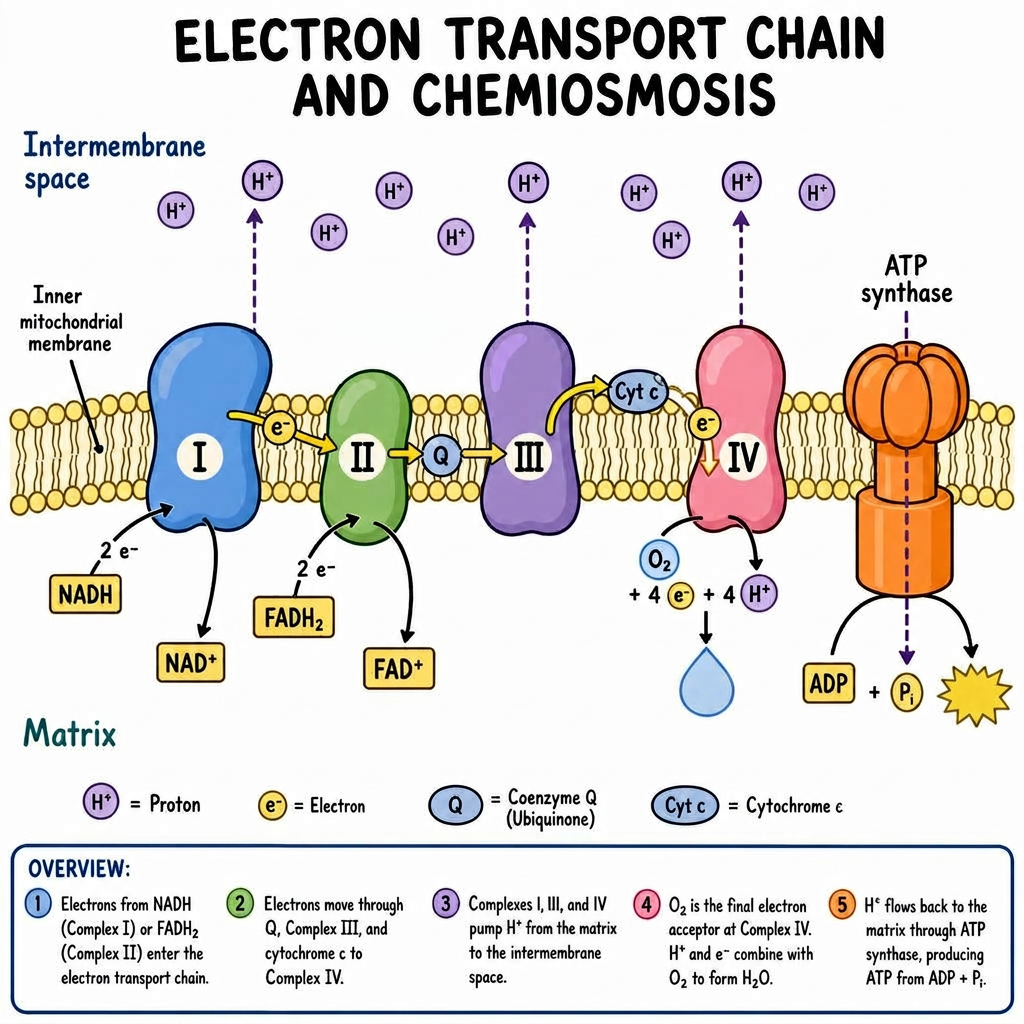
NADH and FADH₂ deliver their high-energy electrons to the electron transport chain, embedded in the inner mitochondrial membrane. As electrons pass through a sequence of protein complexes, the energy released is used to actively pump H⁺ ions from the matrix into the intermembrane space, creating a steep electrochemical gradient.
This gradient is then harnessed by ATP synthase, a molecular motor that allows H⁺ to flow back down its gradient into the matrix while synthesizing ATP from ADP and inorganic phosphate - a process called chemiosmosis. Each NADH contributes enough energy to yield roughly 2.5 ATP, while each FADH₂ yields roughly 1.5 ATP, because FADH₂ enters the chain at a lower energy point.
Oxygen serves as the final electron acceptor at the end of the chain, combining with electrons and H⁺ to form water. Without oxygen available to accept these electrons, the entire chain backs up, NAD⁺ and FAD can no longer be regenerated, the Krebs cycle and pyruvate oxidation stall, and ATP production collapses.
Fermentation
When oxygen is unavailable, cells can still generate a small amount of ATP by keeping glycolysis running through fermentation, which regenerates NAD⁺ from NADH so that glycolysis is not stalled by a shortage of NAD⁺. In lactic acid fermentation (used by animal muscle cells and some bacteria), pyruvate is converted directly into lactate. In alcoholic fermentation (used by yeast and some plant cells), pyruvate is converted into ethanol and CO₂.
It is essential to understand that fermentation itself produces no additional ATP; its only role is regenerating NAD⁺ so that glycolysis's modest net yield of 2 ATP per glucose can continue.

Key terms
4
- Glycolysis
- Cytoplasmic breakdown of glucose into two pyruvate molecules, netting 2 ATP and 2 NADH.
- Chemiosmosis
- ATP synthesis driven by the flow of H⁺ down its gradient through ATP synthase.
- Electron transport chain
- A series of membrane protein complexes that pass electrons from NADH/FADH₂ to O₂, pumping H⁺ in the process.
- Fermentation
- An anaerobic pathway that regenerates NAD⁺ from NADH so glycolysis can continue without oxygen.
Sign-off
Finish this lesson
A lesson only counts once you've read all the way through and completed every activity on the page.
- Read the full lesson (scroll to the end)
- Complete all activities (0/5 done)