AP Bio Lab
Home
Learn
Flashcards
Practice
Mock Exam
Dashboard
About
Sign out
Home
Learn
Flashcards
Practice
Mock Exam
Dashboard
About
AP Bio Lab
Learn
Cell Communication & Cell Cycle
Unit 04
10-15% of exam
7 lessons
Cell Communication & Cell Cycle
Signal transduction, feedback, mitosis, and checkpoints.
Progress
0/7 · 0%
Lessons
4.1
Cell Communication
Cells communicate via direct contact, local signals, and long-distance signals to coordinate behavior.
4.2
Introduction to Signal Transduction
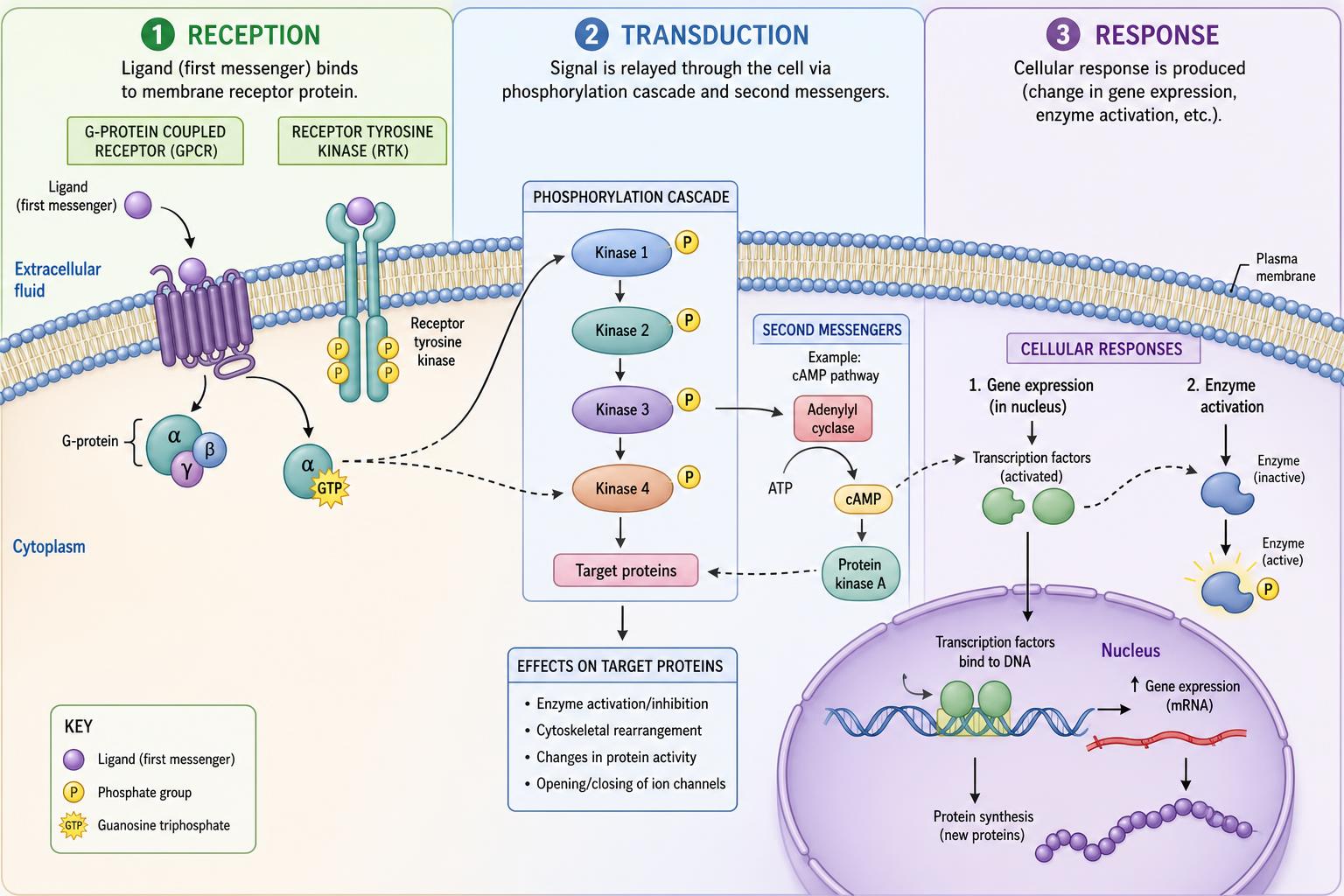
Signaling proceeds through reception, transduction, and response, with distinct receptor types tuned to different ligands.
4.3
Signal Transduction
Transduction relays and amplifies signals through phosphorylation cascades and second messengers before producing a cellular response.
4.4
Changes in Signal Transduction Pathways
Mutations or chemical interference at any step of a signaling pathway can alter or disrupt the cellular response.
4.5
Feedback
Negative feedback loops maintain homeostasis while positive feedback loops amplify a process toward completion.
4.6
Cell Cycle
The cell cycle alternates growth phases with DNA replication and mitosis, producing two genetically identical daughter cells.
4.7
Regulation of Cell Cycle
Checkpoints controlled by cyclins, CDKs, and tumor suppressors ensure the cell cycle proceeds only when conditions are appropriate.
Figure · reference
Practice MCQs
Practice FRQs
Flashcards