
Feedback
Negative feedback loops maintain homeostasis while positive feedback loops amplify a process toward completion.
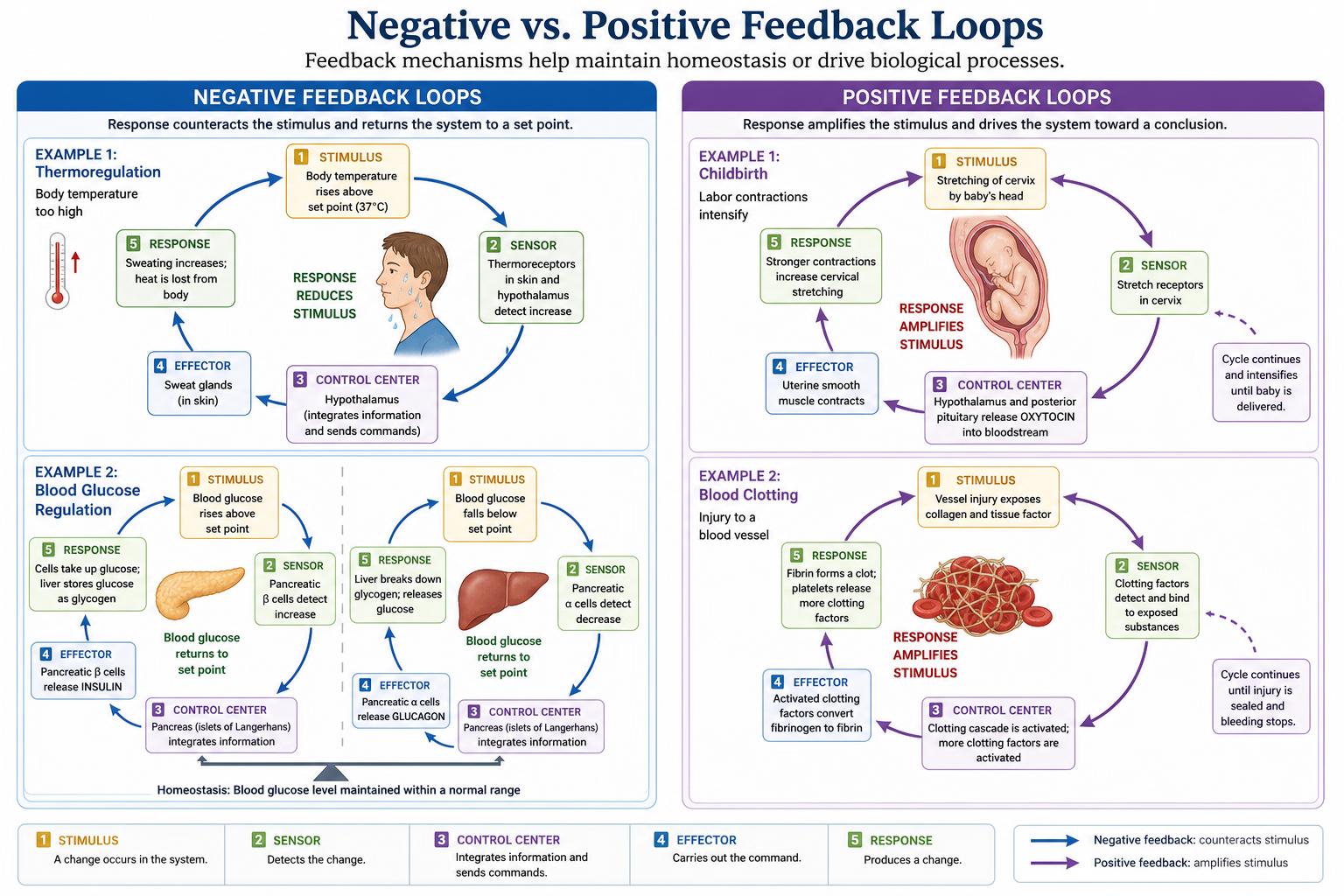
Negative feedback - the default for homeostasis
In negative feedback, a system's output reduces its own input, holding a variable near a set point. This is how thermostats work and how almost every homeostatic mechanism in the body works.
Classic examples: blood glucose (high glucose → insulin → uptake by cells → glucose drops; low glucose → glucagon → glucose released from liver), body temperature, blood pH, ATP inhibiting phosphofructokinase in glycolysis when ATP is plentiful.
Positive feedback - amplifying to a finish line
Positive feedback amplifies the original signal, pushing a system away from its starting state toward a definite endpoint. These loops are rare because they're inherently unstable, but they're essential when a process needs to be driven all the way to completion.
Examples: oxytocin in childbirth (contractions stretch the cervix → more oxytocin → stronger contractions, until birth); blood clotting (each activated clotting factor activates more, until the clot forms); the action potential in neurons (Na⁺ entry depolarizes the membrane → more Na⁺ channels open → faster depolarization).
When feedback breaks down
Disrupted feedback causes disease. In type 2 diabetes, cells stop responding to insulin (insulin resistance), so the negative feedback loop that lowers blood glucose fails and glucose stays dangerously high. Autoimmune disorders, hormone-secreting tumors, and many cancers can all be understood as broken feedback control.
Key terms
4
- Homeostasis
- Maintenance of stable internal conditions.
- Set point
- Target value a control system maintains.
- Negative feedback
- A regulatory mechanism in which a system's output dampens the original stimulus.
- Positive feedback
- A regulatory mechanism in which a system's output reinforces or amplifies the original stimulus.
Sign-off
Finish this lesson
A lesson only counts once you've read all the way through and completed every activity on the page.
- Read the full lesson (scroll to the end)
- Complete all activities (0/1 done)