
Introduction to Signal Transduction
Signaling proceeds through reception, transduction, and response, with distinct receptor types tuned to different ligands.
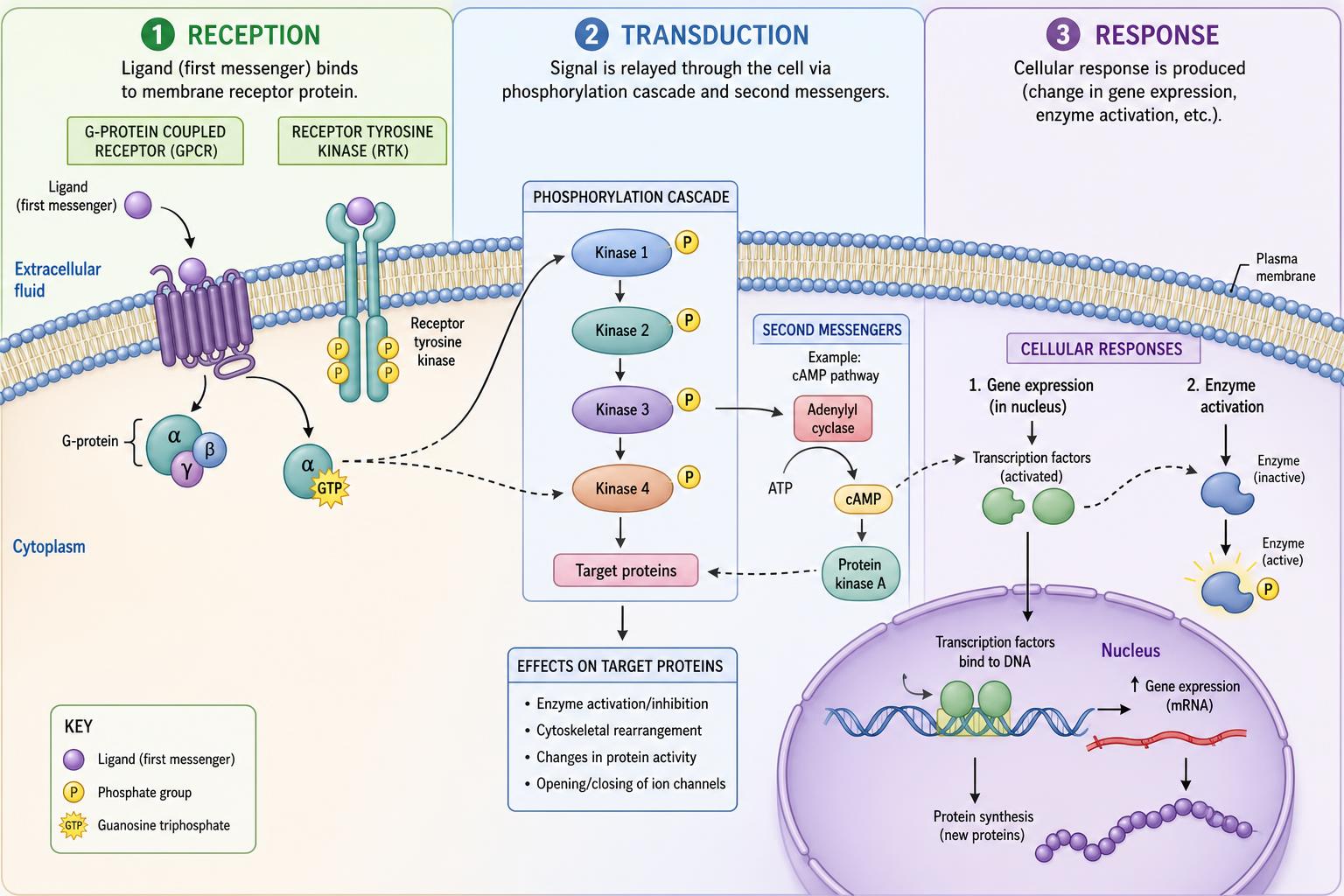
The three stages of signaling
Every signal transduction pathway, regardless of complexity, can be broken into three conceptual stages: reception (a ligand binds a specific receptor protein), transduction (the binding event is converted into a series of intracellular changes, often a relay or cascade), and response (the cell's ultimate reaction, such as altered gene expression, enzyme activity, or secretion).
This framework, first articulated to explain epinephrine's effect on liver cells, generalizes to nearly all signaling in biology, from a plant sensing light to a neuron detecting neurotransmitter to a developing embryo cell responding to a morphogen gradient.
Reception: receptor binds ligand
Reception occurs when a signaling molecule (ligand) binds a receptor protein, causing the receptor to change conformation. Because binding is highly specific - the receptor recognizes a particular molecular shape - a cell only responds to ligands for which it has receptors, allowing different cell types to respond differently (or not at all) to the same signal circulating throughout the body.
Where the receptor is located depends on the chemical nature of the ligand: large or polar ligands cannot cross the hydrophobic interior of the plasma membrane, so their receptors sit embedded in the membrane; small or nonpolar ligands can diffuse through the membrane and bind receptors inside the cell.
Major receptor types
- G-protein-coupled receptors (GPCRs): membrane proteins that snake through the bilayer seven times; ligand binding changes the receptor's shape so it can activate an associated G-protein on the cytoplasmic side, which then activates or inhibits other proteins.
- Receptor tyrosine kinases (RTKs): membrane receptors that dimerize when ligand binds, causing each monomer to phosphorylate tyrosines on its partner (autophosphorylation), creating docking sites for multiple relay proteins and enabling one receptor to trigger several pathways simultaneously.
- Ligand-gated ion channels: membrane proteins that open or close a channel in response to ligand binding, allowing ions to flow down their electrochemical gradient and change membrane potential or ion concentration.
- Intracellular receptors: found in the cytoplasm or nucleus, these bind small hydrophobic ligands (like steroid hormones, thyroid hormone, or nitric oxide) that diffuse across the membrane; the ligand-receptor complex often acts directly as a transcription factor.
Key terms
4
- Reception
- Stage in which a signaling molecule binds a receptor protein, causing it to change shape.
- G-protein-coupled receptor (GPCR)
- Membrane receptor with 7 transmembrane helices that activates an internal G-protein upon ligand binding.
- Receptor tyrosine kinase (RTK)
- Membrane receptor that dimerizes and autophosphorylates tyrosines when ligand binds.
- Intracellular receptor
- Receptor located in the cytoplasm or nucleus that binds small or nonpolar ligands able to cross the membrane.
Sign-off
Finish this lesson
A lesson only counts once you've read all the way through and completed every activity on the page.
- Read the full lesson (scroll to the end)
- Complete all activities (0/1 done)