
Signal Transduction
Transduction relays and amplifies signals through phosphorylation cascades and second messengers before producing a cellular response.
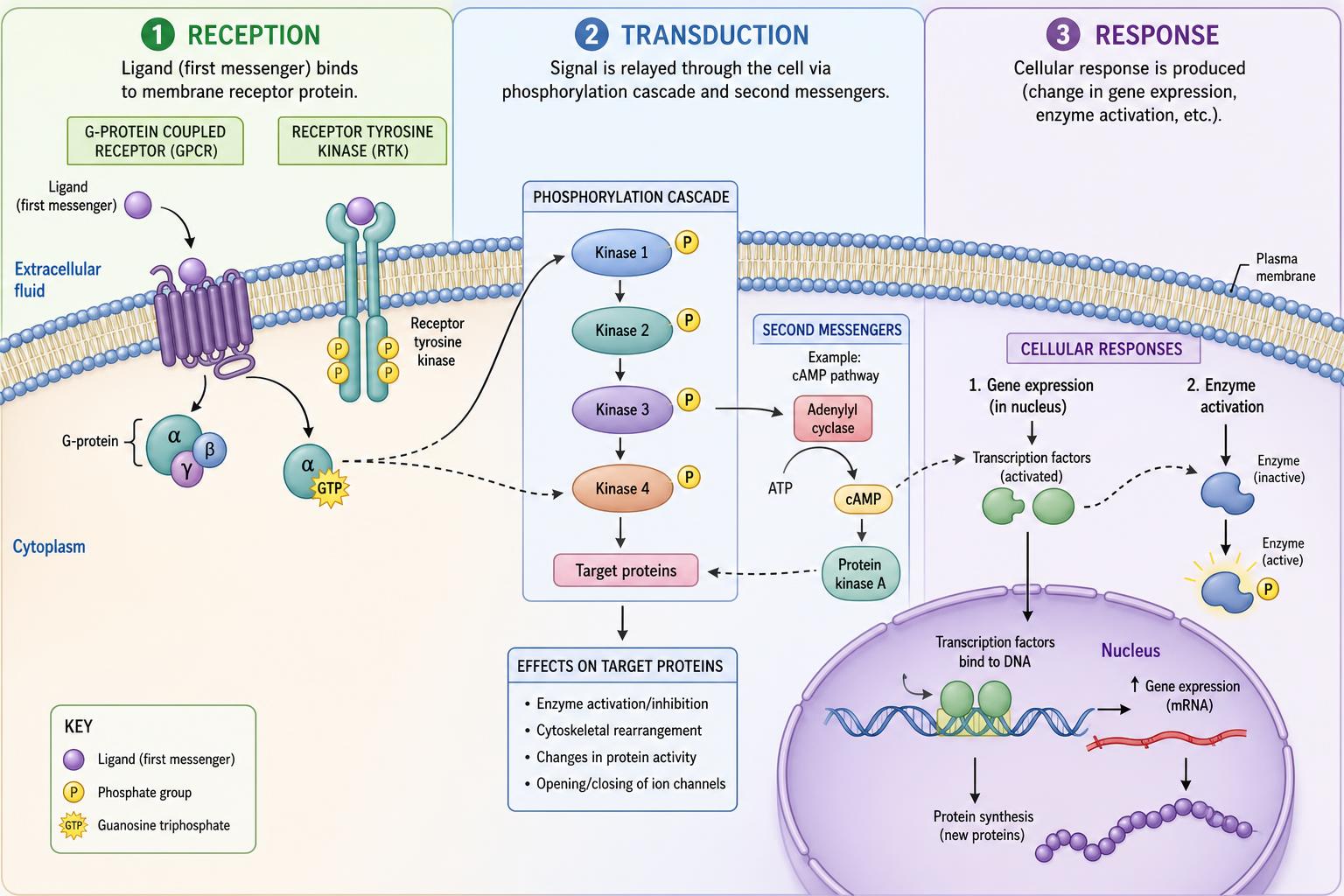
Relaying the signal: phosphorylation cascades
Once a receptor is activated, the signal is usually transduced through a series of molecular changes rather than acted on directly. The most common mechanism is a phosphorylation cascade: an activated protein kinase phosphorylates the next kinase in line, which becomes active and phosphorylates the next, and so on.
Because each activated kinase can phosphorylate many copies of the next protein, cascades massively amplify the original signal - a single bound ligand can ultimately activate thousands of downstream molecules, allowing a small, transient signal at the membrane to produce a large, rapid change inside the cell.
Second messengers spread the signal
Second messengers are small, water-soluble, non-protein molecules or ions that diffuse rapidly through the cytoplasm, broadcasting a signal from the plasma membrane to targets throughout the cell. Common examples include cyclic AMP (cAMP), produced from ATP by adenylyl cyclase downstream of many activated GPCRs; inositol trisphosphate (IP₃) and diacylglycerol (DAG), produced by cleavage of a membrane phospholipid; and calcium ions (Ca²⁺), released from the endoplasmic reticulum in response to IP₃.
Because second messengers are small and diffuse quickly, they can reach targets throughout the cell far faster than a protein could, and one second-messenger-producing enzyme can generate large numbers of second-messenger molecules, adding another layer of amplification to the pathway.
Termination and precision of transduction
Signal transduction pathways must be reversible so cells can respond to changing conditions. Protein phosphatases remove phosphate groups added by kinases, GTPase activity built into G-proteins hydrolyzes bound GTP back to GDP to turn G-proteins off, and enzymes such as phosphodiesterase rapidly degrade second messengers like cAMP.
This tight regulation ensures the amplitude and duration of a response matches the strength and duration of the original signal, and prevents pathways from remaining locked in an 'on' state, which would be damaging or lead to uncontrolled cell behavior.
Key terms
4
- Phosphorylation cascade
- Sequence of protein kinases that each phosphorylate and activate the next, amplifying a signal.
- Second messenger
- Small, non-protein molecule (e.g., cAMP, Ca²⁺) that relays a signal from receptor to internal targets.
- Protein kinase
- Enzyme that transfers a phosphate group from ATP to a target protein, often activating it.
- Protein phosphatase
- Enzyme that removes a phosphate group from a protein, often deactivating it.
Sign-off
Finish this lesson
A lesson only counts once you've read all the way through and completed every activity on the page.
- Read the full lesson (scroll to the end)
- Complete all activities (0/1 done)