
Regulation of Cell Cycle
Checkpoints controlled by cyclins, CDKs, and tumor suppressors ensure the cell cycle proceeds only when conditions are appropriate.
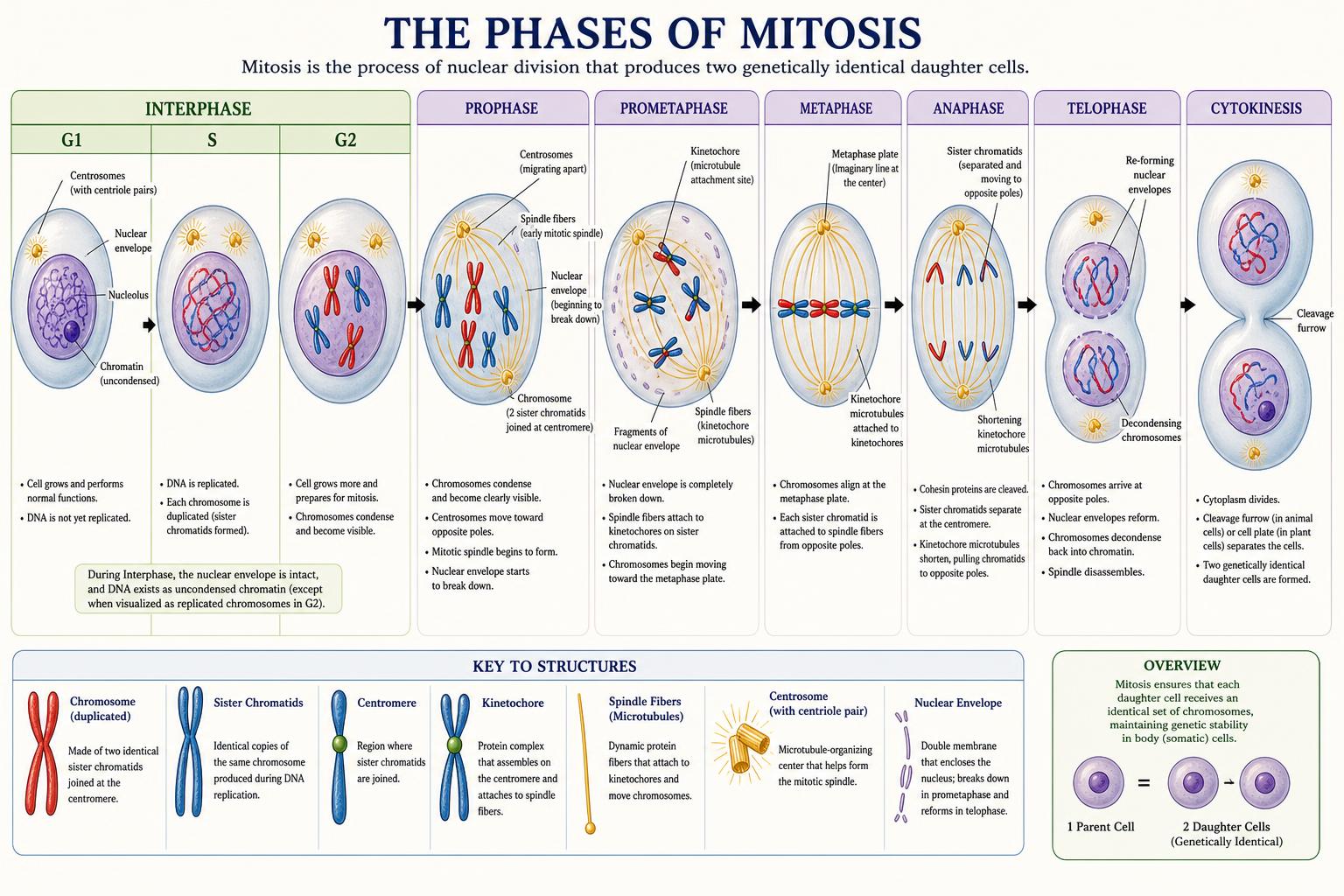
Checkpoints guard the cycle
Three main checkpoints guard the cycle: G1 (am I big enough? is DNA undamaged? are signals to divide present?), G2 (did DNA replicate correctly?), and M (are all chromosomes attached to spindle fibers?).
The G1 checkpoint is often called the 'restriction point' because a cell that passes it is normally committed to completing the cycle; if conditions are unfavorable, the cell instead exits into the resting G0 state.
Cyclins and CDKs drive transitions
Cyclins are regulatory proteins whose levels rise and fall through the cycle. They bind and activate cyclin-dependent kinases (CDKs), which phosphorylate target proteins to advance the cycle. Different cyclin-CDK combos drive different transitions.
Because CDK concentration stays relatively constant while cyclin concentration oscillates, the timing of cyclin synthesis and degradation (often via ubiquitin-tagged proteolysis) determines exactly when in the cycle each CDK complex becomes active, giving the cell precise temporal control over its progression.
Tumor suppressors and cancer
Tumor suppressors like p53 ('the guardian of the genome') halt the cycle at G1 if DNA is damaged and trigger repair or apoptosis. Loss-of-function mutations in p53 are found in more than 50% of human cancers.
Cancer results when cells accumulate mutations that disable checkpoint proteins (like p53 or Rb) or that make growth-signaling pathways constitutively active (oncogenes such as mutated Ras). Both routes let cells bypass the normal controls that would otherwise stop or slow their division.
Apoptosis - programmed cell death
When cells are damaged beyond repair, are no longer needed (e.g., webbing between fetal fingers), or detect infection, they trigger apoptosis - a clean, controlled self-destruction that doesn't cause inflammation. It's an essential complement to cell division for keeping tissues healthy.
Apoptosis is carried out by a cascade of proteases called caspases, which dismantle the cell's proteins and DNA in an orderly way; the cell fragments into membrane-bound vesicles that are engulfed by neighboring cells or immune cells, avoiding the tissue damage that uncontrolled cell death (necrosis) would cause.
Key terms
4
- Cyclin
- Regulatory protein whose levels rise and fall through the cycle, activating CDKs.
- Cyclin-dependent kinase (CDK)
- A kinase that is only active when bound to its cyclin partner, driving cell cycle transitions.
- Checkpoint
- A control point in the cell cycle where the cell verifies conditions are met before proceeding.
- Apoptosis
- Programmed cell death, often triggered when a damaged cell cannot be repaired.
Sign-off
Finish this lesson
A lesson only counts once you've read all the way through and completed every activity on the page.
- Read the full lesson (scroll to the end)
- Complete all activities (0/1 done)