AP Bio Lab
Home
Learn
Flashcards
Practice
Mock Exam
Dashboard
About
Sign out
Home
Learn
Flashcards
Practice
Mock Exam
Dashboard
About
AP Bio Lab
Learn
Natural Selection
Unit 07
13-20% of exam
13 lessons
Natural Selection
Evolution, Hardy-Weinberg, speciation, and phylogeny.
Progress
0/13 · 0%
Lessons
7.1
Introduction to Natural Selection
Evolution is a change in allele frequencies over time, driven by heritable variation and differential survival/reproduction.
7.2
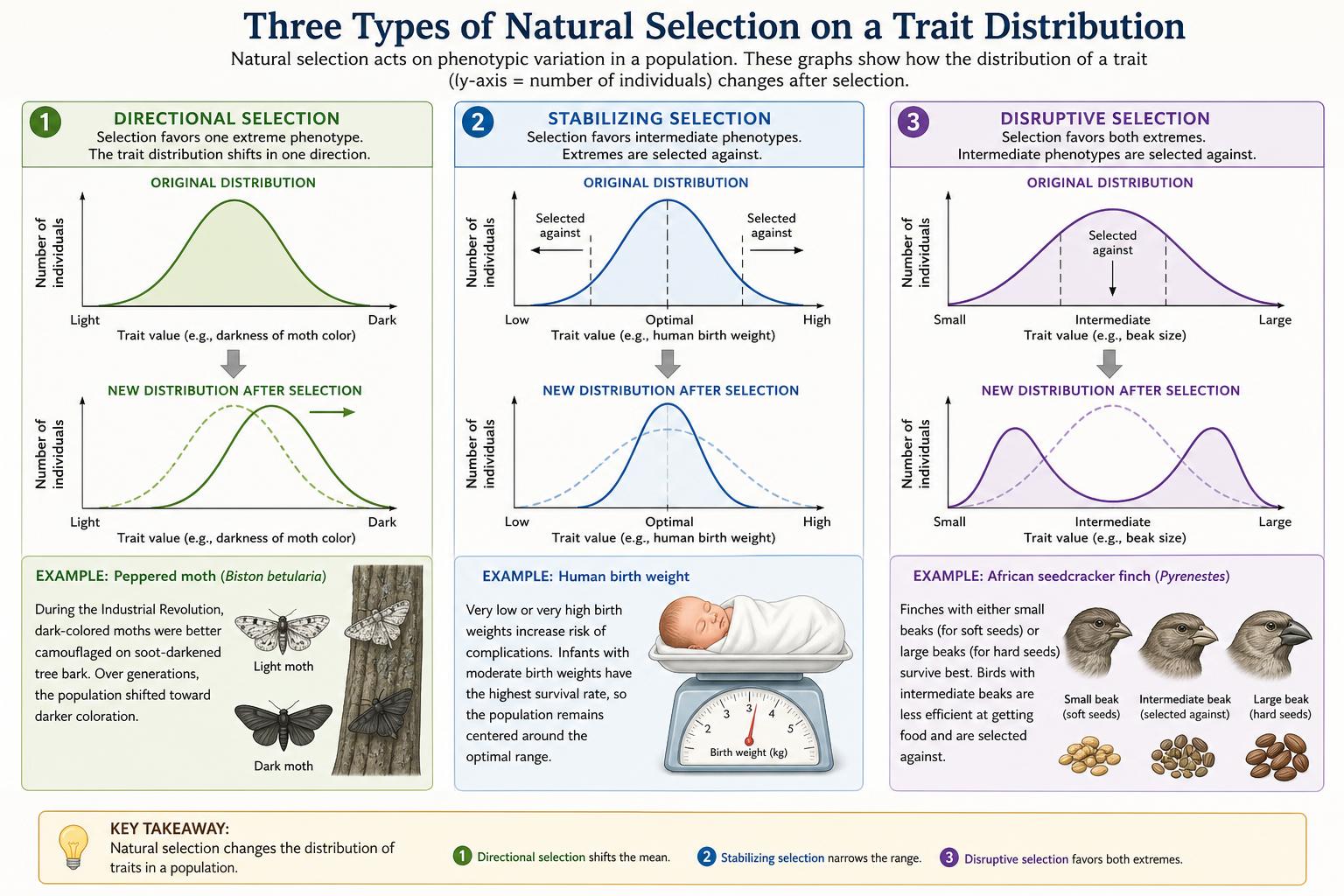
Natural Selection
When heritable variation leads to differential survival and reproduction, allele frequencies shift - this is natural selection.
7.3
Artificial Selection
Humans mimic natural selection by intentionally choosing which organisms reproduce, revealing how selection can rapidly shape populations.
7.4
Population Genetics
Population genetics quantifies allele and genotype frequencies within a gene pool, providing the mathematical basis for tracking evolution.
7.5
Hardy-Weinberg Equilibrium
The Hardy-Weinberg model is a null hypothesis of a non-evolving population, used to detect and quantify evolutionary change.
7.6
Evidence of Evolution
Multiple independent lines of evidence - fossils, biogeography, and comparative anatomy - converge to support the fact of evolution.
7.7
Common Ancestry
Shared anatomical, developmental, and molecular features across organisms provide strong evidence that all life descends from common ancestors.
7.8
Continuing Evolution
Evolution is an ongoing process that continues to shape populations in the present, not a historical event confined to the deep past.
7.9
Phylogeny
Phylogenetic trees and cladograms visually represent hypothesized evolutionary relationships based on shared derived characteristics.
7.10
Speciation
New species arise when populations become reproductively isolated and accumulate genetic differences that prevent interbreeding.
7.11
Extinction
Extinction - the permanent loss of a species - is a normal part of evolutionary history, sometimes occurring in mass events that reshape biodiversity.
7.12
Variations in Populations
The amount and type of variation in a population influences its capacity to survive environmental change and to evolve in response to selection.
7.13
Origin of Life on Earth
Scientific hypotheses propose that life arose from simple organic molecules formed under early Earth conditions, eventually leading to self-replicating, membrane-bound cells.
Figure · reference
Practice MCQs
Practice FRQs
Flashcards