
Introduction to Natural Selection
Evolution is a change in allele frequencies over time, driven by heritable variation and differential survival/reproduction.
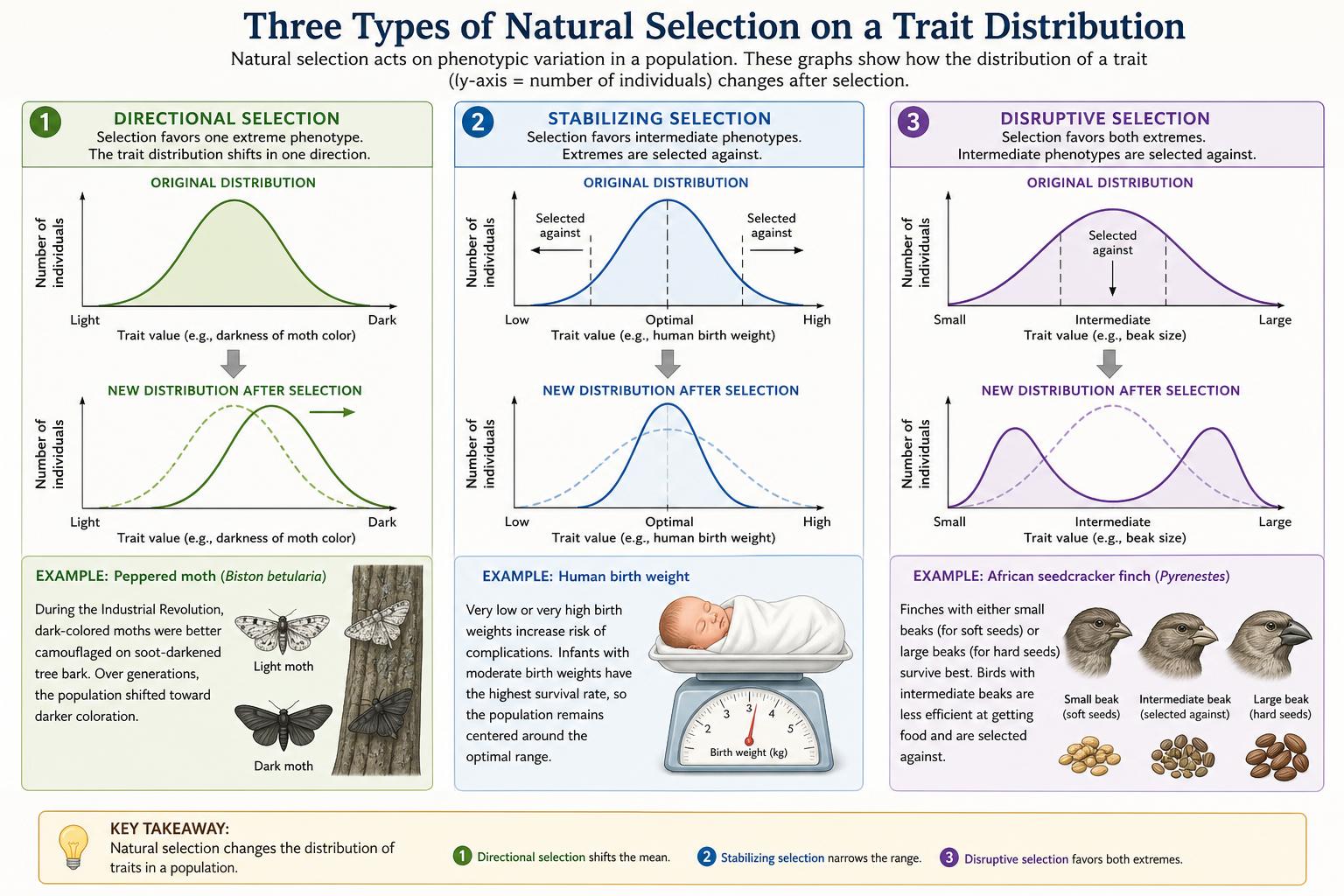
Evolution acts on populations, not individuals
A common misconception is that individual organisms 'evolve' during their lifetime. They don't - an individual's genotype is fixed at fertilization. Evolution is a population-level phenomenon: it is the change, generation to generation, in the frequencies of alleles within a population's shared gene pool. A giraffe doesn't evolve a longer neck by stretching; rather, over many generations, individuals with alleles for longer necks leave more offspring, shifting the population's allele frequencies.
This reframing matters for reasoning through AP problems: any question about 'evolution occurring' is really a question about whether allele or genotype frequencies are changing across generations, which is precisely what Hardy-Weinberg lets us test.
The raw material: heritable variation
Natural selection requires three ingredients: variation among individuals, that variation must be heritable (passed to offspring via genes), and it must produce differences in survival or reproduction. Variation arises ultimately from mutation, and is reshuffled every generation by independent assortment, crossing over, and random fertilization during sexual reproduction.
Not all variation is relevant to evolution - a body-builder's muscles (an acquired trait) don't get passed to offspring the way an inherited allele for muscle fiber type would. AP questions frequently test whether a trait described is heritable (genetic) versus environmentally acquired.
Evolution has no direction or goal
Evolution is not progress toward perfection or complexity; it is simply whichever heritable variants leave the most surviving, reproducing offspring in a given environment at a given time. A trait beneficial in one environment may become a liability if conditions change - there is no 'higher' or 'lower' organism, only organisms more or less suited to their current circumstances.
Key terms
4
- Evolution
- Change in allele frequencies in a population over generations.
- Population
- A group of interbreeding individuals of the same species in a given area, sharing a gene pool.
- Gene pool
- The sum of all alleles for all genes in a population.
- Fitness
- Relative reproductive success of a genotype compared to others in the population.
Sign-off
Finish this lesson
A lesson only counts once you've read all the way through and completed every activity on the page.
- Read the full lesson (scroll to the end)
- Complete all activities (0/1 done)