
Hardy-Weinberg Equilibrium
The Hardy-Weinberg model is a null hypothesis of a non-evolving population, used to detect and quantify evolutionary change.
A baseline for detecting evolution
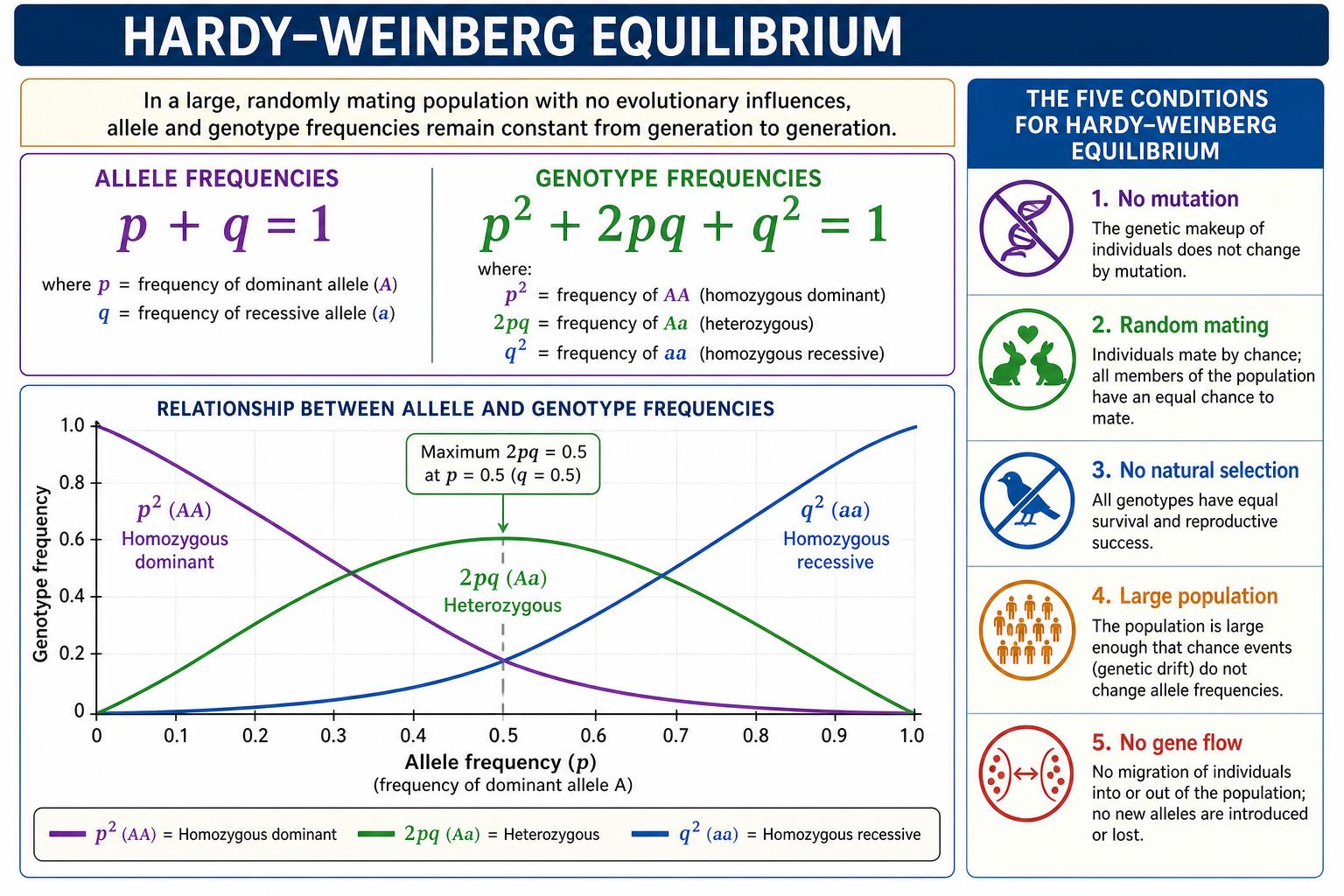
The Hardy-Weinberg principle describes what would happen to a population's allele and genotype frequencies if it were NOT evolving - it is a null model, analogous to a control in an experiment. If a real population's genotype frequencies match Hardy-Weinberg predictions generation after generation, that population is, for the gene in question, in genetic equilibrium and not evolving.
The five assumptions
- No mutations: the allele pool isn't gaining new variants or losing old ones through mutation.
- Random mating: individuals do not select mates based on genotype/phenotype.
- No natural selection: all genotypes have equal survival and reproductive success.
- Very large (effectively infinite) population size: eliminates genetic drift.
- No gene flow: no migration of individuals or gametes into or out of the population.
The equations and how to use them
Allele frequencies: p + q = 1, where p is the frequency of the dominant allele and q is the frequency of the recessive allele in the gene pool. Genotype frequencies: p² + 2pq + q² = 1, where p² is the frequency of homozygous dominant individuals, 2pq is the frequency of heterozygotes, and q² is the frequency of homozygous recessive individuals.
Because the recessive phenotype directly reveals the homozygous recessive genotype (q²), it is usually the easiest starting point in a calculation: take the square root of the recessive phenotype's frequency to find q, then p = 1 − q, and use these to find every other frequency in the population.
Using deviations to detect and explain evolution
In practice, virtually no real population perfectly satisfies all five assumptions, which is precisely why real populations evolve. When observed genotype frequencies in a sampled population differ from Hardy-Weinberg-predicted frequencies, this signals that evolution is occurring and that one or more assumptions are being violated. The next analytical step - a hallmark of AP free-response questions - is identifying which mechanism(s) (selection, drift, gene flow, non-random mating, mutation) most plausibly explains the observed deviation given the scenario described.
Key terms
4
- Hardy-Weinberg equilibrium
- A theoretical state in which allele and genotype frequencies in a population remain constant across generations.
- p
- Conventional symbol for the frequency of the dominant allele in a two-allele system.
- q
- Conventional symbol for the frequency of the recessive allele in a two-allele system.
- Null model
- A hypothesis of no effect/no change, used as a baseline for detecting real patterns.
Sign-off
Finish this lesson
A lesson only counts once you've read all the way through and completed every activity on the page.
- Read the full lesson (scroll to the end)
- Complete all activities (0/1 done)