
Common Ancestry
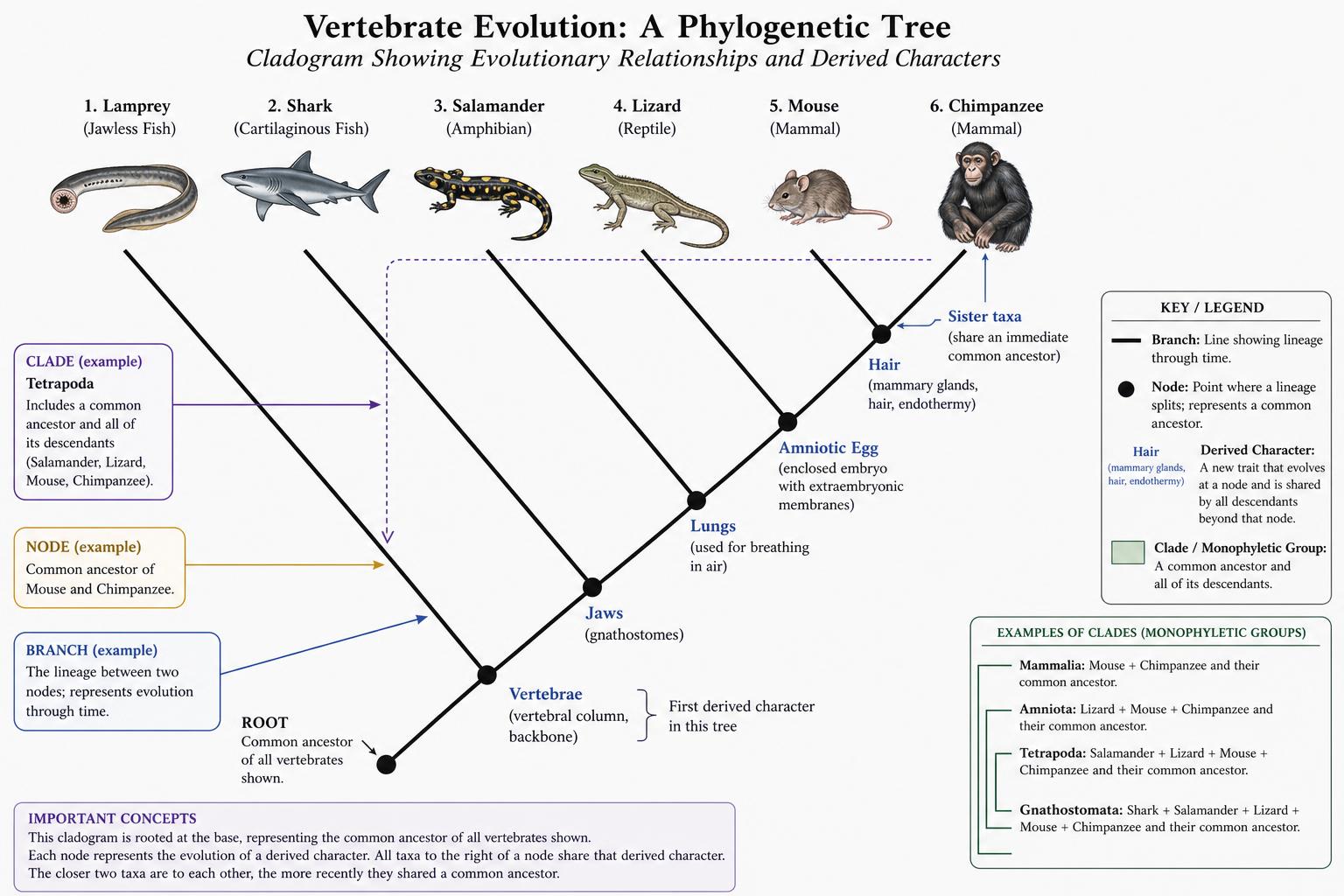
Shared anatomical, developmental, and molecular features across organisms provide strong evidence that all life descends from common ancestors.
Homology vs. analogy
Homologous structures reveal common ancestry: the forelimb bones of a human arm, a whale flipper, a bat wing, and a cat's leg all follow the same underlying skeletal arrangement (one proximal bone, two distal bones, a wrist, digits), despite serving very different functions (grasping, swimming, flying, walking). This shared blueprint is best explained by descent, with modification, from a common tetrapod ancestor.
Analogous structures, by contrast, look or function similarly but arose independently in unrelated lineages facing similar environmental pressures - a phenomenon called convergent evolution. The wings of insects, bats, and birds all enable flight but differ completely in underlying anatomy and developmental origin, showing flight evolved multiple separate times rather than from one common flying ancestor.
Vestigial structures and embryology
Vestigial structures are reduced remnants of features that were functional in an ancestor but have lost most or all of their original function in a descendant lineage - the human appendix (reduced from a larger ancestral cecum used in digesting cellulose), the pelvic bones of whales (remnants of walking ancestors), and non-functional wings of flightless birds like ostriches and kiwis. Their presence is otherwise inexplicable except as evolutionary leftovers.
Comparative embryology reveals additional homology: vertebrate embryos (fish, chickens, humans) pass through remarkably similar early developmental stages, including pharyngeal (gill) pouches, reflecting a shared developmental genetic toolkit inherited from a common ancestor even though the adult forms diverge dramatically.
Molecular evidence for common ancestry
The near-universality of the genetic code (the same codons specify the same amino acids across nearly all known organisms, from bacteria to humans) is itself powerful evidence that all life shares a single common ancestor. Beyond the code itself, the degree of similarity in DNA and protein sequences between species correlates with how recently they diverged: humans and chimpanzees share roughly 98-99% of their DNA sequence, reflecting a very recent common ancestor, while humans and bacteria share far less.
Highly conserved genes - such as those coding for ribosomal RNA or basic metabolic enzymes - change very slowly over evolutionary time because mutations in them are usually harmful, making them especially useful for inferring deep evolutionary relationships across all domains of life.
Key terms
4
- Homologous structure
- A structure shared by related species due to common ancestry, potentially with different current functions.
- Analogous structure
- A structure that is similar in function but evolved independently in unrelated lineages (convergent evolution).
- Vestigial structure
- A reduced or non-functional structure that was functional in an ancestral species.
- Convergent evolution
- The independent evolution of similar traits in unrelated lineages facing similar selective pressures.
Sign-off
Finish this lesson
A lesson only counts once you've read all the way through and completed every activity on the page.
- Read the full lesson (scroll to the end)
- Complete all activities (0/1 done)