
Regulation of Gene Expression
Operons regulate prokaryotic gene clusters, while eukaryotes use multiple layers of regulation including transcription factors and epigenetics.
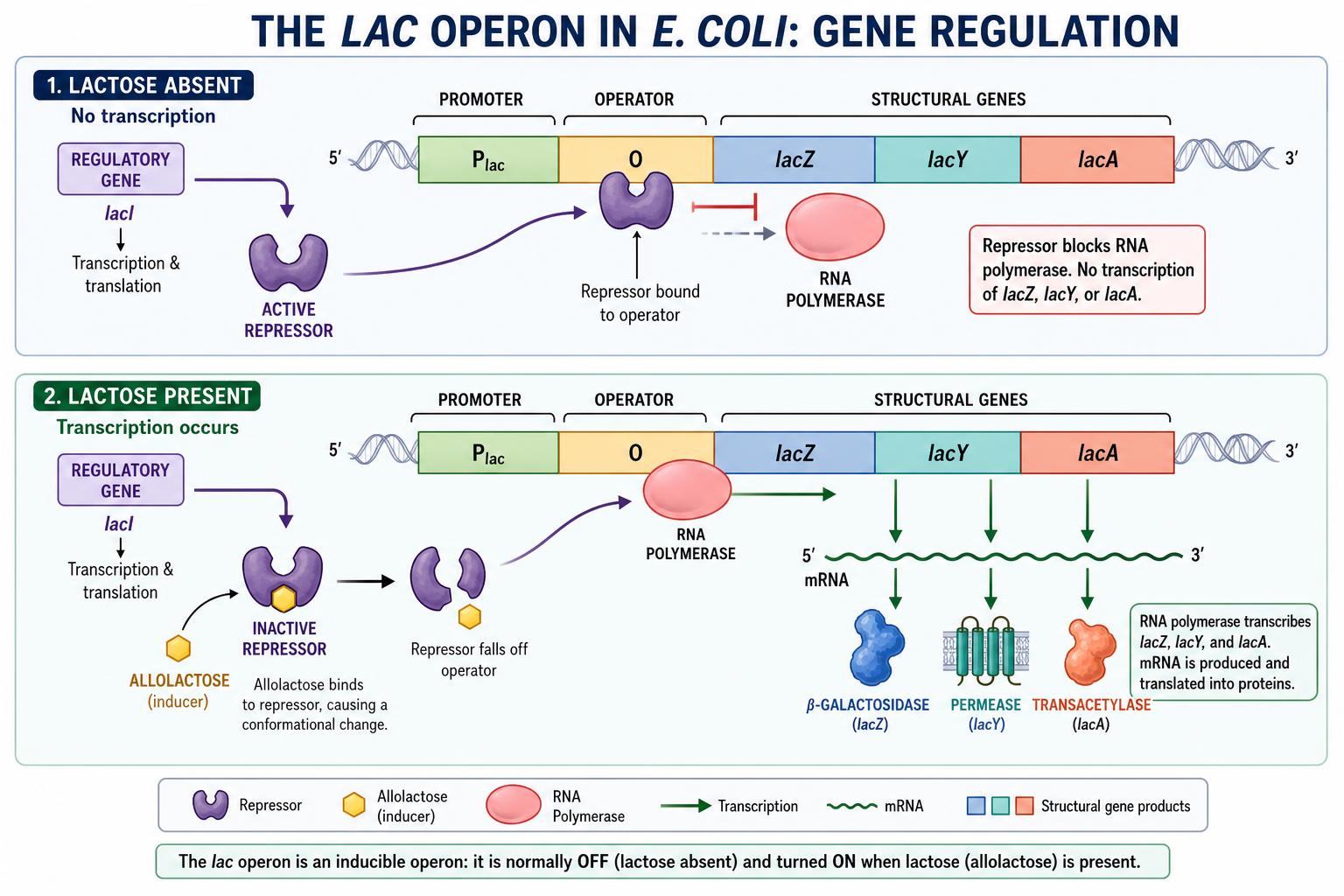
Why cells regulate gene expression
Every cell in a multicellular organism carries essentially the same DNA, yet a neuron, a liver cell, and a muscle cell look and behave nothing alike. The difference lies entirely in which genes are expressed, and when. Similarly, bacteria conserve energy and resources by only producing certain proteins (like enzymes for digesting a particular sugar) when those products are actually needed.
Prokaryotic operons
An operon is a cluster of functionally related genes controlled by a single promoter and regulated as one unit, allowing bacteria to respond quickly and efficiently to a changing environment.
The lac operon is inducible - it is OFF by default. When lactose is present, it (via allolactose) binds to the lac repressor protein and inactivates it, allowing RNA polymerase to transcribe the genes needed to metabolize lactose. The trp operon is repressible - it is ON by default, continuously producing tryptophan. When tryptophan accumulates, it binds the trp repressor and activates it, allowing it to bind the operator and shut transcription off.
Eukaryotic regulation: many more layers
Eukaryotic gene expression can be regulated at essentially every step: chromatin structure, transcription initiation, RNA processing, mRNA stability and export, translation, and post-translational protein modification and degradation.
Specific transcription factors bind promoter and enhancer sequences to recruit RNA polymerase and the rest of the transcription machinery. Enhancers can lie thousands of base pairs away from the gene they regulate; DNA bending and looping bring bound activator proteins into contact with the promoter complex.
Chromatin modification and epigenetics
- Histone acetylation: adding acetyl groups weakens the electrostatic attraction between histones and negatively charged DNA, loosening chromatin and making genes more accessible - generally increasing transcription.
- DNA methylation (adding a methyl group to cytosines, often in CpG islands): typically compacts chromatin and silences genes; methylation patterns can be copied during cell division and are sometimes inherited across generations.
- These modifications do not alter the underlying DNA sequence but can be passed on to daughter cells (and occasionally to offspring) - the study of such heritable, non-sequence-based changes is epigenetics.
Post-transcriptional and post-translational control
Beyond transcriptional control, cells regulate gene expression after the mRNA is made. Alternative splicing generates multiple protein products from a single gene. Small regulatory RNAs, such as microRNAs (miRNAs) and small interfering RNAs (siRNAs), bind complementary sequences on target mRNAs and can trigger their degradation or block their translation, providing a fast and reversible way to fine-tune protein output.
Key terms
4
- Operon
- A cluster of functionally related genes transcribed together under control of a single promoter (prokaryotes).
- Enhancer
- Distant regulatory DNA sequence that increases transcription when bound by activator proteins.
- Epigenetics
- Heritable changes in gene expression that do not alter the underlying DNA sequence.
- Transcription factor
- Protein that binds regulatory DNA sequences to help control transcription of specific genes.
Sign-off
Finish this lesson
A lesson only counts once you've read all the way through and completed every activity on the page.
- Read the full lesson (scroll to the end)
- Complete all activities (0/1 done)