
Translation
Ribosomes read mRNA codons and use tRNA to assemble amino acids into a polypeptide chain.
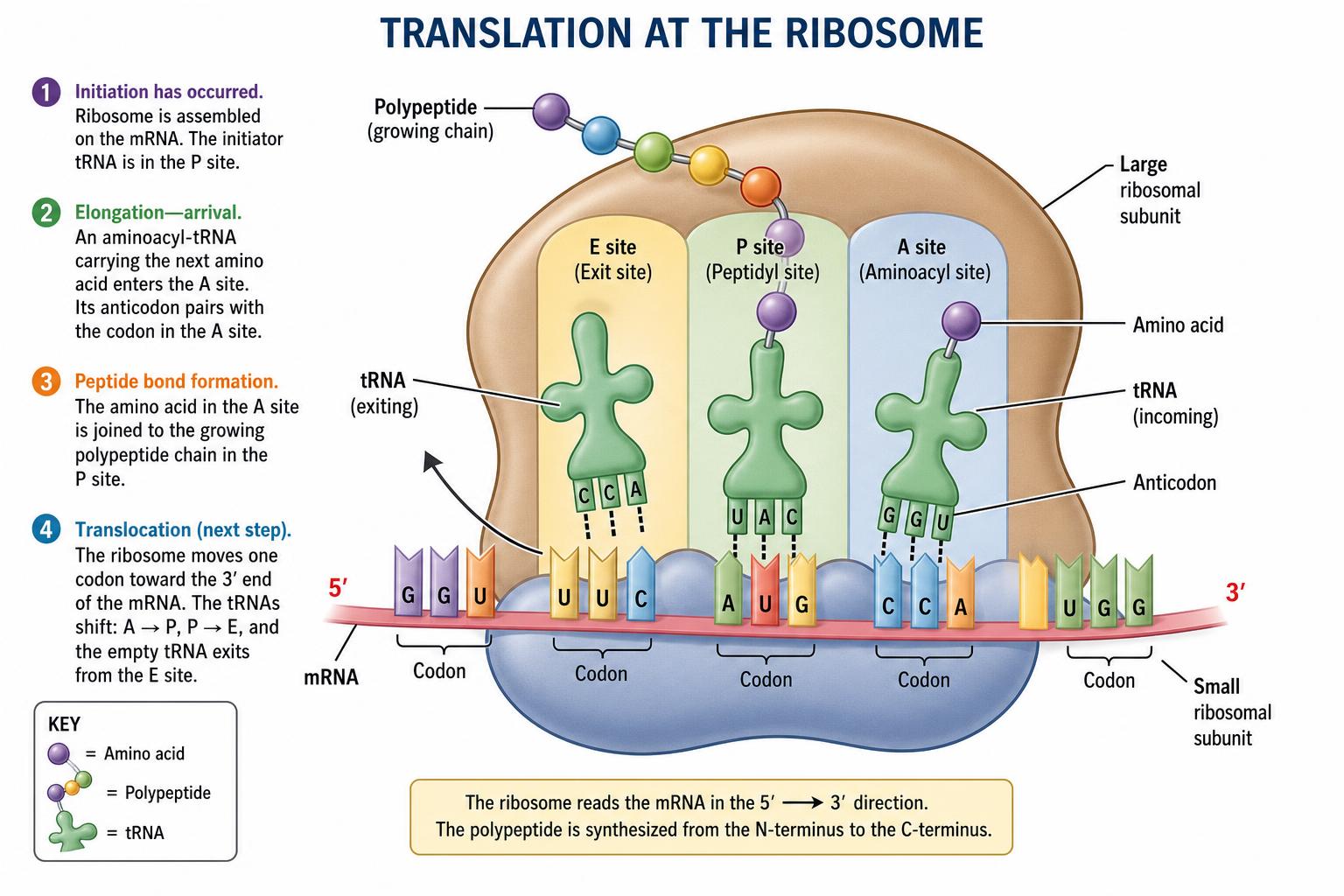
Setting up translation
Translation converts the nucleotide sequence of mRNA into the amino acid sequence of a polypeptide, using the ribosome as the site of synthesis. The small ribosomal subunit binds near the 5' end of the mRNA and scans until it finds the start codon, AUG, which also codes for the amino acid methionine. The large subunit then joins to complete a functional ribosome with three tRNA binding sites: A (aminoacyl, where new charged tRNAs enter), P (peptidyl, where the growing chain is held), and E (exit, where spent tRNA leaves).
Elongation: codon by codon
Each transfer RNA (tRNA) carries a specific amino acid on one end and an anticodon on the other that base-pairs with the complementary mRNA codon in the A site. Aminoacyl-tRNA synthetases are the enzymes responsible for charging each tRNA with its correct amino acid, using ATP for energy.
Once a correctly paired tRNA occupies the A site, the ribosome catalyzes formation of a peptide bond between the new amino acid and the growing polypeptide chain held by the tRNA in the P site. The ribosome then translocates one codon down the mRNA: the now-uncharged tRNA moves to the E site and exits, the peptide-bearing tRNA shifts from A to P, and a new codon is exposed in the A site for the cycle to repeat.
Termination and multiple ribosomes
Elongation continues until a stop codon (UAA, UAG, or UGA) enters the A site. No tRNA recognizes stop codons; instead, a release factor binds, prompting hydrolysis of the bond holding the polypeptide to the final tRNA and release of the completed protein along with dissociation of the ribosomal subunits.
A single mRNA is often translated simultaneously by multiple ribosomes traveling one behind another, forming a polyribosome (polysome) - this dramatically increases the rate of protein production from one transcript.
Post-translational modification
After (and sometimes during) translation, proteins are frequently modified before becoming fully functional: molecular chaperones assist proper folding, signal peptides direct proteins to specific organelles or for secretion, and enzymes may cleave off segments (e.g., the precursor proinsulin is cut to form active insulin) or attach chemical groups such as phosphates (phosphorylation), sugars (glycosylation), or lipids.
Key terms
4
- Codon
- Three-nucleotide sequence on mRNA that specifies one amino acid or a stop signal.
- Anticodon
- Three-nucleotide sequence on tRNA that base-pairs with a complementary mRNA codon.
- Ribosome
- Complex of rRNA and protein with small and large subunits that catalyzes polypeptide synthesis.
- Polypeptide
- Chain of amino acids linked by peptide bonds; folds into a functional protein.
Sign-off
Finish this lesson
A lesson only counts once you've read all the way through and completed every activity on the page.
- Read the full lesson (scroll to the end)
- Complete all activities (0/1 done)