
Plasma Membranes
The plasma membrane is a fluid mosaic of phospholipids and proteins that defines the cell and controls exchange with its environment.
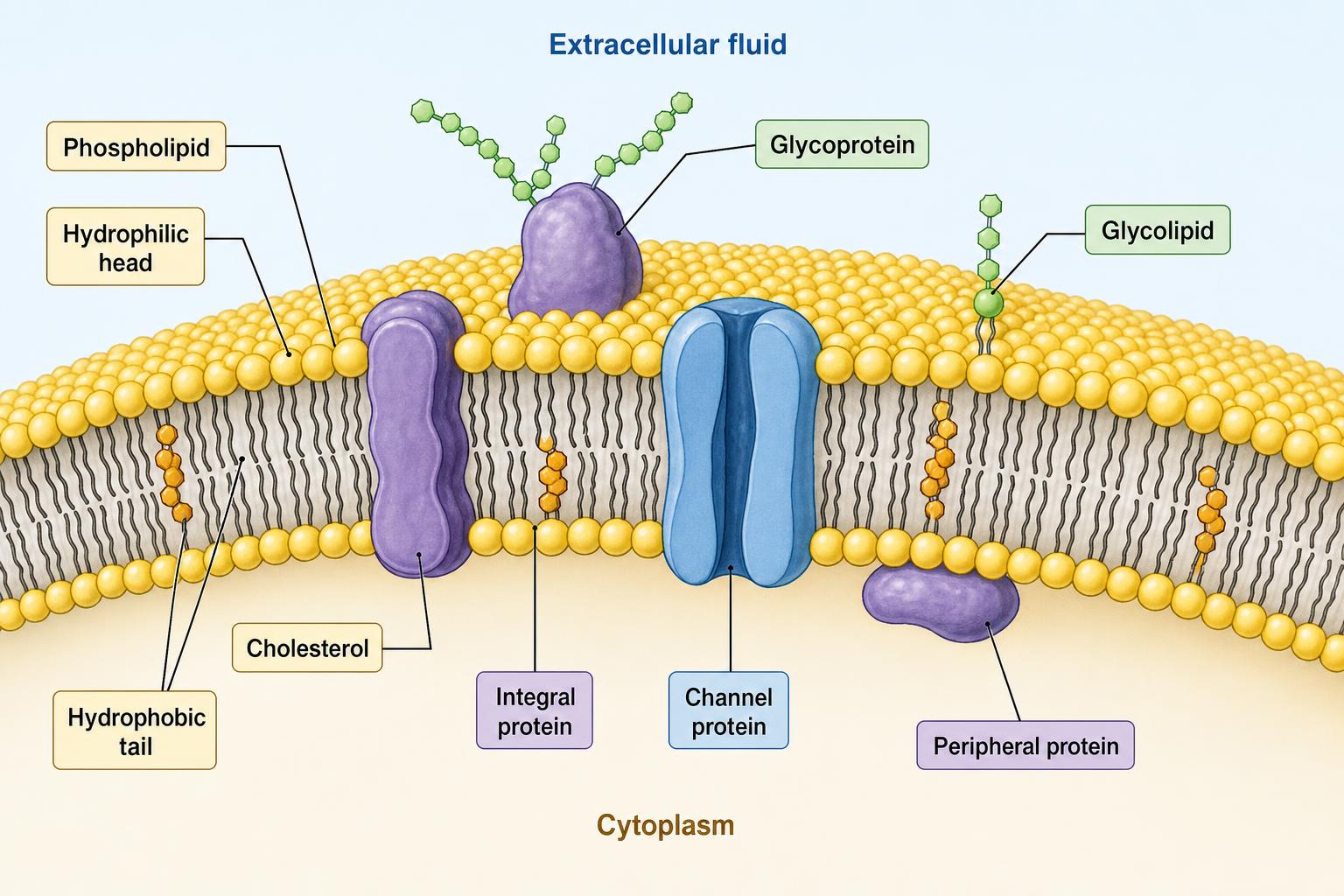
The phospholipid bilayer
Phospholipids are amphipathic molecules: a hydrophilic phosphate-containing head and two hydrophobic fatty acid tails. In water, they spontaneously self-assemble into a bilayer, with heads facing the aqueous cytoplasm and extracellular fluid, and tails clustered together away from water.
This bilayer forms a continuous, self-sealing sheet that defines the boundary of the cell (and of internal organelles). Because the interior is hydrophobic, the bilayer itself is a barrier to ions and polar molecules, while small nonpolar molecules can pass through relatively easily.
The mosaic of proteins
Embedded in the bilayer are integral membrane proteins, many of which span the entire membrane (transmembrane proteins) and function as channels, carriers, receptors, or enzymes. Peripheral proteins attach loosely to the membrane surface, often anchored to integral proteins or lipid heads, and play structural or signaling roles.
Carbohydrate chains attached to lipids (glycolipids) or proteins (glycoproteins) project from the outer surface of the membrane and serve as identity tags recognized by other cells - critical in tissue formation, immune recognition, and blood type determination.
Cholesterol and membrane fluidity
Cholesterol molecules are wedged between phospholipids in animal cell membranes. At high temperatures, cholesterol restrains phospholipid movement and reduces fluidity; at low temperatures, it prevents tight packing and keeps the membrane from solidifying.
Unsaturated fatty acid tails contain kinks from double bonds that prevent tight packing, keeping the membrane fluid at lower temperatures, while saturated tails pack tightly and make membranes more rigid. Organisms living in cold environments tend to have more unsaturated phospholipids in their membranes to maintain functional fluidity.
Membrane asymmetry and dynamic structure
The two leaflets of the bilayer are not identical - certain phospholipids, glycolipids, and proteins are found preferentially on one face, giving the membrane distinct inner and outer surfaces with different functional roles.
The membrane is constantly remodeled: proteins are inserted via the endomembrane system, lipids are exchanged, and patches of membrane are added or removed through exocytosis and endocytosis, making the plasma membrane a highly dynamic, self-repairing structure rather than a fixed wall.
Key terms
4
- Fluid mosaic model
- The model describing the plasma membrane as a fluid phospholipid bilayer with a mosaic of embedded proteins that can move laterally.
- Amphipathic
- Having both a hydrophilic region and a hydrophobic region, as in phospholipids.
- Integral protein
- A membrane protein embedded within, and often spanning, the phospholipid bilayer.
- Glycoprotein
- A protein with an attached carbohydrate chain, often used for cell-cell recognition on the membrane's outer surface.
Sign-off
Finish this lesson
A lesson only counts once you've read all the way through and completed every activity on the page.
- Read the full lesson (scroll to the end)
- Complete all activities (0/1 done)