
Cell Size
The surface area-to-volume ratio constrains how large a cell can grow while remaining metabolically efficient.
The geometry of the problem
Imagine a cell as a sphere of radius r. Its volume scales with r³, but its surface area scales only with r². As r increases, volume increases much faster than surface area, so the surface area-to-volume ratio (SA:V) steadily declines.
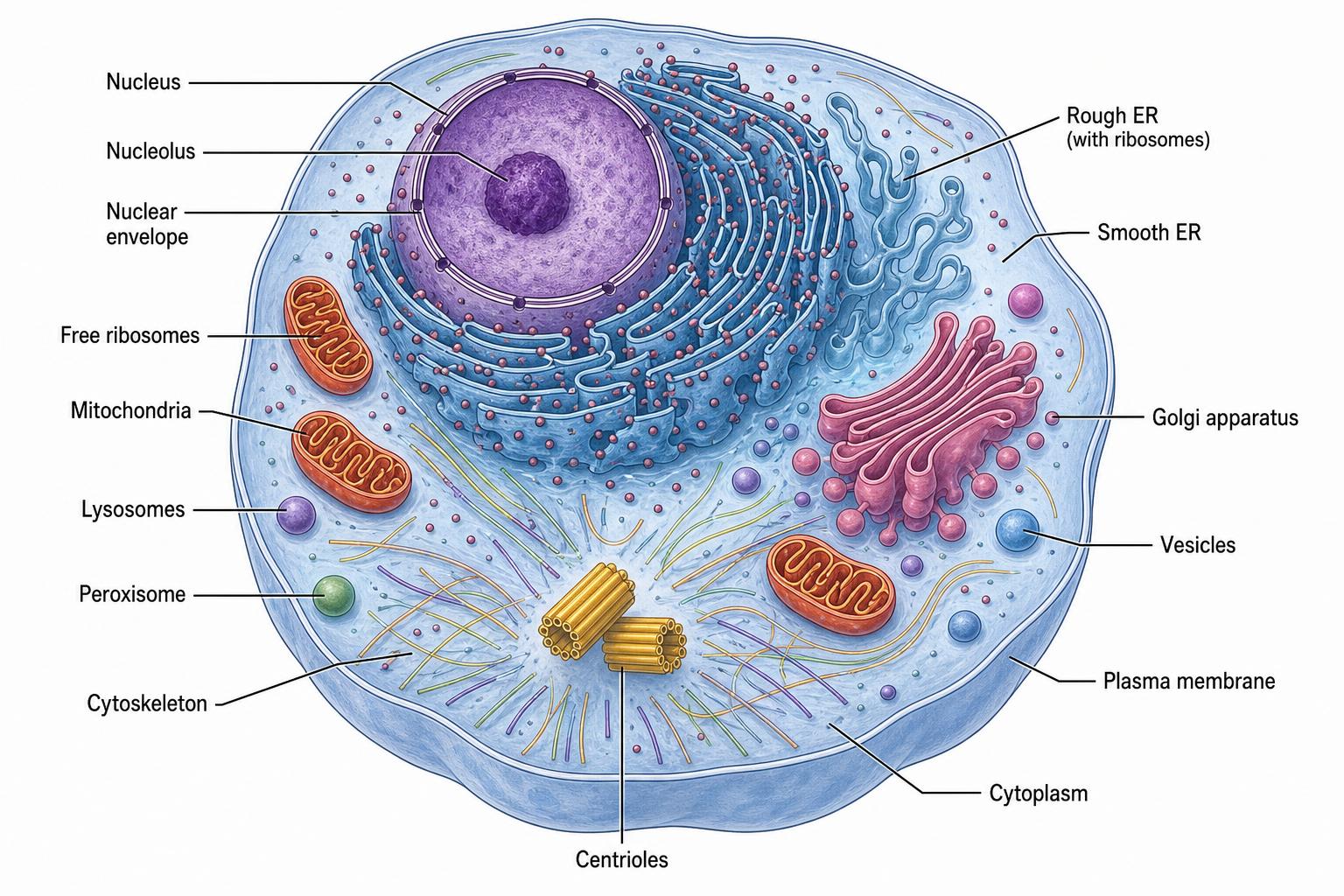
This matters because the plasma membrane is the cell's only interface with its environment - it is the surface across which nutrients enter, wastes exit, and gases like O₂ and CO₂ diffuse. A cell's cytoplasmic volume, however, is what generates the metabolic demand for those exchanges.
Why small cells are more efficient
A small cell has a high SA:V ratio, meaning it has abundant membrane surface relative to the volume that needs servicing. Materials can diffuse quickly across the short distance from the membrane to any point in the cytoplasm.
A hypothetically enormous cell would have a very low SA:V ratio: not enough membrane surface to import nutrients and export wastes fast enough, and diffusion distances so long that the interior would starve or accumulate toxic waste before materials could reach it. This is a major reason nearly all cells are microscopic.
Structural solutions to the SA:V problem
- Folding the membrane: microvilli on intestinal epithelial cells, cristae in mitochondria, and thylakoids in chloroplasts all increase surface area without increasing overall cell volume.
- Elongated or thin shapes: neurons can be very long without being 'large' in volume, keeping diffusion distances short across their thin diameter.
- Cytoplasmic streaming and internal compartmentalization: organelles bring specific reactions physically close to where materials are needed, reducing effective diffusion distances.
Multicellularity as an evolutionary solution
Rather than evolving one enormous, inefficient cell, most large organisms are built from vast numbers of small, specialized cells. This allows the organism as a whole to be large while every individual cell retains a favorable SA:V ratio for efficient exchange.
Multicellularity also allows division of labor: different cell types can specialize in transport, exchange, or structural support (e.g., blood cells, alveolar cells, root hair cells), each adapted with shape and structure suited to maximizing their particular exchange function.
Key terms
4
- Surface area-to-volume ratio
- The ratio of a cell's outer membrane area to its internal volume; it decreases as cell size increases.
- Microvilli
- Finger-like projections of the plasma membrane that increase surface area for absorption, as in intestinal cells.
- Diffusion distance
- The distance a molecule must travel within a cell; larger cells have longer, less efficient diffusion distances.
- Multicellularity
- An evolutionary strategy for increasing organismal size and complexity while keeping individual cells small and efficient.
Sign-off
Finish this lesson
A lesson only counts once you've read all the way through and completed every activity on the page.
- Read the full lesson (scroll to the end)
- Complete all activities (0/1 done)