
Cell Structure: Subcellular Components
Eukaryotic organelles are membrane-bound compartments that specialize distinct cellular functions.
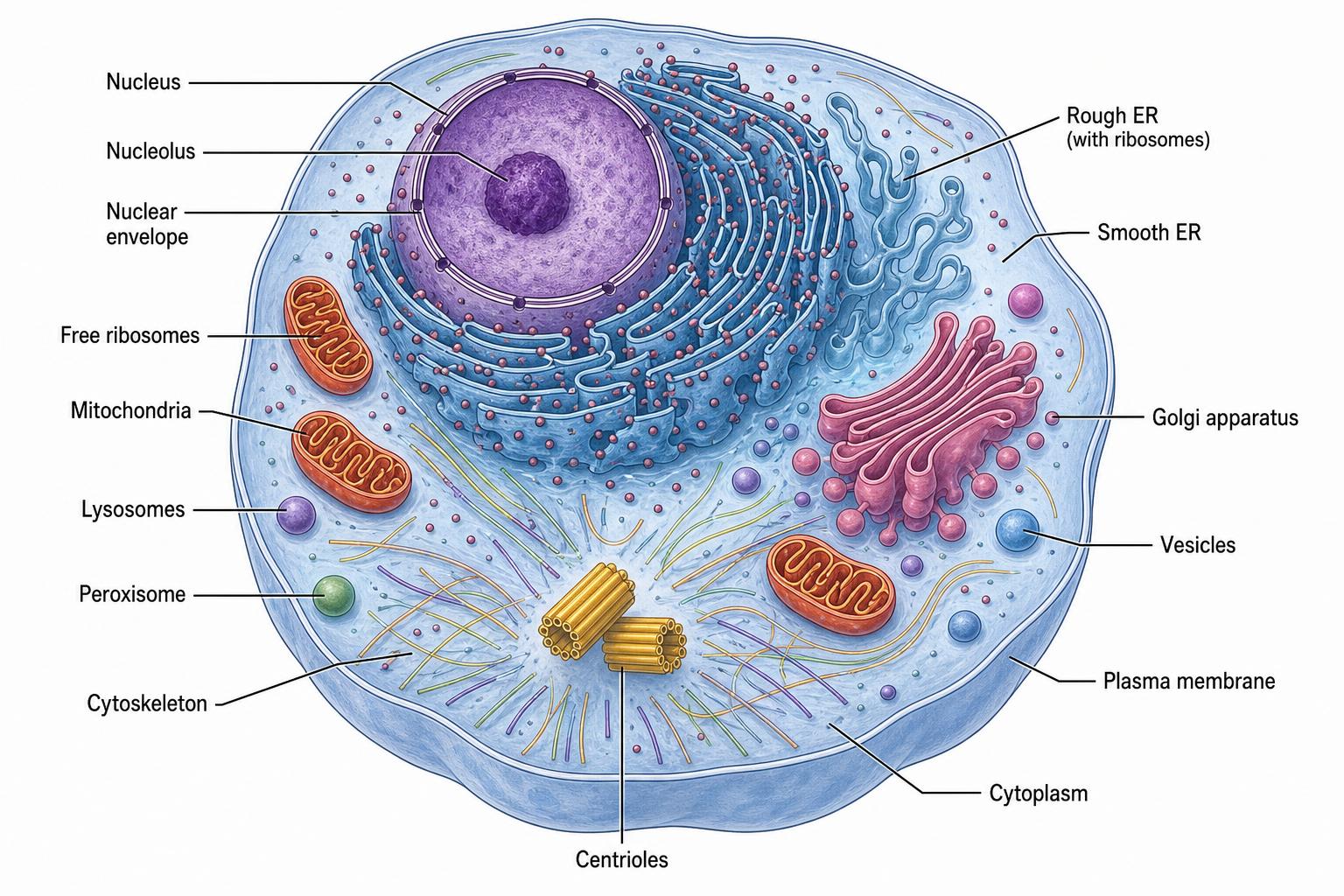
The nucleus and ribosomes: the information hub
The nucleus houses the cell's genetic material inside a double membrane called the nuclear envelope, which is perforated by nuclear pores that regulate the passage of RNA and proteins between the nucleus and cytoplasm. Within the nucleus, the nucleolus is a dense region where ribosomal RNA is transcribed and combined with proteins to form the large and small ribosomal subunits.
Ribosomes themselves are not membrane-bound organelles - they are ribonucleoprotein complexes found free in the cytosol or docked on the rough endoplasmic reticulum. Because every cell, prokaryotic or eukaryotic, must synthesize proteins, ribosomes are universal to all life, though eukaryotic ribosomes are somewhat larger than prokaryotic ones.
The endomembrane system
Rough ER is studded with ribosomes and specializes in synthesizing, folding, and initially glycosylating proteins destined for secretion, the plasma membrane, or lysosomes. Smooth ER lacks ribosomes and instead synthesizes lipids, metabolizes carbohydrates, detoxifies drugs and poisons (abundant in liver cells), and stores calcium ions (abundant in muscle cells for triggering contraction).
Proteins and lipids move from the ER to the Golgi apparatus via transport vesicles. The Golgi acts like a processing and shipping center: it modifies proteins (e.g., adding carbohydrate groups to form glycoproteins), sorts them by their final destination, and packages them into new vesicles.
Lysosomes are vesicles containing hydrolytic enzymes that function optimally at the acidic pH (~5) maintained inside them by proton pumps. They break down worn-out organelles in a process called autophagy, digest material taken in by phagocytosis, and in some cases trigger programmed cell death.
Energy-converting organelles
Mitochondria are the sites of cellular respiration, converting the chemical energy of glucose into ATP. They have a double membrane, with the inner membrane folded into cristae that dramatically increase the surface area available for the electron transport chain and ATP synthase.
Chloroplasts, found in plants and algae, are the sites of photosynthesis. The light reactions occur across the thylakoid membranes (stacked into grana), while the Calvin cycle occurs in the surrounding fluid, the stroma.
Plant-specific structures
- Cell wall: a rigid layer of cellulose outside the plasma membrane that provides structural support and prevents lysis when the cell is in a hypotonic environment.
- Central vacuole: a large, fluid-filled organelle that stores water, ions, pigments, and toxins; the turgor pressure it generates keeps non-woody plant tissue rigid.
- Plasmodesmata: cytoplasmic channels through adjacent cell walls that allow direct communication and transport of materials between neighboring plant cells.
The cytoskeleton
The cytoskeleton is a dynamic, ATP-dependent network of protein filaments that gives eukaryotic cells their shape, anchors organelles in place, and drives cell movement and division. It is not a static skeleton but is constantly assembled and disassembled.
Microfilaments (built of actin) support cell shape and drive muscle contraction and cytokinesis. Intermediate filaments provide mechanical strength and anchor the nucleus and other organelles. Microtubules (built of tubulin) serve as tracks for motor-protein-driven vesicle transport and form the mitotic spindle, as well as the core of cilia and flagella.
Key terms
4
- Endosymbiotic theory
- The theory that mitochondria and chloroplasts arose from free-living prokaryotes engulfed by an ancestral host cell.
- Endomembrane system
- The interconnected system of ER, Golgi, lysosomes, vacuoles, and plasma membrane that manufactures and transports proteins and lipids.
- Cytoskeleton
- A network of protein filaments (microfilaments, intermediate filaments, microtubules) that provides shape, support, and movement.
- Cristae
- Folds of the inner mitochondrial membrane that increase surface area for the electron transport chain.
Sign-off
Finish this lesson
A lesson only counts once you've read all the way through and completed every activity on the page.
- Read the full lesson (scroll to the end)
- Complete all activities (0/1 done)