
Membrane Permeability
The hydrophobic core of the membrane makes it selectively permeable, freely admitting some molecules while blocking others.
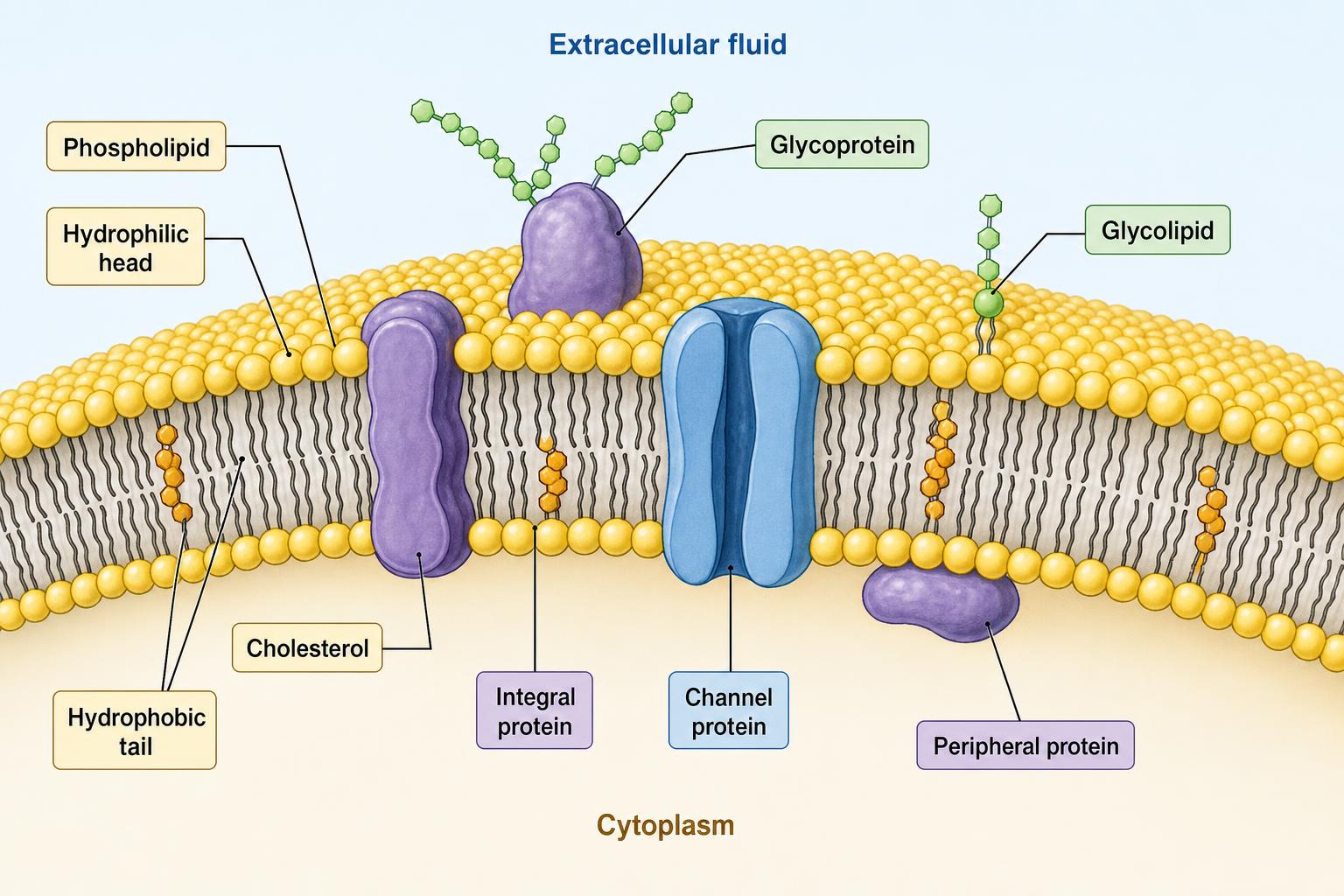
What determines permeability
A molecule's ability to cross the plasma membrane unaided depends primarily on its size, polarity, and charge. The hydrophobic fatty acid tails at the membrane's core present a significant energetic barrier to any molecule that is charged or has an uneven distribution of charge.
Small nonpolar molecules, such as O₂, CO₂, and N₂, dissolve readily in the lipid interior and diffuse directly across the membrane down their concentration gradients without any assistance from proteins. Small, uncharged polar molecules like water and, to a lesser extent, urea, can also cross, though more slowly, both directly through transient gaps in the bilayer and via dedicated channel proteins.
What cannot cross unaided
Ions such as Na⁺, K⁺, Ca²⁺, Cl⁻, and H⁺ carry a full charge and are strongly repelled by the nonpolar core; they require specific ion channels or active transporters to cross. Large polar molecules, including glucose and amino acids, are similarly excluded and depend on carrier proteins.
Macromolecules such as proteins, polysaccharides, and nucleic acids are far too large and polar to cross the bilayer at all; the cell must use bulk transport mechanisms like endocytosis and exocytosis to move them across the membrane boundary.
Consequences of selective permeability
Because the membrane is selectively rather than freely permeable, the cell can maintain an internal chemical environment that differs dramatically from its surroundings - for example, keeping intracellular Na⁺ low and K⁺ high relative to extracellular fluid.
This selective barrier is what makes it possible for cells to generate concentration gradients and membrane potentials that are essential for processes ranging from ATP synthesis to nerve impulse transmission. Without selective permeability, cells could not sustain the ordered, non-equilibrium internal state that defines living systems.
Key terms
4
- Selective permeability
- The property of the plasma membrane allowing some substances to cross more easily than others.
- Hydrophobic interior
- The nonpolar fatty acid tail region of the bilayer that impedes passage of ions and polar molecules.
- Nonpolar molecule
- A molecule lacking a significant charge separation, e.g., O2, CO2, and steroid hormones, which cross membranes readily.
- Polar molecule
- A molecule with unevenly distributed charge, e.g., glucose or water, that is impeded by the hydrophobic membrane interior.
Sign-off
Finish this lesson
A lesson only counts once you've read all the way through and completed every activity on the page.
- Read the full lesson (scroll to the end)
- Complete all activities (0/1 done)