
Membrane Transport
Cells move materials across membranes passively down gradients or actively against them using energy.
Two fundamental strategies
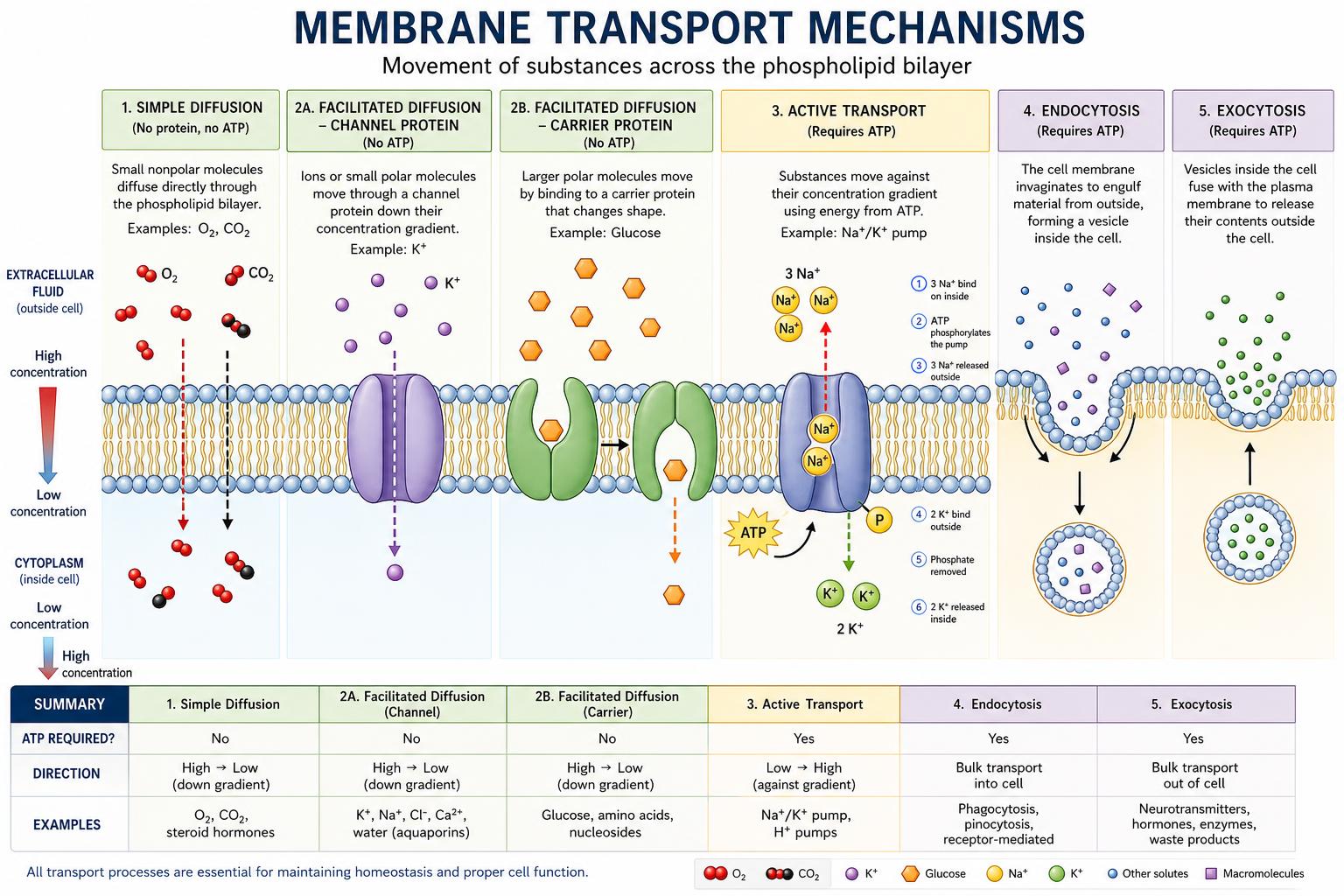
All membrane transport can be sorted into two broad strategies: moving with the gradient (passive, energetically favorable, spontaneous) or moving against the gradient (active, energetically unfavorable, requiring an input of energy). This mirrors the second law of thermodynamics - moving down a gradient increases entropy and releases free energy, while moving against a gradient decreases entropy and requires free energy input.
Which strategy a cell must use for a given solute is dictated entirely by the direction of the existing gradient relative to the direction the cell needs the solute to move - the same protein or pathway is never simultaneously 'passive' and 'active' for the same solute.
Passive transport in overview
- Simple diffusion: nonpolar molecules move directly through the bilayer down their gradient (e.g., O₂ into a respiring cell).
- Facilitated diffusion: polar molecules and ions move down their gradient through channel or carrier proteins.
- Osmosis: water moves down its own gradient (toward higher solute concentration) often assisted by aquaporins.
Active transport in overview
Active transport requires a source of energy because it moves solutes from an area of lower concentration to an area of higher concentration - an energetically uphill process. This energy typically comes from direct ATP hydrolysis (primary active transport) or from an existing ion gradient built by a primary pump (secondary active transport).
The sodium-potassium pump is the archetypal example: it hydrolyzes one ATP to export three Na⁺ ions and import two K⁺ ions per cycle, building steep electrochemical gradients that the cell later 'spends' to power other processes, such as nutrient uptake and electrical signaling in neurons.
Bulk transport
When cargo is too large to move through individual channel or carrier proteins, cells use bulk transport, which packages material into membrane-bound vesicles. Endocytosis brings material into the cell (phagocytosis for large particles, pinocytosis for fluid, and receptor-mediated endocytosis for specific molecules), while exocytosis releases material from the cell by fusing a vesicle with the plasma membrane.
Both endocytosis and exocytosis require ATP to power the cytoskeletal rearrangements and membrane fusion events involved, placing bulk transport in the broader category of energy-requiring processes even though individual molecules within the vesicle are not being pumped against a gradient one at a time.
Key terms
4
- Passive transport
- Movement of substances across a membrane down their concentration gradient without expenditure of cellular energy.
- Active transport
- Movement of substances across a membrane against their gradient, requiring ATP or another energy source.
- Concentration gradient
- A difference in the concentration of a substance across space, such as across a membrane.
- Bulk transport
- Movement of large molecules or particles across the membrane via vesicles, including endocytosis and exocytosis.
Sign-off
Finish this lesson
A lesson only counts once you've read all the way through and completed every activity on the page.
- Read the full lesson (scroll to the end)
- Complete all activities (0/1 done)