
Facilitated Diffusion
Facilitated diffusion uses channel and carrier proteins to passively move polar or charged solutes down their gradient.
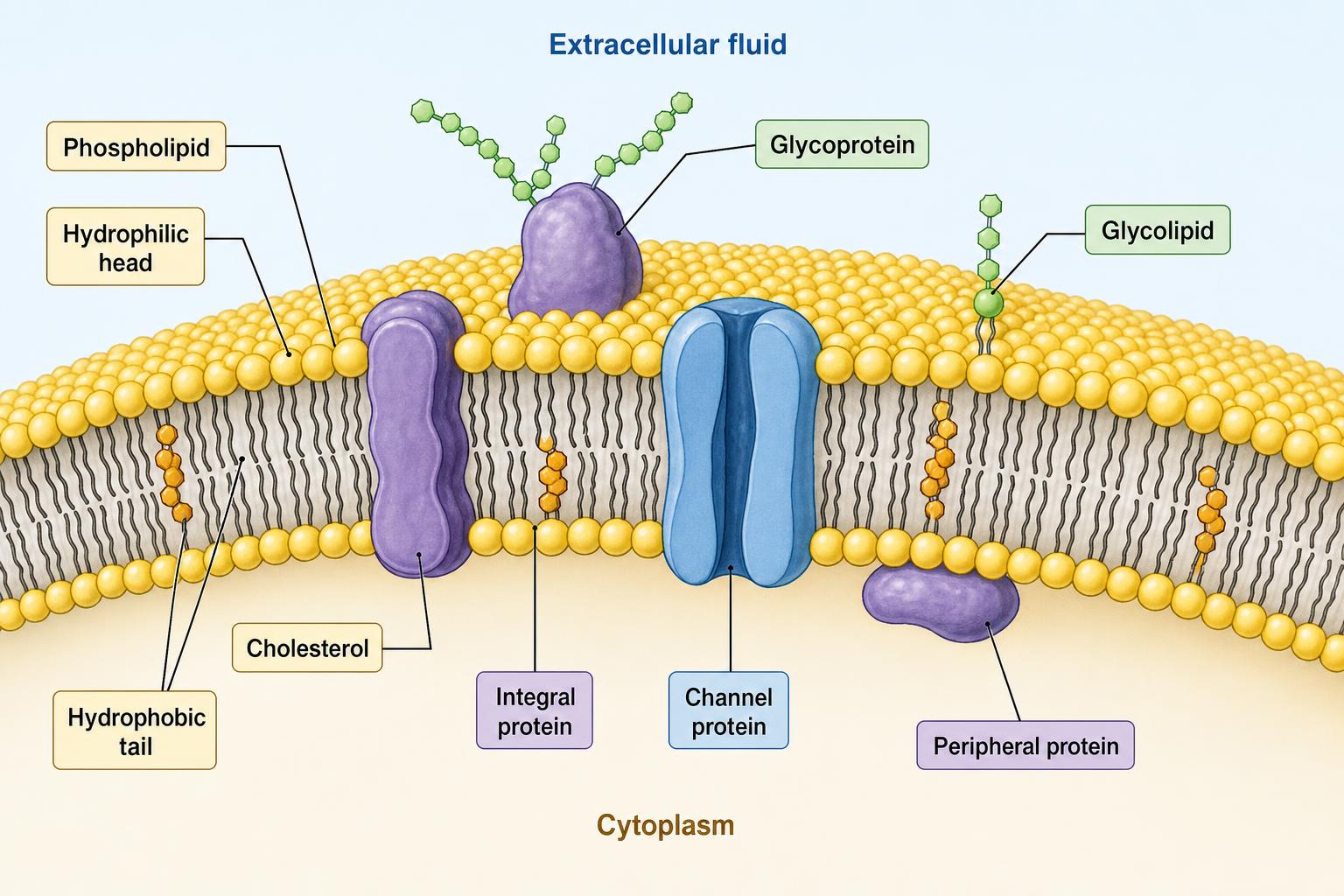
Why facilitation is needed
Many biologically important solutes - glucose, amino acids, and ions such as Na⁺, K⁺, and Cl⁻ - are too polar or charged to cross the hydrophobic membrane interior at a biologically useful rate on their own. Facilitated diffusion solves this by providing a hydrophilic passageway through the membrane, allowing these solutes to move down their existing concentration gradient far faster than unassisted diffusion would allow.
Crucially, facilitated diffusion is still a passive process: because the solute is moving from high to low concentration, no ATP is consumed. The protein simply lowers the activation energy barrier for crossing the membrane; it does not push the solute against its gradient.
Channel proteins
Channel proteins form continuous, water-filled pores across the membrane. Some are always open (leak channels), while others are gated - opening or closing in response to a stimulus such as a change in voltage (voltage-gated channels), the binding of a signaling molecule (ligand-gated channels), or mechanical stress (mechanically gated channels).
Aquaporins are a specialized class of channel protein that dramatically increases the permeability of a membrane to water, which is essential in cells like kidney tubule cells that must move large volumes of water quickly.
Carrier proteins
Unlike channels, carrier proteins do not form an open pore. Instead, the solute binds to a specific site on the carrier, triggering a conformational change that shuttles the solute from one side of the membrane to the other before releasing it. GLUT transporters that move glucose into cells are a classic example.
Because carrier-mediated transport depends on a limited number of binding sites and requires a conformational cycle, its rate can saturate: once all carrier proteins are occupied, increasing the solute's concentration gradient no longer increases the rate of transport, unlike simple diffusion, which increases in rate roughly proportionally to the gradient.
Key terms
4
- Facilitated diffusion
- Passive movement of a solute across a membrane down its concentration gradient, assisted by a channel or carrier protein.
- Channel protein
- A membrane protein that forms a hydrophilic pore allowing specific ions or molecules to diffuse across the membrane.
- Carrier protein
- A membrane transport protein that binds a specific solute and undergoes a conformational change to move it across the membrane.
- Aquaporin
- A channel protein that greatly increases the rate of water diffusion across the plasma membrane.
Sign-off
Finish this lesson
A lesson only counts once you've read all the way through and completed every activity on the page.
- Read the full lesson (scroll to the end)
- Complete all activities (0/1 done)