
Mendelian Genetics
Mendel's laws of segregation and independent assortment, and the tools (Punnett squares, test crosses, probability, chi-square) used to predict and test inheritance patterns.
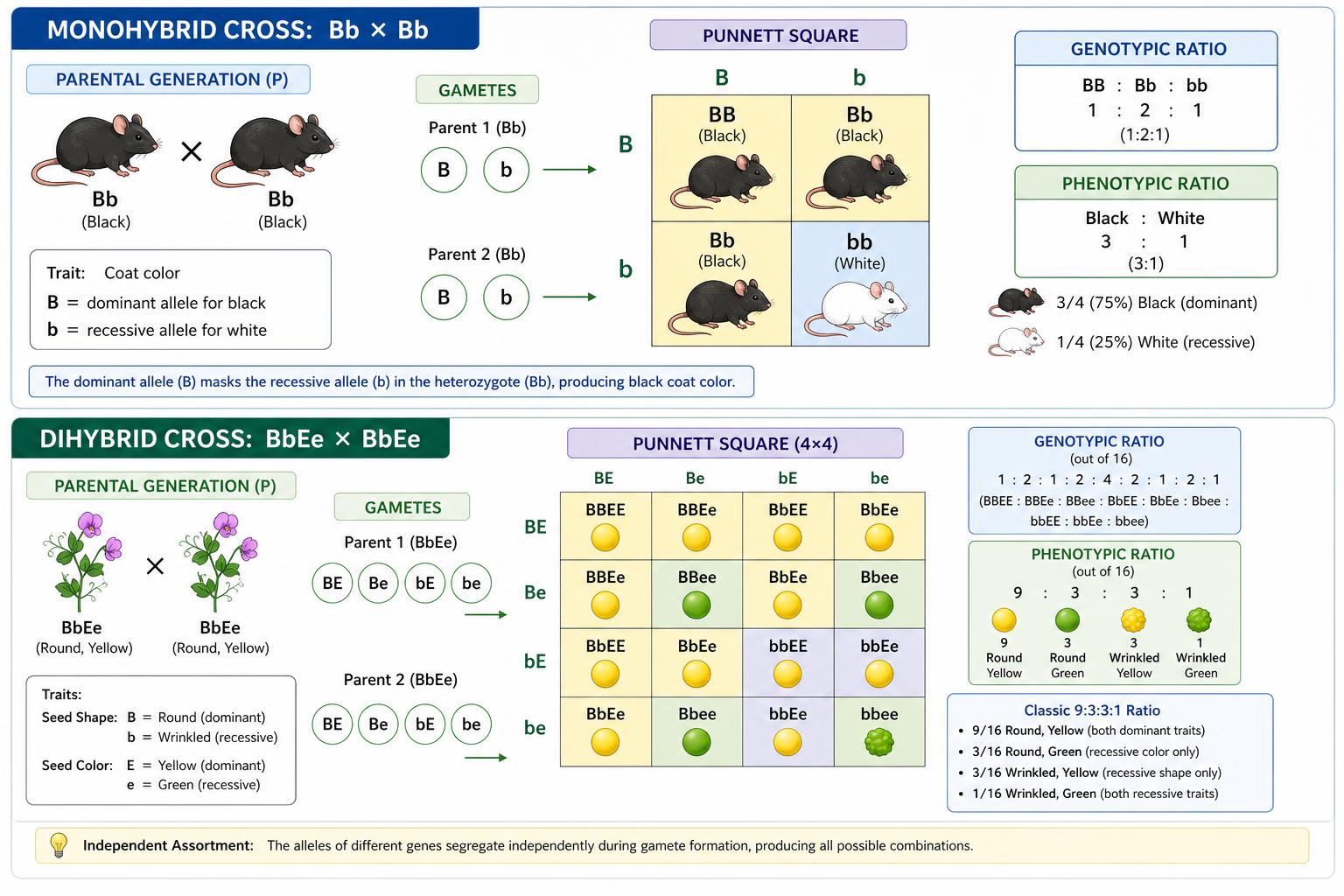
Mendel's two laws
Gregor Mendel's pea plant experiments revealed that hereditary information is passed as discrete particles (now called genes), not through blending. The Law of Segregation states that each individual carries two alleles for each gene, one from each parent, and that these two alleles segregate from each other during meiosis I so that each gamete receives only one.
The Law of Independent Assortment states that alleles for different genes, provided the genes are on different chromosomes (or far apart on the same one), sort into gametes independently of one another. This is a direct consequence of the random orientation of different tetrads at metaphase I. Together, these laws predict that a monohybrid cross (Aa × Aa) yields a 3:1 phenotypic ratio, while a dihybrid cross (AaBb × AaBb) yields a 9:3:3:1 phenotypic ratio.
Punnett squares
A Punnett square is a grid used to predict the genotypes and phenotypes of offspring from a cross. Possible gametes from one parent are listed along the top, gametes from the other parent along the side, and each interior cell represents one equally likely fertilization outcome.
For a monohybrid cross Aa × Aa, the square gives genotypes in a 1 AA : 2 Aa : 1 aa ratio, which translates to a 3:1 phenotypic ratio if A is completely dominant. For a dihybrid cross AaBb × AaBb, a 4×4 square (16 boxes) yields the classic 9:3:3:1 phenotypic ratio, assuming the two genes assort independently.
Test crosses
An organism showing a dominant phenotype could be homozygous dominant (AA) or heterozygous (Aa) - the phenotype alone cannot distinguish them. A test cross resolves this ambiguity by mating the unknown individual with a homozygous recessive (aa) partner.
If all offspring display the dominant phenotype, the unknown parent was almost certainly AA. If roughly half the offspring show the recessive phenotype, the unknown parent must have been Aa, since only a heterozygote can pass on a recessive allele.
Probability rules in genetics
- Product rule (multiplication): the probability that two independent events both occur equals the product of their individual probabilities; used for 'AND' situations, such as combining outcomes at two separate gene loci.
- Sum rule (addition): the probability that either of two mutually exclusive events occurs equals the sum of their individual probabilities; used for 'OR' situations, such as two different genotypes that produce the same phenotype.
- Example: In a cross AaBb × AaBb, the probability of an aabb offspring is P(aa) × P(bb) = 1/4 × 1/4 = 1/16.
The chi-square (χ²) test
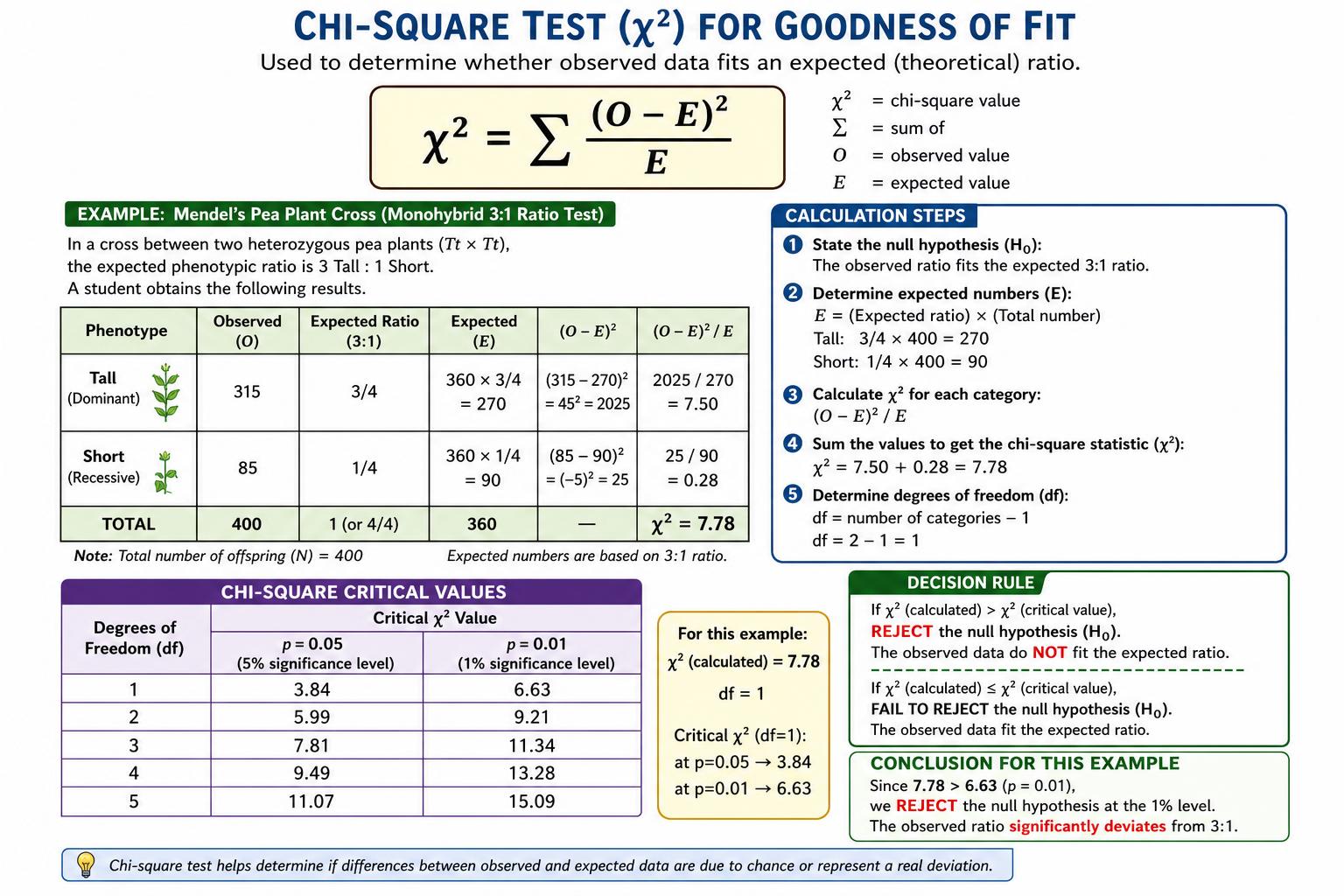
Chi-square analysis is a statistical tool used to determine whether observed offspring ratios differ significantly from the ratios predicted by a genetic hypothesis (such as 3:1 or 9:3:3:1), or whether the deviation could plausibly be due to chance sampling error.
The test statistic is calculated as χ² = Σ (observed − expected)² / expected, summed across all phenotypic categories. This value is compared to a critical value from a chi-square distribution table at the appropriate degrees of freedom (df = number of categories − 1) and a chosen significance level (typically p = 0.05).
If the calculated χ² exceeds the critical value, the null hypothesis (that the data fit the expected ratio) is rejected, suggesting some factor other than simple Mendelian inheritance - such as linkage, lethal alleles, or experimental error - may be at play.
Key terms
4
- Allele
- One of the alternative versions of a gene that may produce distinguishable phenotypic effects.
- Homozygous
- Having two identical alleles for a gene.
- Heterozygous
- Having two different alleles for a gene.
- Test cross
- A cross between an individual of unknown genotype and a homozygous recessive individual, used to reveal the unknown genotype.
Sign-off
Finish this lesson
A lesson only counts once you've read all the way through and completed every activity on the page.
- Read the full lesson (scroll to the end)
- Complete all activities (0/2 done)