
Non-Mendelian Genetics
Many traits deviate from simple dominant/recessive inheritance through incomplete dominance, codominance, multiple alleles, sex linkage, linked genes, and polygenic inheritance.
Incomplete dominance and codominance
Mendel's pea traits happened to show complete dominance, but many real traits do not. In incomplete dominance, the heterozygote's phenotype is a blend intermediate between the two homozygous phenotypes - for example, a cross between red-flowered and white-flowered snapdragons produces pink-flowered heterozygotes, because pigment production is only partially dosage-dependent.
In codominance, by contrast, the heterozygote displays both parental phenotypes fully and distinctly rather than blended. Human AB blood type is codominant: individuals with genotype IᴬIᴮ express both A and B surface antigens on their red blood cells simultaneously. Roan cattle coats, showing distinct patches of red and white hair, are another classic example.
Multiple alleles: ABO blood typing
While any single diploid individual carries only two alleles for a gene, more than two alleles can exist within a population - this is called multiple allelism. The human ABO blood group gene has three common alleles: Iᴬ and Iᴮ, which are codominant with each other, and i, which is recessive to both.
This produces four phenotypes from six possible genotypes: type A (IᴬIᴬ or Iᴬi), type B (IᴮIᴮ or Iᴮi), type AB (IᴬIᴮ), and type O (ii). Because the underlying genotype cannot always be determined from phenotype alone (e.g., type A could be IᴬIᴬ or Iᴬi), pedigree analysis or test crosses may be needed.
Sex-linked inheritance
Genes located on the X chromosome show inheritance patterns distinct from autosomal genes because males (XY) have only a single copy of the X chromosome while females (XX) have two. A recessive X-linked allele is therefore always expressed in males, since there is no second X allele to mask it, but is only expressed in females who are homozygous recessive.
This explains why X-linked recessive conditions such as red-green color blindness and hemophilia occur far more frequently in men than women. A carrier mother (heterozygous, XᴬXᵃ) has a 50% chance of passing the recessive allele to each son (who would then be affected) and a 50% chance of passing it to each daughter (who would become a carrier). An affected father passes his X-linked allele to all of his daughters (making them at least carriers) but to none of his sons, since sons receive his Y chromosome.
Linked genes and recombination
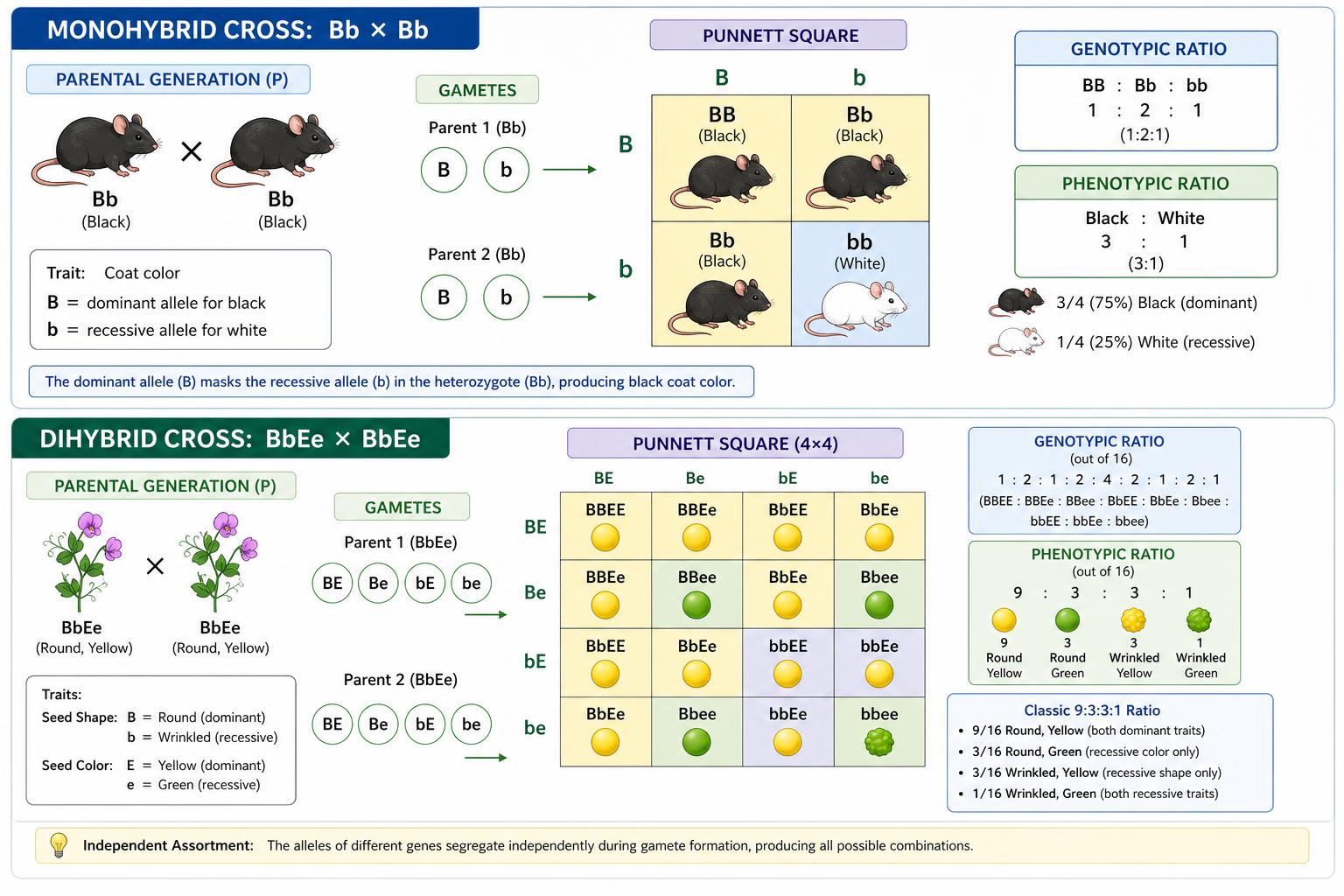
Genes located near each other on the same chromosome do not assort independently - they tend to be inherited together as a unit because they are physically connected, a phenomenon called linkage. This means crosses involving linked genes produce phenotype ratios that deviate from the Mendelian 9:3:3:1 expectation, with parental-type combinations overrepresented.
Crossing over during prophase I can separate linked genes, producing recombinant gametes. The recombination frequency - calculated as (number of recombinant offspring ÷ total offspring) × 100% - increases with the physical distance between two genes on a chromosome, since there is more opportunity for a crossover to occur between them. This relationship is the basis of genetic linkage maps, where 1% recombination frequency is defined as one map unit (centimorgan).
Polygenic inheritance
Many important traits - human height, skin color, and eye color among them - are polygenic, meaning they are influenced by two or more genes, often at different loci, each contributing a small additive effect to the phenotype. Rather than falling into a few discrete categories, polygenic traits typically display continuous variation across a population, producing a bell-shaped (normal) distribution when phenotype is plotted against frequency.
Because so many genes and their combinations contribute, the more genes involved in a trait, the smoother and more continuous the resulting phenotypic distribution tends to appear.
Key terms
4
- Incomplete dominance
- Heterozygote phenotype is an intermediate blend between the two homozygous phenotypes.
- Codominance
- Both alleles are fully and separately expressed in the heterozygote.
- Sex-linked gene
- A gene located on a sex chromosome, most commonly the X chromosome.
- Recombination frequency
- The percentage of offspring that are recombinant, used to estimate the map distance between two linked genes.
Sign-off
Finish this lesson
A lesson only counts once you've read all the way through and completed every activity on the page.
- Read the full lesson (scroll to the end)
- Complete all activities (0/1 done)