
Meiosis and Genetic Diversity
Crossing over, independent assortment, and random fertilization together generate the enormous genetic diversity that fuels evolution.
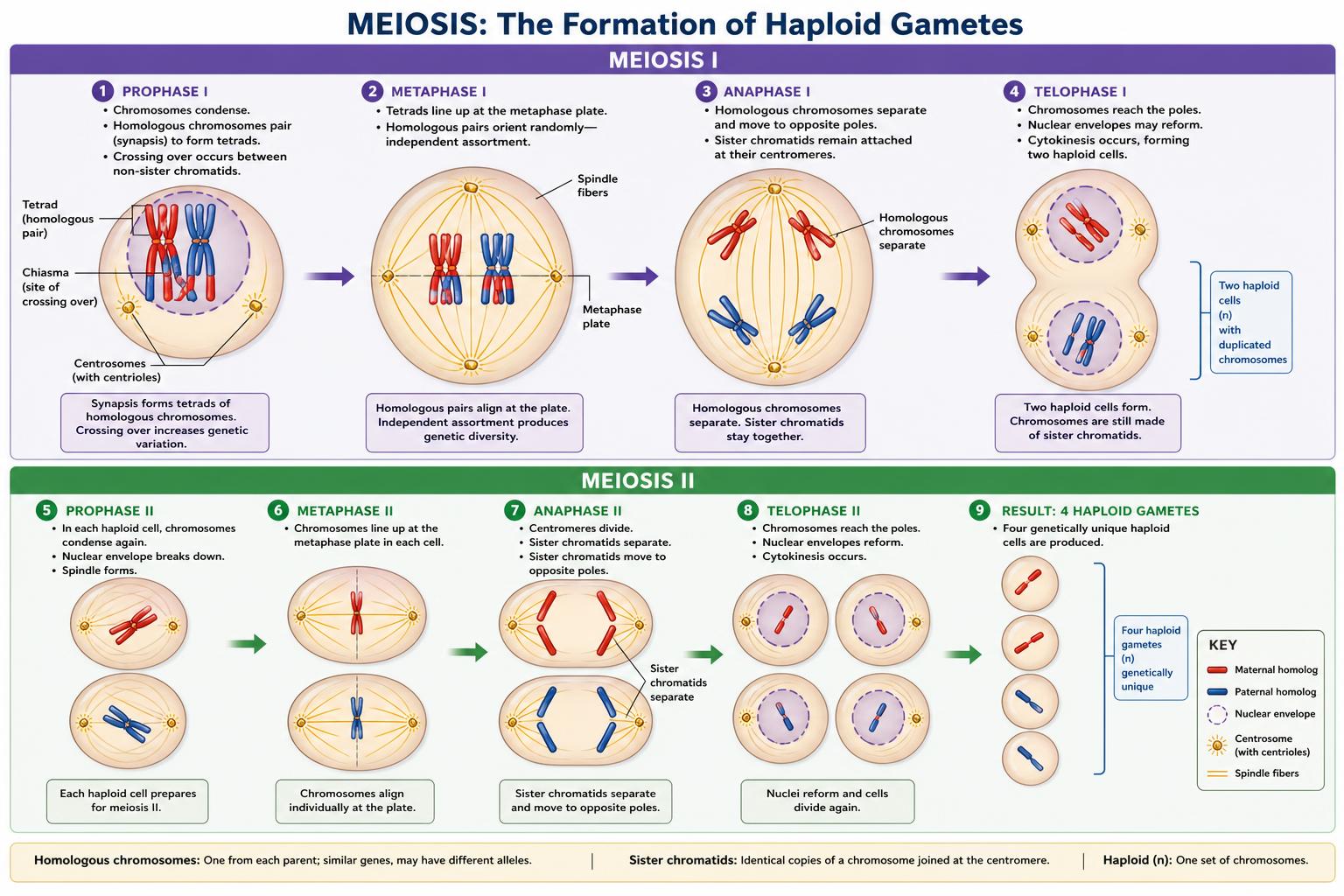
Crossing over generates new allele combinations
During prophase I, homologous chromosomes pair tightly at synapsis, and enzyme complexes catalyze physical breakage and rejoining of non-sister chromatids at chiasmata. This exchange recombines maternal and paternal alleles onto the same chromosome, creating recombinant chromatids that carry combinations of alleles never present together in either parent.
Because crossover locations are essentially random along the chromosome, genes that are far apart are more likely to be separated by a crossover than genes that sit close together. This relationship underlies genetic mapping (covered under linkage), but for genetic diversity purposes, the key takeaway is that crossing over multiplies variation within each individual chromosome.
Independent assortment shuffles whole chromosomes
At metaphase I, each tetrad orients on the metaphase plate independently of the others - whether the maternally-inherited or paternally-inherited homolog faces a given pole is a coin flip for each chromosome pair, unaffected by how other pairs oriented. This means the set of chromosomes that ends up in a gamete is essentially a random mix of maternal and paternal chromosomes.
For an organism with n pairs of chromosomes, there are 2ⁿ possible chromosome combinations in the gametes purely from independent assortment. Humans have 23 pairs, so 2²³ ≈ 8.4 million distinct combinations are possible - before crossing over is even considered.
Random fertilization compounds the variation
Fertilization is the fusion of any one of the huge variety of possible sperm with any one of the huge variety of possible eggs. Since each gamete is already one of millions of possible genetic combinations, the resulting zygote's genotype represents the product of two independent, essentially random samples - 8.4 million × 8.4 million possible combinations from independent assortment alone in humans, ignoring crossing over entirely.
Together, crossing over, independent assortment, and random fertilization explain why full (non-twin) siblings share genes but are never genetically identical, and why sexual reproduction generates so much heritable variation for natural selection to act upon.
Key terms
4
- Crossing over
- Reciprocal exchange of DNA segments between non-sister chromatids of homologous chromosomes during prophase I.
- Independent assortment
- Random orientation of each tetrad at metaphase I, so the distribution of maternal/paternal chromosomes to gametes is independent for each chromosome pair.
- Recombinant chromosome
- A chromosome containing a new combination of maternal and paternal alleles due to crossing over.
- Genetic diversity
- The variety of alleles and genotypes present in a population.
Sign-off
Finish this lesson
A lesson only counts once you've read all the way through and completed every activity on the page.
- Read the full lesson (scroll to the end)
- Complete all activities (0/1 done)