
Meiosis
Meiosis is a two-division process that halves chromosome number to produce haploid gametes.
Why meiosis exists
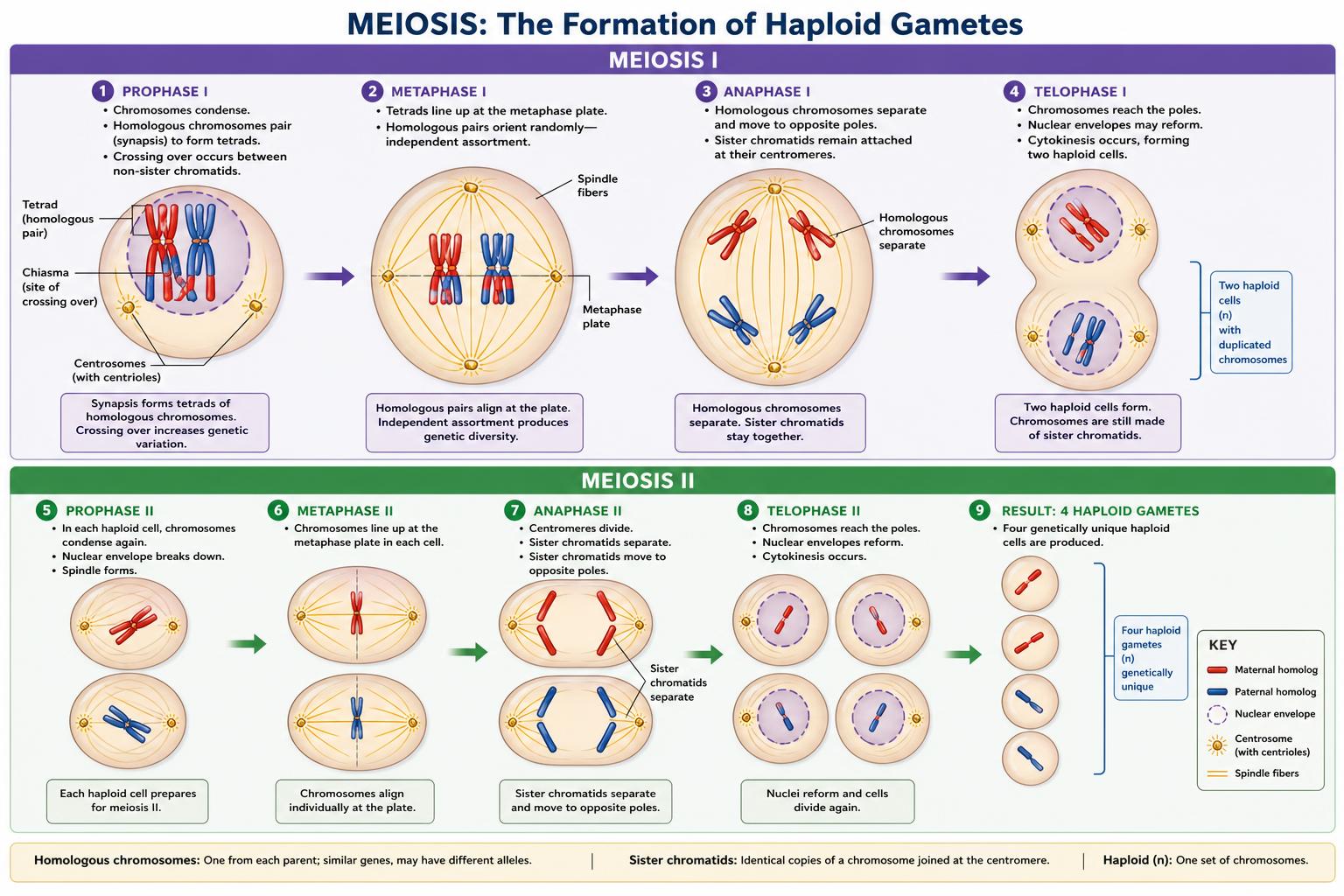
Sexually reproducing organisms need a mechanism to halve the chromosome number when making gametes so that fertilization restores, rather than doubles, the diploid chromosome count each generation. Meiosis accomplishes this with a single round of DNA replication (in S phase) followed by two successive rounds of nuclear division.
A diploid (2n) germ-line cell that undergoes meiosis produces four haploid (n) cells. Because of the mechanics of the two divisions, plus recombination, these four products are genetically distinct from one another and from the parent cell.
Meiosis I: the reductional division
After replication, each chromosome consists of two sister chromatids. In prophase I, homologous chromosomes find each other and pair up along their length in a process called synapsis, forming a four-chromatid structure called a tetrad (or bivalent). While paired, non-sister chromatids can exchange segments of DNA - crossing over - at sites called chiasmata.
At metaphase I, tetrads (not single chromosomes) line up at the metaphase plate. The orientation of each tetrad - which homolog faces which pole - is random and independent of every other tetrad's orientation, a phenomenon called independent assortment. At anaphase I, homologous chromosomes are pulled to opposite poles; sister chromatids remain attached at their centromere and move together.
The result of meiosis I is two cells, each containing n chromosomes, but each of those chromosomes still consists of two sister chromatids (possibly no longer identical, thanks to crossing over).
Meiosis II: the equational division
Meiosis II closely resembles a mitotic division, except it begins with haploid cells and there is no DNA replication beforehand. Sister chromatids align at the metaphase plate during metaphase II, and at anaphase II the centromeres split, sending individual chromatids - now considered full chromosomes - to opposite poles.
The end result of the complete meiotic sequence is four haploid cells, each with a single copy of each chromosome. In animals, meiosis in males (spermatogenesis) produces four functional sperm, while in females (oogenesis) unequal cytokinesis typically yields one large egg and smaller polar bodies that degrade.
Mitosis versus meiosis
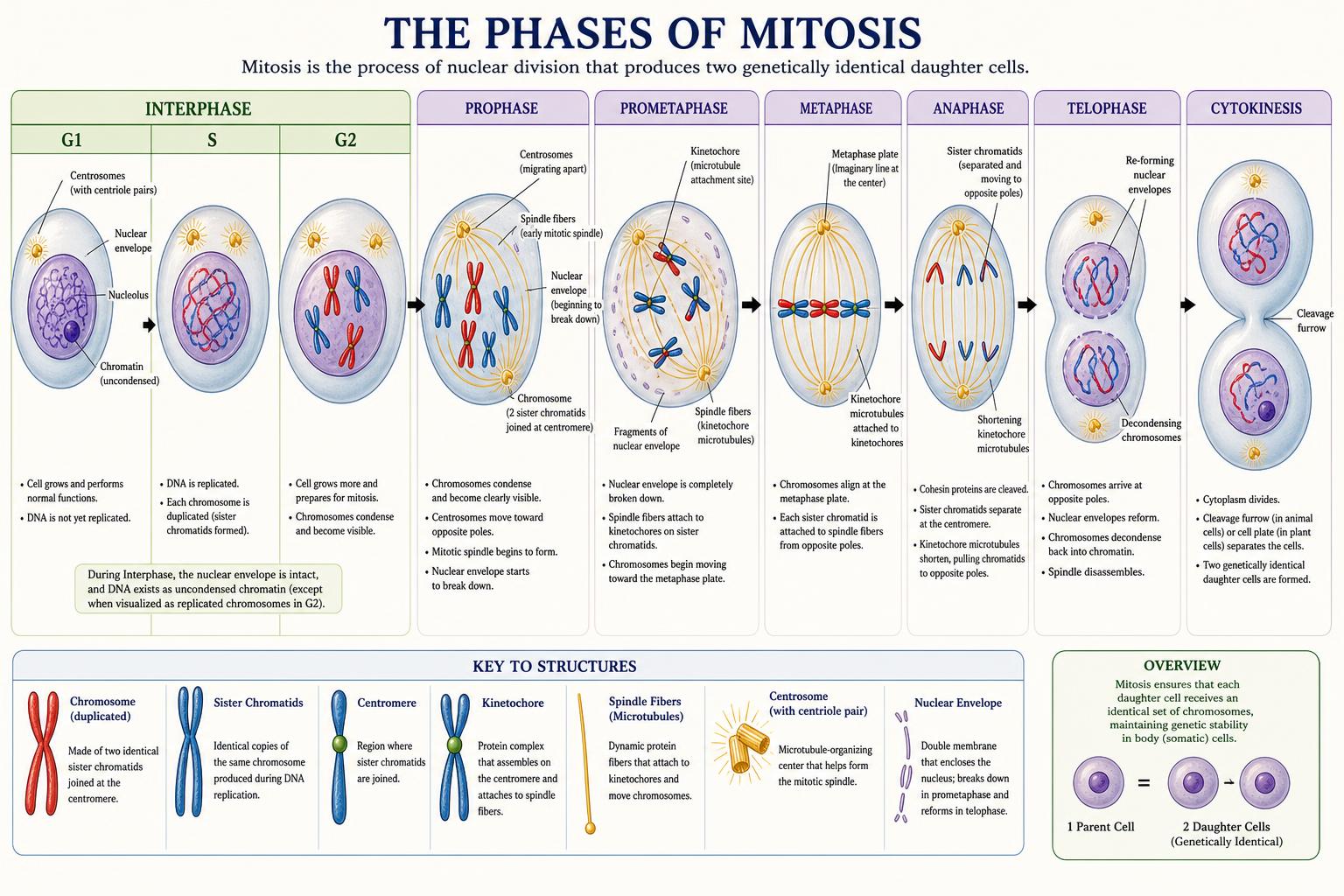
- Mitosis: one division; produces two diploid daughter cells genetically identical to the parent; no synapsis or crossing over; used for growth and repair.
- Meiosis: two divisions; produces four haploid daughter cells that are all genetically unique; homologs synapse and cross over in prophase I; used only for gamete/spore formation.
- Both processes are preceded by a single round of DNA replication in S phase - the difference lies entirely in what happens afterward.
Key terms
4
- Homologous chromosomes
- Chromosome pair with the same genes/loci but possibly different alleles, one from each parent.
- Tetrad
- Structure of four chromatids formed when homologs synapse during prophase I.
- Synapsis
- Pairing of homologous chromosomes during prophase I.
- Sister chromatids
- Identical copies of a chromosome joined at the centromere after replication.
Sign-off
Finish this lesson
A lesson only counts once you've read all the way through and completed every activity on the page.
- Read the full lesson (scroll to the end)
- Complete all activities (0/2 done)