
DNA and RNA Structure
DNA and RNA are polymers of nucleotides whose structure encodes and transmits genetic information.
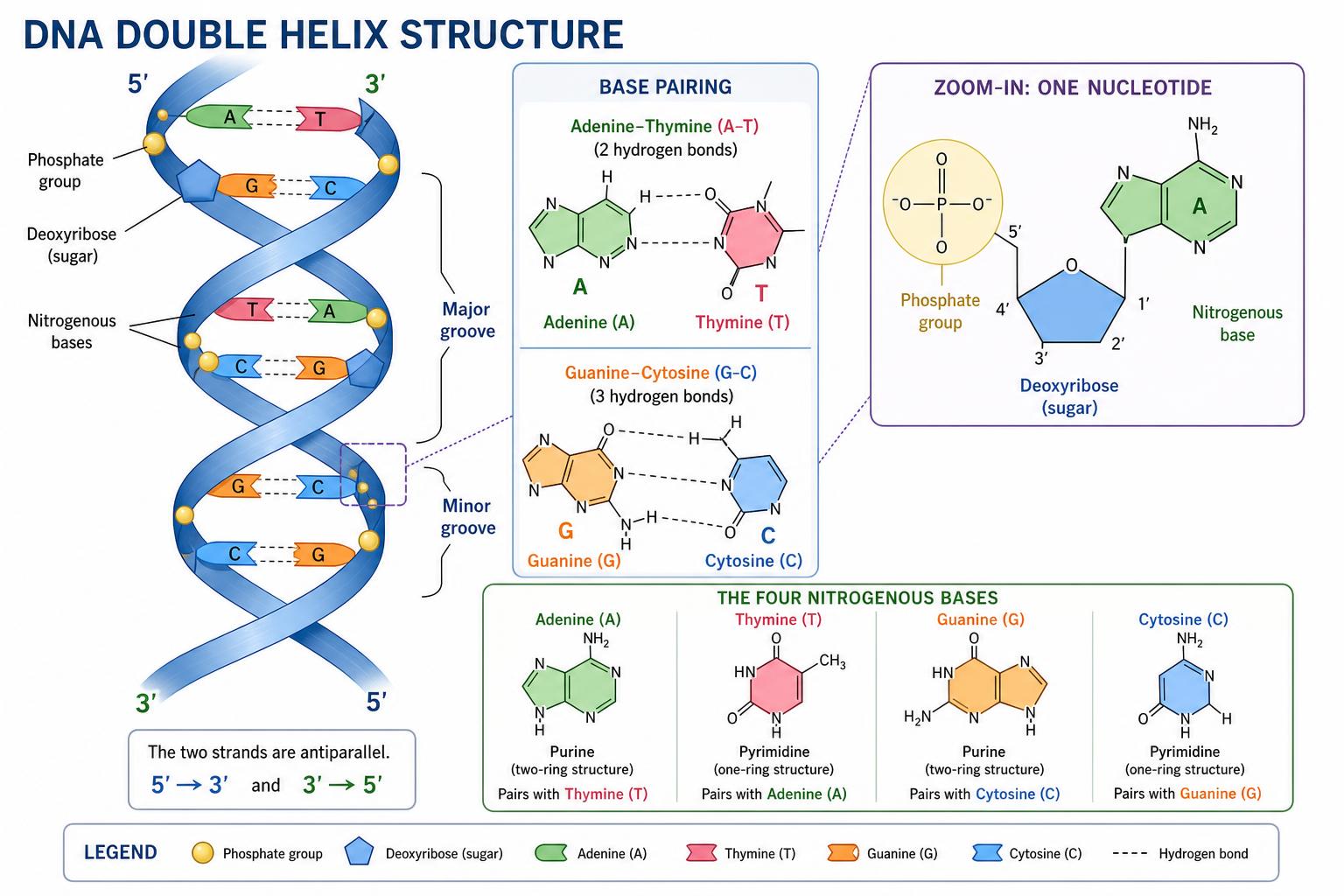
Nucleotide building blocks
Every nucleic acid is built from nucleotide monomers, each consisting of three parts: a five-carbon sugar (deoxyribose in DNA, ribose in RNA), a phosphate group, and a nitrogenous base. The sugar and phosphate alternate to form the backbone of the strand, connected by phosphodiester bonds between the 3' carbon of one sugar and the 5' phosphate of the next - this gives every strand directionality, a free 5' end and a free 3' end.
The nitrogenous bases fall into two structural classes: purines (adenine and guanine), which have a double-ring structure, and pyrimidines (cytosine, thymine, and uracil), which have a single ring. In DNA, thymine replaces the uracil found in RNA; uracil lacks a methyl group that thymine has, and RNA polymerases and machinery are built to distinguish the two.
Base pairing and antiparallel double helix
Erwin Chargaff observed that in any organism's DNA, the amount of adenine equals the amount of thymine, and the amount of guanine equals the amount of cytosine - a clue that A pairs with T and G pairs with C. Watson and Crick, using Rosalind Franklin's X-ray diffraction images (which revealed a helical structure with regular spacing) and Chargaff's ratios, proposed the double helix model in 1953.
A-T pairs form two hydrogen bonds; G-C pairs form three, making G-C rich regions more thermally stable and harder to separate. The two strands of the helix run antiparallel - one 5'→3', the other 3'→5' - which is essential for how replication and transcription machinery read and synthesize strands.
DNA vs. RNA structure and function
- DNA: double-stranded, deoxyribose sugar, bases A/T/G/C, stable long-term storage of genetic information in the nucleus (or nucleoid).
- RNA: usually single-stranded, ribose sugar (has an extra -OH group, making RNA more reactive and less stable), bases A/U/G/C.
- RNA's single-stranded nature lets it fold into complex secondary/tertiary structures (e.g., tRNA cloverleaf, ribozymes) that also carry out catalytic and structural roles, not just information storage.
Why structure matters for function
The complementary, antiparallel double helix isn't just aesthetically elegant - it is the literal mechanism by which genetic information can be faithfully copied (each strand serves as a template for a new complementary strand) and repaired (damage on one strand can be corrected using the other as a reference).
The relative instability of RNA (due to the reactive 2'-OH group and being single-stranded) makes it well suited as a short-lived messenger and regulatory molecule, while DNA's stability suits it for long-term storage of the genome across an organism's lifetime and across generations.
Key terms
4
- Nucleotide
- Monomer of nucleic acids: sugar + phosphate + nitrogenous base.
- Antiparallel
- The two DNA strands run in opposite 5'→3' directions.
- Purine/Pyrimidine
- Double-ring bases (A, G) pair with single-ring bases (C, T/U).
- Complementary base pairing
- A-T(U) and G-C pairing that allows accurate copying of genetic information.
Sign-off
Finish this lesson
A lesson only counts once you've read all the way through and completed every activity on the page.
- Read the full lesson (scroll to the end)
- Complete all activities (0/1 done)