
Replication
Semiconservative replication uses each parental strand as a template to build two identical daughter molecules.
Semiconservative replication
Each new DNA double helix contains one parental (old) strand and one newly synthesized strand. The Meselson-Stahl experiment proved this elegantly: bacteria grown in heavy ¹⁵N-labeled medium were shifted to light ¹⁴N medium, and density-gradient centrifugation of their DNA after one and two rounds of replication produced exactly the density bands predicted by the semiconservative model, ruling out conservative and dispersive alternatives.
Replication begins at specific origins of replication, where the helix unwinds into a replication bubble. Eukaryotic chromosomes have multiple origins to replicate the large genome quickly, while bacterial circular chromosomes typically have just one.
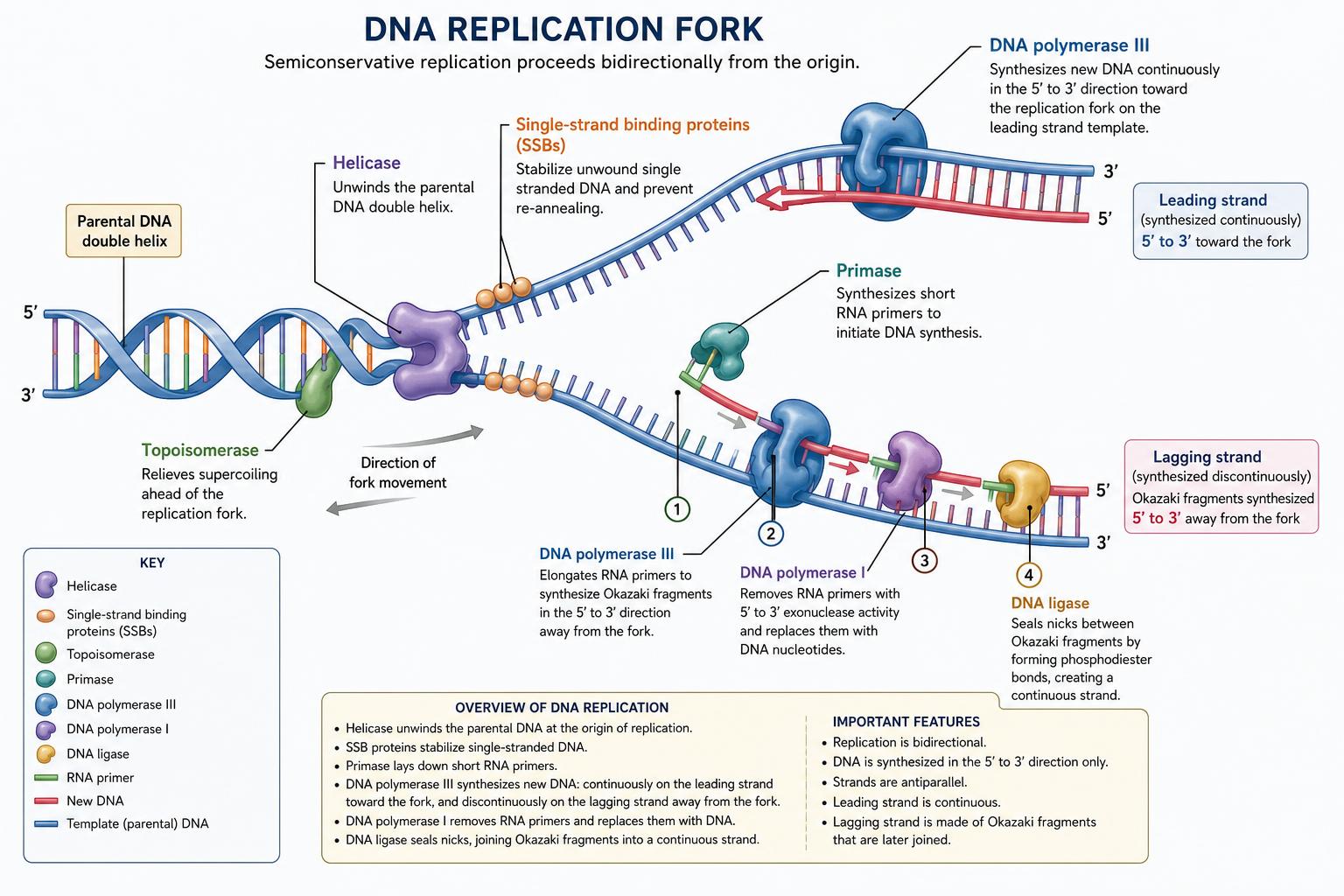
Players at the replication fork
- Helicase: unwinds the double helix at the origin of replication, forming a replication fork.
- Single-strand binding proteins: keep separated strands from re-annealing before they can be copied.
- Topoisomerase: relieves the supercoiling tension that builds up ahead of the fork as the helix unwinds.
- Primase: lays a short RNA primer, providing the free 3' OH group that DNA polymerase requires to begin.
- DNA polymerase III: synthesizes the new strand 5'→3', adding nucleotides to the exposed 3' end.
- DNA polymerase I: removes RNA primers and replaces them with DNA nucleotides.
- DNA ligase: seals the remaining gaps (nicks) between adjacent DNA fragments, forming a continuous strand.
Leading vs. lagging strand synthesis
DNA polymerase can only synthesize DNA in the 5'→3' direction. Because the two parental strands are antiparallel, one new strand - the leading strand - can be synthesized continuously as the fork opens, always moving toward the fork.
The other new strand - the lagging strand - must be synthesized away from the fork in short pieces called Okazaki fragments. Each fragment requires its own RNA primer; once made, the RNA primers are replaced with DNA and the fragments are joined together by DNA ligase to create one continuous strand.
Proofreading, repair, and the end-replication problem
DNA polymerase has a built-in proofreading (exonuclease) function: if it inserts a mismatched base, it can detect the distortion, back up, and remove the error before continuing. Combined with separate mismatch repair enzymes that scan newly made DNA, the overall replication error rate falls to roughly one mistake per billion base pairs.
Because DNA polymerase requires a primer and cannot fill in a gap at the very end of a linear chromosome, linear eukaryotic chromosomes lose a small amount of DNA at their ends with every round of replication - the end-replication problem. Telomeres, repetitive non-coding DNA sequences capping the chromosome ends, act as a buffer that is shortened over successive divisions instead of losing important genes. The enzyme telomerase, active in germ cells, stem cells, and many cancer cells, can extend telomeres to counteract this shortening.
Key terms
4
- Semiconservative replication
- Each new DNA molecule retains one old strand and one new strand.
- Okazaki fragments
- Short DNA segments synthesized discontinuously on the lagging strand.
- Origin of replication
- Specific DNA sequence where replication begins and the helix unwinds.
- Telomere
- Repetitive non-coding DNA at chromosome ends that buffers gene loss during replication.
Sign-off
Finish this lesson
A lesson only counts once you've read all the way through and completed every activity on the page.
- Read the full lesson (scroll to the end)
- Complete all activities (0/2 done)