
Introduction to Biological Macromolecules
Carbohydrates, proteins, and nucleic acids are polymers assembled from monomers via dehydration synthesis and disassembled by hydrolysis; lipids are large but not true polymers.
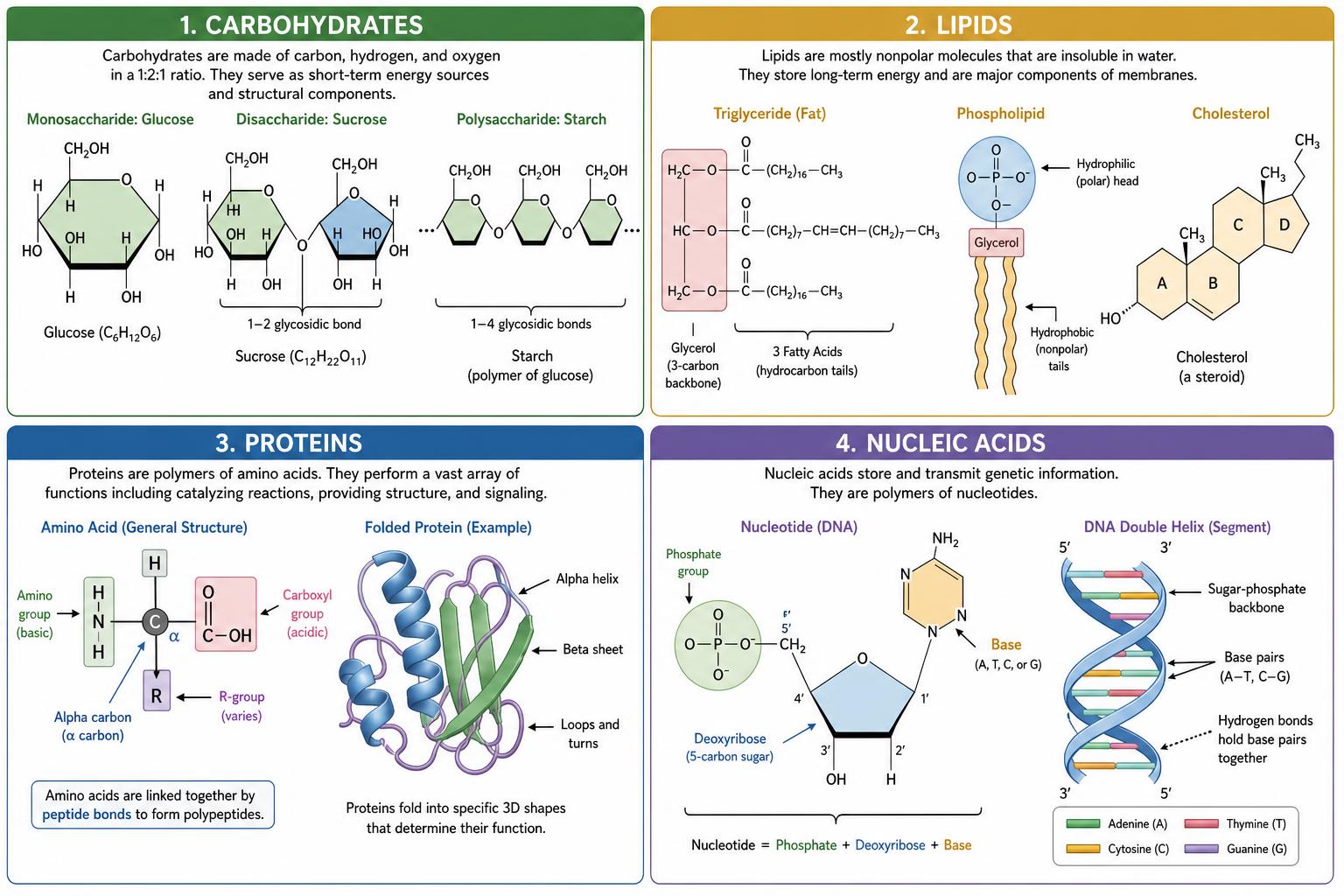
Monomers and polymers
Carbohydrates, proteins, and nucleic acids are polymers built from repeating or related monomers: monosaccharides for carbohydrates, amino acids for proteins, and nucleotides for nucleic acids. Lipids are large biological molecules, but they are not true polymers because they are not made from long chains of repeating monomer units.
This monomer/polymer framework is central to the AP course because it lets you predict behavior: breaking a polymer into monomers (digestion, catabolism) requires hydrolysis, while building a polymer from monomers (biosynthesis, anabolism) requires dehydration synthesis, and both classes of reaction recur throughout metabolism.
Dehydration synthesis
In dehydration synthesis, two monomers are joined by a covalent bond, and in the process a water molecule (H₂O) is released - one monomer contributes an -OH group and the other contributes an -H. This reaction requires energy input and is typically enzyme-catalyzed in cells.
This single mechanism explains how glycosidic bonds form between monosaccharides, peptide bonds form between amino acids, phosphodiester bonds form between nucleotides, and (in a related condensation reaction) ester bonds form between glycerol and fatty acids.
Hydrolysis
Hydrolysis is the reverse reaction: a water molecule is added across a covalent bond, splitting a polymer into smaller units or into its constituent monomers. The -OH from water attaches to one product and the -H attaches to the other, restoring the original monomers.
Hydrolysis is how digestive enzymes (e.g., amylase, proteases, lipases, nucleases) break down dietary macromolecules into absorbable subunits, and it is also how cells recycle their own macromolecules for energy or raw materials.
Why this matters across all four macromolecule classes
Because dehydration synthesis and hydrolysis are the shared mechanisms for assembling and disassembling carbohydrates, proteins, and nucleic acids, the AP exam frequently tests whether you can identify which reaction is occurring in an unfamiliar molecular diagram - look for whether a water molecule is a product (dehydration) or a reactant (hydrolysis).
This shared chemistry also underlies why organisms can convert one type of stored energy into another and why enzymes that catalyze one type of bond formation/breakage often belong to recognizable families (e.g., glycosidases, proteases, nucleases) targeting a specific bond type.
Key terms
4
- Monomer
- A small repeating molecular subunit that links with others to form a polymer.
- Polymer
- A large molecule built from many covalently linked monomers.
- Dehydration synthesis
- Bond formed between two monomers by removing a water molecule.
- Hydrolysis
- Bond broken by adding a water molecule across it.
Sign-off
Finish this lesson
A lesson only counts once you've read all the way through and completed every activity on the page.
- Read the full lesson (scroll to the end)
- Complete all activities (0/1 done)