
Origins of Cell Compartmentalization
Membrane-bound organelles likely evolved through infolding of the plasma membrane and, for mitochondria and chloroplasts, through endosymbiosis.
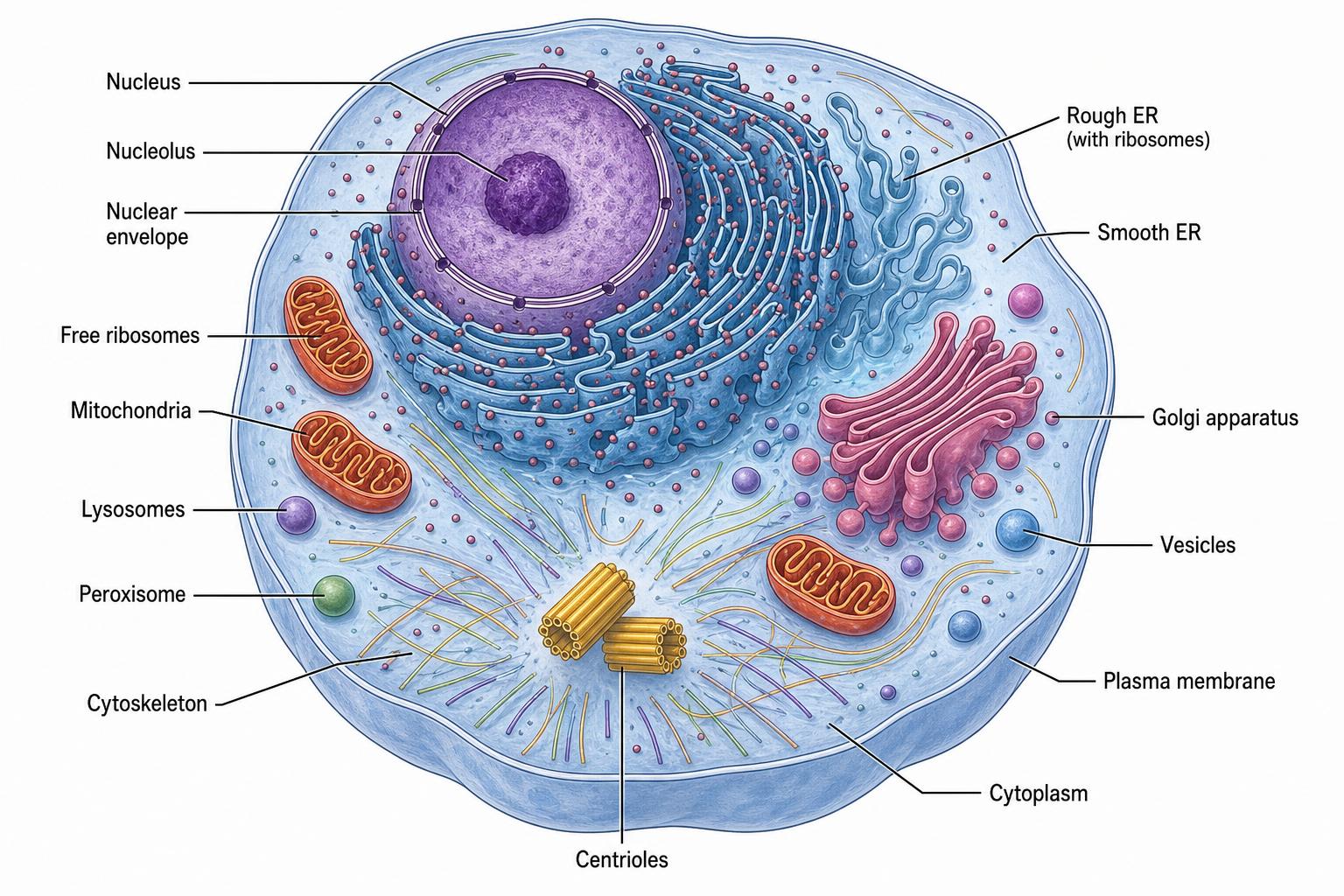
Two distinct origins for two kinds of organelles
The membrane-bound compartments of eukaryotic cells appear to have arisen through two different evolutionary processes. The nucleus, endoplasmic reticulum, Golgi apparatus, lysosomes, and vacuoles are thought to have evolved gradually through infolding of the ancestral plasma membrane, which pinched off internal pockets that became specialized over time.
Mitochondria and chloroplasts, by contrast, are believed to have arisen through endosymbiosis - the permanent incorporation of one free-living prokaryotic cell inside another. These two very different origins are reflected in very different types of supporting evidence.
Serial endosymbiosis theory
According to serial endosymbiosis theory, an ancestral host cell engulfed (but did not digest) an aerobic, respiring bacterium. Rather than being broken down, the engulfed bacterium survived and became a permanent resident, eventually evolving into the mitochondrion - providing its host with a much more efficient means of ATP production.
Later, in the lineage leading to plants and algae, a similar event occurred: a eukaryotic cell that already possessed mitochondria engulfed a photosynthetic cyanobacterium, which became the chloroplast. This explains why chloroplasts are found only in the photosynthetic eukaryotic lineages, which all share this later, second engulfment event.
Evidence supporting endosymbiotic origin
- Double membranes: the inner membrane corresponds to the original bacterial plasma membrane, while the outer membrane derives from the host's engulfing vesicle.
- Own circular DNA: like bacteria, mitochondria and chloroplasts contain a single circular chromosome, not the linear chromosomes found in the eukaryotic nucleus.
- Prokaryote-sized ribosomes: mitochondrial and chloroplast ribosomes closely resemble bacterial ribosomes in size and sensitivity to certain antibiotics, distinct from cytoplasmic eukaryotic ribosomes.
- Independent, binary-fission-like division: mitochondria and chloroplasts replicate on their own schedule within the cell, dividing by a process resembling bacterial binary fission rather than being built from scratch by the cell each generation.
- Molecular sequence comparisons: ribosomal RNA and other gene sequences from mitochondria and chloroplasts are more similar to specific bacterial lineages (alpha-proteobacteria and cyanobacteria, respectively) than to the nuclear genome of their eukaryotic host.
Why compartmentalization mattered evolutionarily
The evolution of internal compartments - whether by membrane infolding or endosymbiosis - was a pivotal step that allowed eukaryotic cells to become larger and more metabolically complex than prokaryotic cells. By isolating incompatible processes and creating dedicated membrane surfaces for gradient-based energy production, compartmentalization removed key constraints that limit prokaryotic cell size and complexity.
This increased complexity, in turn, set the stage for the evolution of multicellularity, specialized tissues, and the vast diversity of eukaryotic life, making compartmentalization one of the most consequential innovations in the history of life on Earth.
Key terms
4
- Endosymbiosis
- A mutually beneficial relationship in which one organism lives within the cells of another; proposed origin of mitochondria and chloroplasts.
- Serial endosymbiosis theory
- The hypothesis that eukaryotic organelles arose through a sequence of engulfment events of prokaryotic cells by a host cell.
- Membrane infolding
- The proposed process by which the endomembrane system arose from inward folds of the ancestral plasma membrane.
- Last eukaryotic common ancestor (LECA)
- The hypothesized ancestral eukaryotic cell from which all modern eukaryotes descended, already possessing a nucleus and organelles.
Sign-off
Finish this lesson
A lesson only counts once you've read all the way through and completed every activity on the page.
- Read the full lesson (scroll to the end)
- Complete all activities (0/1 done)