
Mechanisms of Transport
The type of transport mechanism a cell uses - passive, active, or bulk - depends on the size, polarity, and gradient of the transported substance.
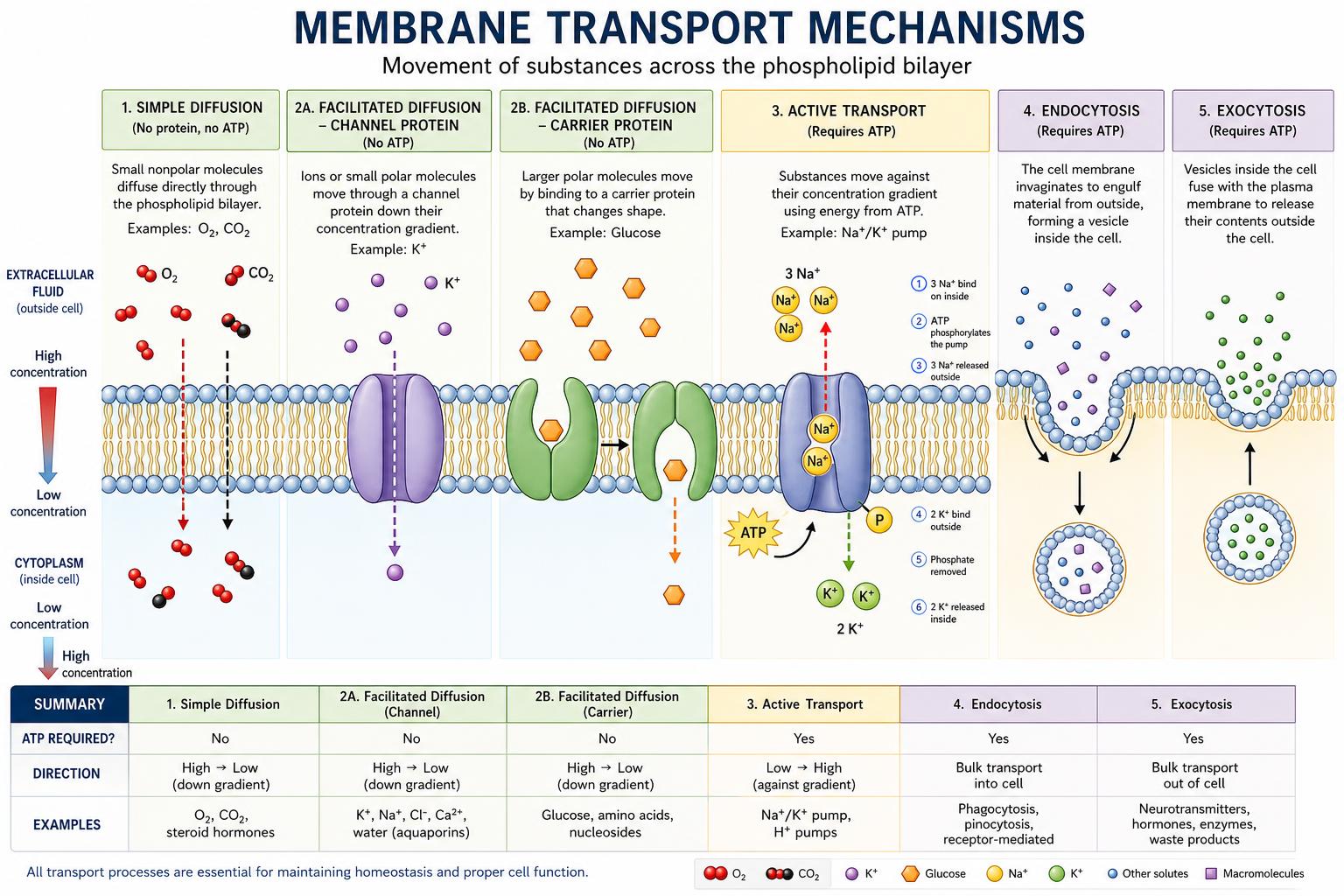
Choosing the right mechanism
The appropriate transport mechanism for a given substance is determined by three questions: Is the molecule small and nonpolar, or large/polar/charged? Is it moving down its gradient or against it? Is it a single small molecule, or a large particle/bulk quantity of fluid? Answering these in sequence identifies whether simple diffusion, facilitated diffusion, active transport, or bulk transport is at work.
This logical framework is heavily tested on the AP exam: students are often given a scenario (e.g., a molecule's size, charge, and relative concentrations) and asked to predict or justify which transport mechanism must be involved and whether ATP is required.
Primary active transport
Primary active transport couples the hydrolysis of ATP directly to the conformational changes of a transport protein, allowing it to move a solute against its concentration or electrochemical gradient. The sodium-potassium pump (Na⁺/K⁺-ATPase) is the definitive example: for each ATP hydrolyzed, it exports 3 Na⁺ ions and imports 2 K⁺ ions, both against their gradients.
This pump is essential to nearly all animal cells - it maintains the resting membrane potential, regulates cell volume, and creates the steep Na⁺ gradient that many other transport processes depend on.
Secondary active transport (cotransport)
Secondary active transport does not use ATP directly. Instead, it harnesses the potential energy stored in an ion gradient established by a primary pump. As the ion (often Na⁺) flows back down its gradient through a cotransporter, the energy released is used to move a second solute against its own gradient.
A key example is the sodium-glucose cotransporter (SGLT) in intestinal and kidney epithelial cells: Na⁺ flows into the cell down its gradient (established by the Na⁺/K⁺ pump elsewhere in the cell), and this movement is coupled to the uphill transport of glucose into the cell, even when glucose is already more concentrated inside than outside.
Bulk transport mechanisms
When material is too large for any individual channel or carrier protein - or when large quantities of fluid or many molecules need to move at once - cells use vesicle-based bulk transport, which always requires ATP for cytoskeletal movement and membrane remodeling.
Endocytosis includes phagocytosis (engulfing large particles or cells), pinocytosis (nonspecific uptake of extracellular fluid), and receptor-mediated endocytosis (specific uptake triggered by ligand binding to membrane receptors, as with LDL cholesterol uptake). Exocytosis reverses this process, fusing internal vesicles with the plasma membrane to secrete hormones, neurotransmitters, or waste products.
Key terms
4
- Primary active transport
- Active transport directly powered by ATP hydrolysis, such as the sodium-potassium pump.
- Secondary active transport
- Active transport that uses the potential energy of an ion gradient (built by primary active transport) to move a different solute.
- Cotransport
- The coupled movement of two solutes across a membrane by a single transport protein, one moving down and one moving against its gradient.
- Exocytosis
- The bulk transport process by which vesicles fuse with the plasma membrane to release their contents outside the cell.
Sign-off
Finish this lesson
A lesson only counts once you've read all the way through and completed every activity on the page.
- Read the full lesson (scroll to the end)
- Complete all activities (0/1 done)