
Biotechnology
Modern molecular tools like PCR, gel electrophoresis, CRISPR, and recombinant DNA let scientists analyze and manipulate genetic material.
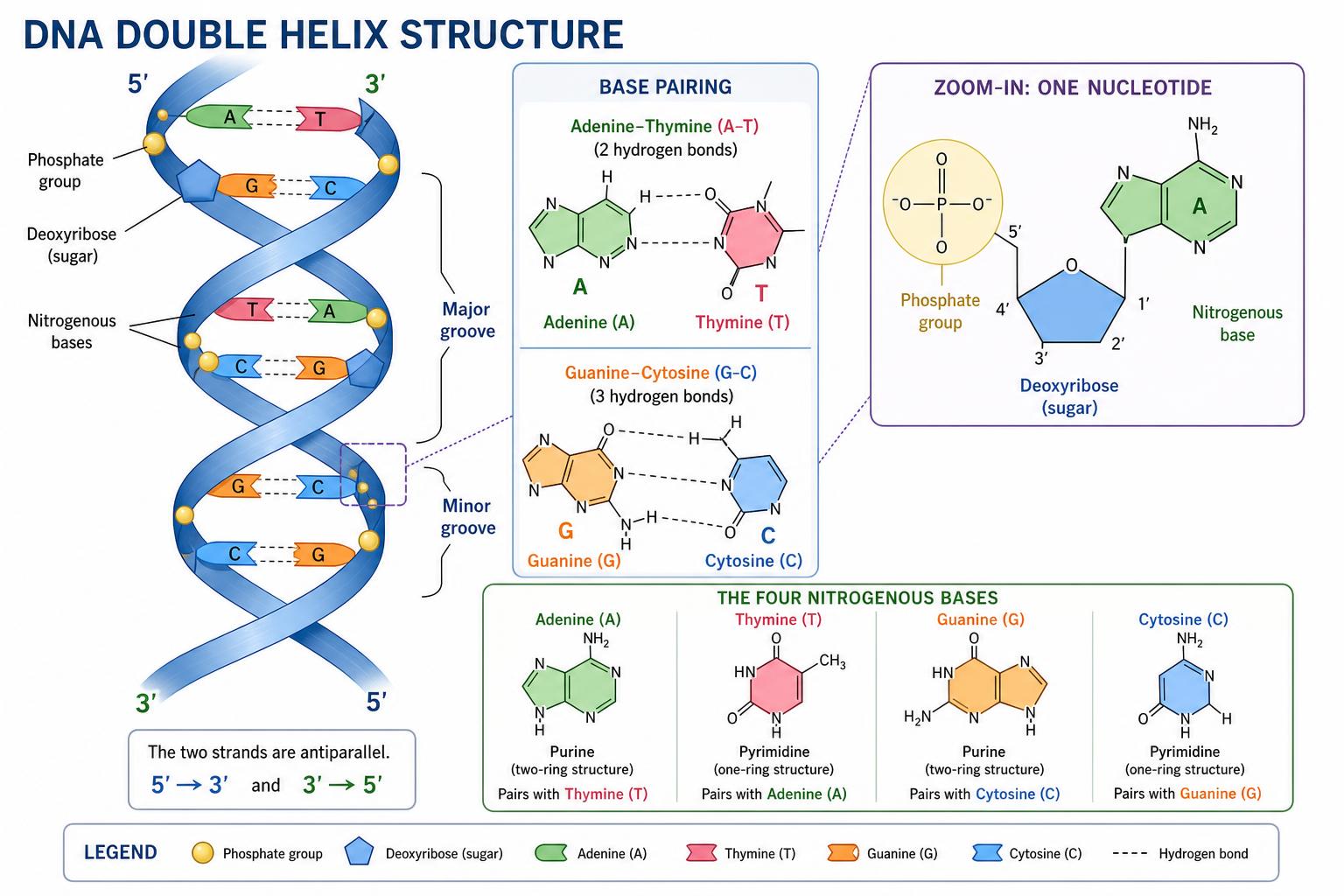
Polymerase chain reaction (PCR)
PCR makes millions to billions of copies of a specific, targeted region of DNA starting from a tiny sample. A reaction mixture containing template DNA, short primers complementary to the flanking regions of the target sequence, free nucleotides (dNTPs), and heat-stable Taq polymerase (originally isolated from a thermophilic bacterium) is cycled through three temperature stages.
Each cycle has three steps: denaturation (~95°C, separating the double-stranded DNA into single strands), annealing (~50-65°C, allowing primers to bind their complementary sequences), and extension (~72°C, during which Taq polymerase synthesizes new complementary strands). Because each new strand serves as a template in the next cycle, the amount of target DNA roughly doubles with every cycle, producing exponential amplification.
Gel electrophoresis
Gel electrophoresis separates DNA, RNA, or protein fragments according to size using an electric field. Samples are loaded into wells in an agarose (for nucleic acids) or polyacrylamide (often for proteins) gel, and a current is applied. Because DNA and RNA backbones are negatively charged (from the phosphate groups), they migrate toward the positive electrode; smaller fragments move through the gel matrix more easily and thus travel farther than larger fragments in the same amount of time.
This technique is used to visualize and compare the results of PCR reactions, to perform DNA fingerprinting for forensic or paternity testing, to verify successful gene cloning, and as a step in DNA sequencing.
CRISPR-Cas9 gene editing
CRISPR-Cas9 originated as part of a bacterial and archaeal adaptive immune system used to recognize and destroy viral DNA; it has been repurposed into the most versatile and precise gene-editing tool currently available. A guide RNA is engineered to be complementary to a specific target DNA sequence; it directs the Cas9 nuclease enzyme to bind and cut the DNA double helix at exactly that location.
Once cut, the cell's own DNA repair machinery mends the break - either through error-prone non-homologous end joining (which can disrupt/knock out the gene) or, if a template is supplied, through homology-directed repair (which can insert or correct a specific sequence). Applications include developing disease-resistant crops, correcting mutations that cause genetic diseases like sickle-cell anemia, creating animal models of disease, and even proposed gene drives for controlling pest or disease-vector populations - raising significant ethical questions, especially regarding edits to human germline cells.
Recombinant DNA and bacterial transformation
Plasmids are small, circular DNA molecules found in bacteria that replicate independently of the main chromosome, making them convenient vectors for carrying foreign genes. Restriction enzymes cut both a plasmid and a gene of interest at matching recognition sequences, often leaving complementary "sticky ends"; DNA ligase then joins the fragments together to form a recombinant plasmid.
The recombinant plasmid is introduced into bacterial cells through transformation, and the bacteria are grown on selective media (often using an antibiotic-resistance marker gene on the plasmid) to identify successfully transformed colonies. The transformed bacteria can then mass-produce the protein encoded by the foreign gene - this is exactly how recombinant human insulin is manufactured at industrial scale for treating diabetes.
Key terms
4
- PCR
- Polymerase chain reaction; a technique that exponentially amplifies a targeted DNA sequence.
- Gel electrophoresis
- Technique that separates nucleic acid or protein fragments by size using an electric field.
- CRISPR-Cas9
- Gene-editing system using a guide RNA to direct the Cas9 nuclease to cut a specific DNA sequence.
- Plasmid
- Small circular DNA molecule, independent of the chromosome, used as a vector for gene delivery in biotechnology.
Sign-off
Finish this lesson
A lesson only counts once you've read all the way through and completed every activity on the page.
- Read the full lesson (scroll to the end)
- Complete all activities (0/1 done)