
Nucleic Acids
DNA and RNA are antiparallel polymers of nucleotides whose sequence and complementary base pairing store and transmit genetic information.
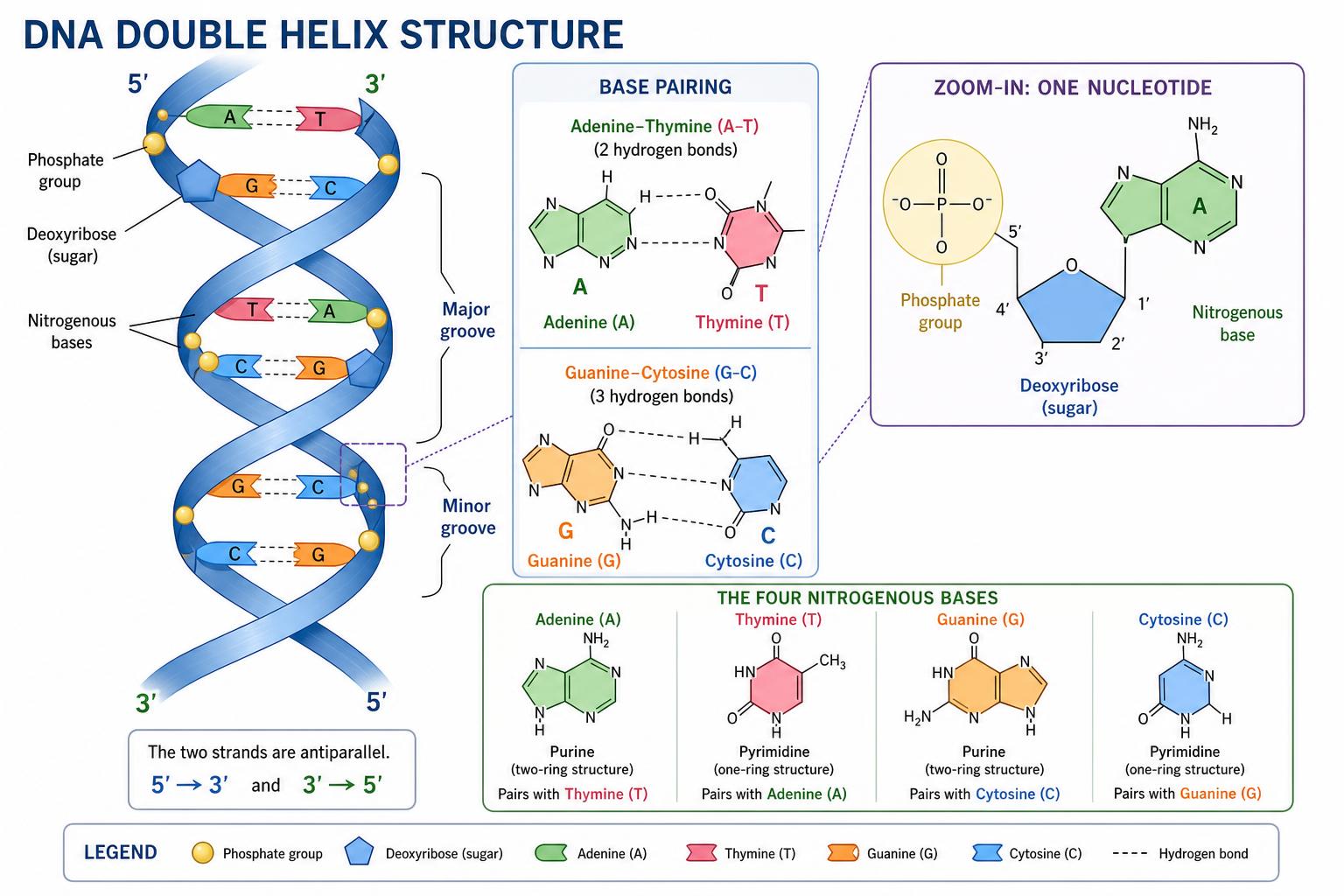
Nucleotide structure
Nucleotides are the monomers of nucleic acids and consist of three parts: a 5-carbon sugar (deoxyribose in DNA, ribose in RNA), a phosphate group, and a nitrogenous base attached to the sugar. The sugar's identity - whether it has a hydroxyl or just a hydrogen at the 2' carbon - is the defining chemical difference between DNA and RNA nucleotides.
Nitrogenous bases fall into two structural categories: purines (adenine and guanine), which have a fused double-ring structure, and pyrimidines (cytosine, thymine, and uracil), which have a single ring. DNA uses adenine, thymine, guanine, and cytosine; RNA uses adenine, uracil, guanine, and cytosine, substituting uracil for thymine.
Linking nucleotides: the sugar-phosphate backbone
Nucleotides are joined by phosphodiester bonds formed between the 3' carbon of one sugar and the 5' phosphate of the next nucleotide's sugar, via dehydration synthesis. This creates a repeating sugar-phosphate backbone with the nitrogenous bases projecting off to the side.
Because the bond always forms between a specific 3' carbon and a specific 5' phosphate, every nucleic acid strand has an inherent directionality, conventionally described as running from its 5' end to its 3' end. This directionality is essential to how DNA replication and RNA synthesis proceed - polymerases can only add new nucleotides to the 3' end of a growing strand.
The DNA double helix and complementary base pairing
DNA typically exists as a double helix formed by two strands running antiparallel to each other (one 5'→3', the other 3'→5'), wound around a common axis. The two strands are held together by hydrogen bonds between complementary bases projecting inward from each backbone: adenine pairs with thymine (2 hydrogen bonds), and guanine pairs with cytosine (3 hydrogen bonds).
This base-pairing rule (A-T, G-C) means the sequence of one strand fully determines the sequence of the other, which is the chemical basis for accurate DNA replication and for using one strand as a template to synthesize the other. Because G-C pairs have an extra hydrogen bond, DNA regions rich in G-C content require more energy to separate (melt) than regions rich in A-T content.
RNA: structure and diversity of roles
RNA is usually single-stranded, though it can fold back on itself to form local double-stranded regions and complex secondary structures (as in tRNA and rRNA) through internal complementary base pairing. Its ribose sugar and use of uracil instead of thymine distinguish it chemically from DNA.
Multiple classes of RNA carry out distinct roles in gene expression: messenger RNA (mRNA) carries genetic information from DNA to ribosomes, transfer RNA (tRNA) delivers specific amino acids during translation, and ribosomal RNA (rRNA) forms part of the ribosome's catalytic and structural core. This functional diversity, despite RNA's chemical similarity to DNA, previews Unit 6's treatment of gene expression.
Key terms
4
- Nucleotide
- Monomer of nucleic acids: sugar + phosphate + nitrogenous base.
- Purine
- Double-ring nitrogenous base: adenine or guanine.
- Pyrimidine
- Single-ring nitrogenous base: cytosine, thymine, or uracil.
- Antiparallel
- DNA strands run in opposite 5'→3' directions relative to one another.
Sign-off
Finish this lesson
A lesson only counts once you've read all the way through and completed every activity on the page.
- Read the full lesson (scroll to the end)
- Complete all activities (0/1 done)